
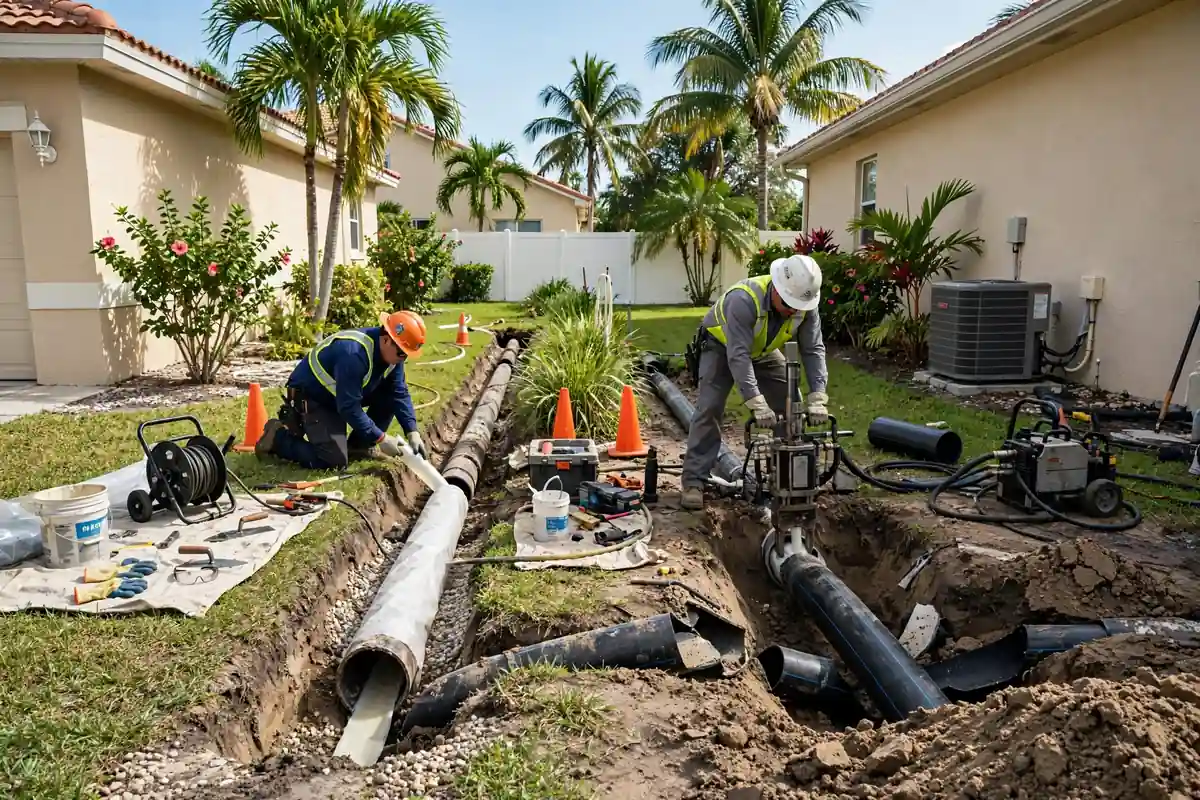
When a Coconut Creek homeowner learns their sewer lateral is failing, the conversation quickly reaches a fork: pipe lining or pipe bursting. Both are trenchless — neither one tears a trench across the yard — but they solve different problems in different ways. Picking the wrong one wastes money; picking the right one can add decades to your line.
This comparison puts lining and bursting side by side on the factors that actually decide: pipe condition, pipe material, access, cost drivers, and what your yard looks like afterward. The camera inspection footage is the tiebreaker, and by the end of this article you will know how to read the recommendation a crew gives you.
The Core Difference in One Paragraph
Cured-in-place pipe lining builds a new pipe inside the old one. The old pipe stays in the ground as a host, and a resin-soaked liner cures against its walls into a smooth, jointless tube. It preserves the existing alignment and works best when the old pipe still holds its shape.
Pipe bursting destroys the old pipe and replaces it. A bursting head fractures the old line outward while pulling a brand-new pipe — usually HDPE or fused PVC — into the same path. It is a full replacement that happens to travel underground, and it works best when the old pipe is too far gone to host a liner.
Pipe Condition: The Deciding Factor
Lining needs a host pipe with structural integrity. Cracks, corrosion, root intrusion through joints, and minor offsets are all fine — the liner bridges them. What lining cannot fix is a fully collapsed section, a severe belly holding standing water, or joints offset so far that the liner would wrinkle or tear. The host pipe must be round enough to receive the liner.
Bursting needs the opposite: a pipe brittle enough to fracture. Clay, cast iron, concrete, and Orangeburg all break predictably. Bursting can also handle collapsed sections the head can pass through, and it can upsize the diameter — something lining cannot do. If your line has multiple collapses or you need a bigger pipe, bursting usually wins the condition argument.
Access, Disruption, and Timeline
Lining typically needs just one access point, often the existing cleanout, which makes it the least disruptive option. No pits, no excavation beyond possibly exposing the cleanout. Most residential lining jobs finish in a single day with the yard essentially untouched.
Bursting needs two pits — entry and exit — each a few feet across. That is more surface disturbance than lining but far less than an open trench. Timelines are similar, one to two days for a residential lateral. If your lateral runs under a new paver driveway or a mature landscape, lining's single-point access is the gentler choice; if the pipe is too damaged for lining, bursting's two pits are still a bargain compared with trenching the whole run.
Longevity and Flow
A lined pipe gains a jointless interior that resists roots and scale. The liner is thin, so the inside diameter barely changes, and the smoother surface often improves flow compared with the old corroded pipe. Expected service life is measured in decades.
A burst pipe is a brand-new pipe — new material, new joints (or rather, fused jointless runs), and the option of a larger diameter for better capacity. Its service life starts fresh at the full rated life of HDPE or PVC. When a line is at the end of its life and you want the longest possible reset, full replacement through bursting is the stronger answer.
How to Read a Crew's Recommendation
A trustworthy recommendation always starts with camera footage shown to you, not described to you. Ask the technician to point at the specific defects on the video and explain why they rule lining in or out. 'Too collapsed to line' should come with a visible collapse; 'perfect lining candidate' should come with a visibly round host pipe.
Be cautious of any crew that recommends one method without offering the other — or without explaining why the alternative fails. Companies that perform both lining and bursting, like Sewer Line Repair Crew at (833) 713-2101, have no incentive to force-fit your problem into the one tool they own. The right method is the one the footage supports.
Frequently Asked Questions
Can lining and bursting be combined on one job?
Yes. A long lateral might have one section too damaged for lining but perfect for bursting, while the rest lines beautifully. Crews plan hybrid jobs when the camera shows mixed conditions along the run.
Which method is better for root problems?
Both defeat roots when done right — lining seals the joints roots enter through, and bursting removes the old pipe entirely. The deciding factor is the pipe's condition, not the roots themselves.
Does bursting work under a swimming pool?
It can, as long as the pits can be placed clear of the pool structure and the alignment passes safely. This is exactly the kind of job where the camera survey and utility locate matter most — the crew maps everything before committing.
Which option handles heavy rain better afterward?
Both produce sealed, jointless lines that resist groundwater infiltration during storms. The bigger infiltration risk is the connection points at the house and the street — make sure the crew seals and inspects those regardless of method.
Talk to a Sewer Line Pro Today
Describe the problem once — a local specialist serving Coconut Creek, FL plans the visit. 24/7 emergency line.
(833) 713-2101No obligation · Emergency help 24/7