
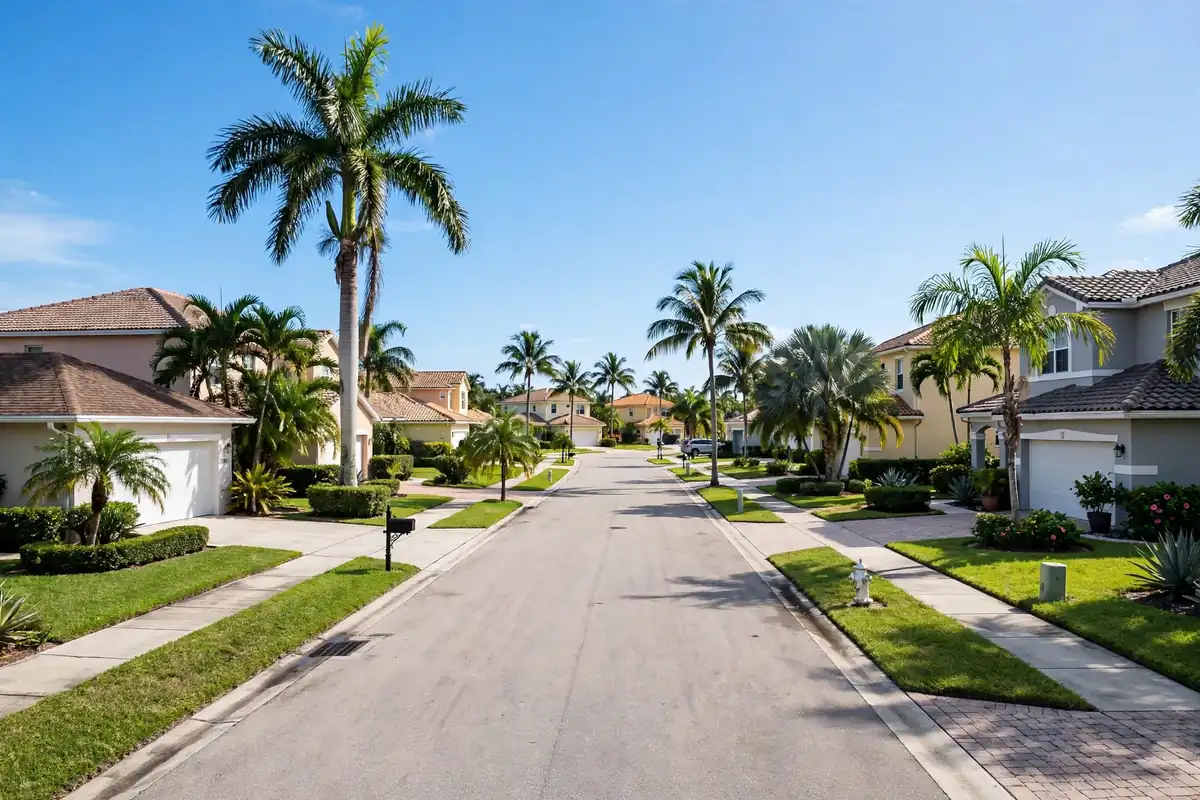
In short: ZIP 33321 is west Tamarac's 55+ village belt: the Mainlands of Tamarac Lakes (1971 builds), Kings Point in Tamarac — active since 1983, about 4,869 residences across 13 gated neighborhoods — and Concord Village, plus 1980s tracts westward. The pitch is the Delray and Oriole Gardens playbook at larger scale: multi-association approval chains and whole-village reline programs. Call (833) 713-2101.
Area Facts
- Area
- Tamarac, FL
- ZIP
- 33321
- Housing
- 55+ village belt: Mainlands of Tamarac Lakes (1971), Kings Point (13 gated neighborhoods, ~4,869 residences, since 1983), Concord Village; 1980s tracts west
- Pipe stock
- Cast iron (1960s–70s); 55+ mid-rises retain original cast-iron stacks; PVC transition in 1980s tracts
- Water table
- 2–6 ft; highest seasonal water on west-edge lots toward the Everglades; C-14 canal north; golf-course lakes
- Landmarks
- Mainlands of Tamarac Lakes (6810 NW 76th St), Kings Point (7620 Nob Hill Rd), Commercial Blvd corridor, Tamarac Lakes South
ZIP 33321 is the west-Tamarac 55+ village belt, denser and larger than its 33319 sibling: the Mainlands of Tamarac Lakes with verified 1971 builds at 6810 NW 76th Street, Kings Point in Tamarac — active since 1983, roughly 4,869 residences across 13 gated neighborhoods of condos, villas, and coach homes at 7620 Nob Hill Road — and Concord Village, with 1980s single-family tracts pushing westward toward the Everglades edge. The Malvern townhomes at Kings Point and Tamarac Lakes South fill out the village fabric; the Commercial Boulevard corridor runs the southern commercial spine. The pipe stock is 1960s–70s cast iron across the villages — the mid-rise buildings retaining their original cast-iron stacks, now 40–55 years old — with PVC transition in the 1980s tracts. Slab-on-grade throughout, the C-14 canal on the north, golf-course lakes holding seasonal water. Tamarac Lakes South's townhome rows fill the gaps between the big villages — smaller associations, same cast-iron era, same board-packet standard.
This is the association-driven market at its largest scale in the group — the Delray and Oriole Gardens playbook, run bigger. Kings Point's 13 neighborhoods plus the Mainlands villages mean multi-association approval chains: not one board but a federation of boards, each moving on its own calendar. The product is the whole-village reline program: camera surveys building by building, findings compiled into per-neighborhood board packets, trenchless relining phased neighborhood by neighborhood with resident notification coordinated across the federation. The 1960s–70s cast iron sits under golf-course-adjacent saturated soils, where constant irrigation keeps roots hunting cracked joints year-round, and the west-edge lots toward the Everglades and the water-conservation area carry the pair's worst seasonal infiltration — saturated soils pressing groundwater into every open joint. Sewer Line Repair Crew scopes 33321 as infiltration diagnosis plus association-level reline programs: the camera proves the water entry, the board packet proves the program, and the phasing proves the village can afford it on its own calendar. The Malvern townhomes at Kings Point show the coach-home variant — attached units with shared laterals that need the easement mapping the crew does in dense villages.
How Sewer Work Changes in Tamarac
Village-belt scale is the local hook, and it makes the paperwork the product as much as the pipe. Thirteen gated neighborhoods in Kings Point plus the Mainlands villages is a federation, and the sales process has to route through multi-association approval chains where each neighborhood's board votes on its own calendar — no single meeting decides the village. The winning structure is the phased village program: camera surveys building by building, findings compiled into per-neighborhood board packets with footage, measured defects, recommended segments, and per-neighborhood scope; relining scheduled neighborhood by neighborhood; resident notification coordinated across the federation so the village moves as one project without any board surrendering its authority. No individual-unit contractor survives this process — the bid has to read as a program document, because the buyer is a set of committees, not a homeowner. The crew's 33321 proposals are built that way from the first page: program scope, phasing, notification, per-neighborhood structure. Federation-wide, the crew staggers the neighborhood phases so no two adjacent neighborhoods are under construction simultaneously — the village keeps living around the work.
The second factor is the west-edge water — the pair's worst seasonal infiltration, and the reason the camera here is read for infiltration first. The lots toward the Everglades see the highest seasonal water tables of the Tamarac pair: the conservation-area edge holds water, the golf-course lakes hold seasonal water, irrigation never stops — and that water presses into every cracked 1960s–70s cast-iron joint on the western blocks. Roots follow the moisture year-round, so the western diagnosis is infiltration first, roots second: the water is the constant, the roots are its consequence. Trenchless relining seals both in one project — the liner stops the water entry and starves the roots at the same time — which is why the 33321 pitch pairs the infiltration diagnosis with the reline program instead of selling them separately. Cutting alone on the west edge is mowing a lawn that the water keeps watering; the liner drains the swamp, so to speak, by sealing the joints the water enters through. West-edge surveys are scheduled for the rainy season's peak — the infiltration evidence is strongest when the Everglades-edge water table is highest, and the reline scope is clearest.
Services Available in Tamarac
In Tamarac 33321 the services that matter most are whole-village camera survey programs — building by building, compiled into per-neighborhood board packets — trenchless CIPP relining of 1960s–70s cast-iron stacks, shared mains, and laterals, phased neighborhood by neighborhood with resident notification coordinated across the village federation, and infiltration-first diagnosis for the west-edge Everglades lots. Root-intrusion cutting on the golf-adjacent maintenance rhythm covers the joints between reline phases. Multi-association coordination is built into every program scope as the core deliverable, not an add-on. For the 1980s western tracts, the service is homeowner camera inspections and PVC maintenance — a different pipe, a different profile. Open-cut replacement is reserved for collapsed sections, quoted with the west edge's high seasonal water table in the dewatering plan. The crew's village program includes a post-program trend report — pre- and post-reline footage compared per neighborhood, archived with the federation's records. The trend report is delivered per neighborhood — the federation sees which villages improved and which need the next phase.
Sewer Services in Tamarac
Commercial Sewer Services
Tamarac, FL 33321
Learn moreEmergency Sewer Repair
Tamarac, FL 33321
Learn morePipe Bursting
Tamarac, FL 33321
Learn morePipe Lining
Tamarac, FL 33321
Learn moreSewer Camera Inspection
Tamarac, FL 33321
Learn moreSewer Leak Detection
Tamarac, FL 33321
Learn moreSewer Line Cleaning
Tamarac, FL 33321
Learn moreSewer Line Installation
Tamarac, FL 33321
Learn moreSewer Line Replacement
Tamarac, FL 33321
Learn moreSewer Maintenance
Tamarac, FL 33321
Learn moreTree Root Removal
Tamarac, FL 33321
Learn moreTrenchless Sewer Repair
Tamarac, FL 33321
Learn moreFrequently Asked Questions
Our Kings Point neighborhood wants to plan sewer work across multiple buildings. Where do we start?
With a building-by-building camera survey compiled into your neighborhood's board packet: footage, measured defects, recommended reline segments, per-neighborhood scope, and a phasing schedule. Each of the 13 neighborhoods moves on its own board calendar, so the survey gives every board the same factual basis to vote from. The crew then phases the trenchless reline program neighborhood by neighborhood, with resident notification coordinated across the federation. Call (833) 713-2101 to start the survey that every board needs first.
Why does our village need a program instead of fixing buildings as they fail?
Because 1960s–70s cast iron fails on a schedule, not randomly — and the emergency path is the most expensive way to buy the same pipe life. Emergency work costs more per building, disrupts more residents, never ends, and leaves the board explaining each incident. A phased whole-village reline program fixes the stacks and mains on the village's calendar at a planned per-neighborhood scope. The camera survey gives the boards the numbers to compare: documented emergency spend per year against the programmed project, with the footage showing why the emergencies will keep coming.
Our west-edge building gets backups every rainy season. What is different about our side?
The water — the pair's worst seasonal infiltration, by the card's own geography. West-edge lots toward the Everglades carry the highest seasonal water tables in the Tamarac pair: conservation-area seepage plus golf-course irrigation plus seasonal lake levels, pressing groundwater into every cracked cast-iron joint. Your backups are infiltration-driven first, roots second. The camera survey documents the water entry points, and the reline program seals them: one project stops the water and starves the roots at the same time.
How do multiple associations coordinate on one program?
They do not have to move in lockstep — that is the point of the per-neighborhood structure. Each board gets its own packet, votes on its own calendar, and its buildings are phased accordingly; the crew coordinates the cross-neighborhood scheduling and resident notification so the federation moves as one project. No board surrenders its authority, no neighborhood waits on another's vote. The program is designed for federation reality, not for a single-board fantasy.
Our building is 1980s construction on the west side. Same problem?
No — and the camera is what keeps the honest line. The 1980s western tracts are PVC transition stock: camera inspections and root maintenance, not reline programs. The village-belt program is for the 1960s–70s cast-iron villages with their multi-association chains. Same ZIP, different pipe generations, different scopes — the survey sorts every building into the right one.
What happens to residents during a village reline phase?
They stay in place — that is the point of trenchless at village scale. The work goes through roof vents and cleanouts: no unit entry, no demolition, no trenches through the village grounds. Water interruptions are scheduled per phase and announced in advance across the neighborhood. The program moves building by building, daily village life continues around it, and the board gets progress documentation per phase — the same packet standard as the survey that started it.
Don't Let a Sewer Problem Sit
Get connected with a trusted local specialist serving Coconut Creek and nearby areas — call anytime.
(833) 713-2101Talk to a specialist now · Free call
Serving Tamarac, FL 33321