
Sewer Camera Inspection in Coconut Creek, FL
Stop guessing about your sewer line. A camera inspection shows you exactly what is happening underground — live video, exact locations, and honest answers. Call Sewer Line Repair Crew at (833) 713-2101 to schedule yours in Coconut Creek.
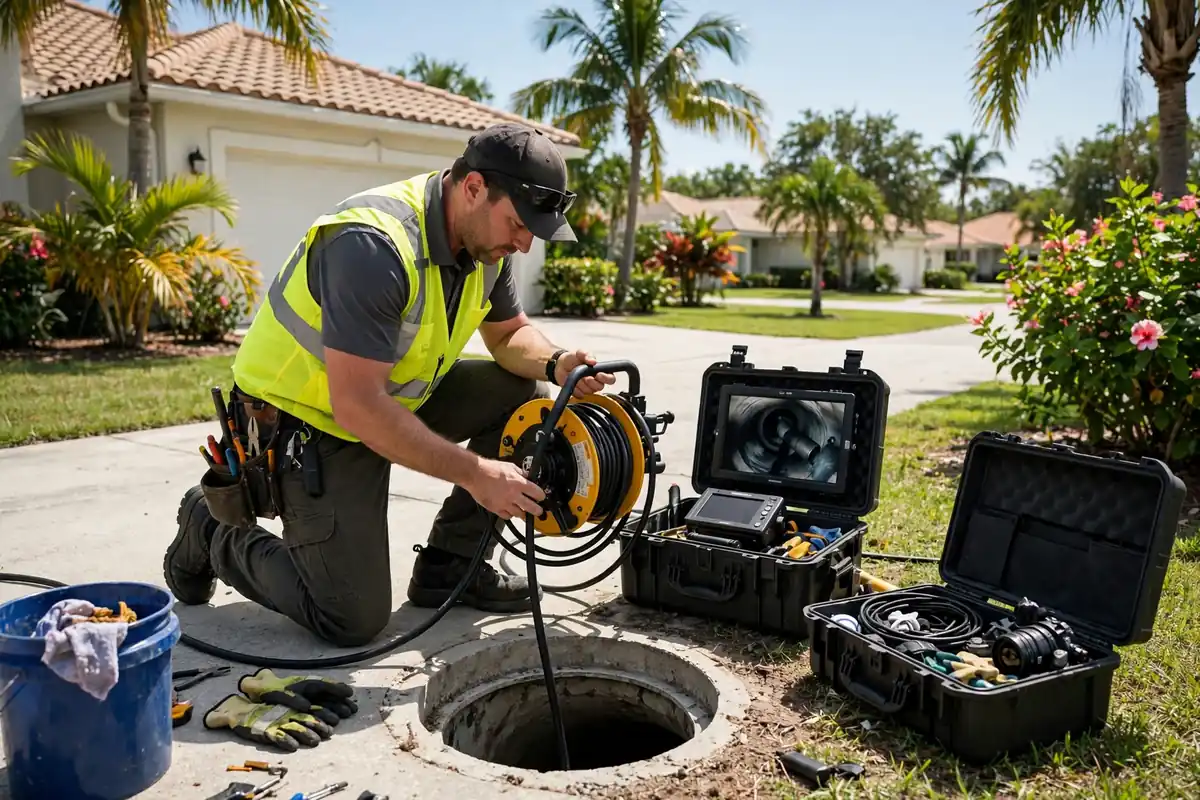
In short: This page covers professional sewer camera inspections in Coconut Creek, FL 33063 and 33066: what the camera sees, how we locate problems, and what your footage means. Call (833) 713-2101 and we will run the camera, record everything, and explain your line's condition in plain language.
Every sewer decision — clean it, line it, burst it, or replace it — should start with seeing inside the pipe. A sewer camera inspection does exactly that: a waterproof, high-resolution camera on a flexible push rod travels through your line from a cleanout or access point, transmitting live video to a monitor above ground while a locator tracks the camera's exact position and depth. What used to require exploratory digging is now a non-invasive diagnostic you can watch in real time.
In Coconut Creek, camera inspections earn their keep constantly. Homebuyers use them to avoid inheriting a collapsed Orangeburg lateral in a 1960s ranch. Homeowners use them to find out whether recurring backups are roots, grease, or a broken pipe — because each one needs a completely different fix. Property managers and HOA boards use recorded inspections as documentation for maintenance decisions and reserve planning. Whatever your reason, the principle is the same: you should never pay for sewer work based on a guess when a camera can show you the truth for a fraction of the repair cost.
Signs You Need Sewer Camera Inspection
You are buying a home and want to know the sewer's condition
In Coconut Creek's 1960s-to-1990s housing stock, the sewer lateral is often the oldest unexamined system in the house. A pre-purchase camera inspection reveals collapsed sections, root intrusion, and failing pipe material before you sign — the single most valuable inspection a buyer can order on an older home.
Backups keep returning after cleaning
If a cable or even jetting cleared the line and the problem came back, the camera finds out why: a root mass that needs lining, a belly that collects solids, or a break that cleaning can never fix. Repeated cleaning without a camera is spending money without a diagnosis.
You need to choose between repair options
Lining, bursting, spot repair, and full replacement each require different pipe conditions. Only a camera can tell you which options your line actually qualifies for. We never recommend a trenchless method without camera footage proving the pipe is a candidate.
Unexplained wet spots or sinkholes in the yard
Sandy soil hides leaking sewer lines well — water drains away instead of pooling. A camera run combined with a locator pinpoints the leaking joint or break, so any excavation targets a marked spot instead of a hopeful trench.
A contractor or insurer asked for documentation
Real estate transactions, insurance claims, and HOA board approvals all move faster with recorded footage and a written condition report. We provide both: video files you can keep and a plain-language summary of pipe material, defects, locations, and depths.
Your home is 30-plus years old and never been inspected
Cast iron, clay tile, and Orangeburg all have finite service lives, and Coconut Creek's sandy soil, high water table, and aggressive roots shorten them further. A baseline inspection in your 30s-to-50s-year-old home tells you whether you are maintaining a healthy line or sitting on a future emergency.
What Causes It
Camera inspections in Coconut Creek reveal the same cast of problems again and again, because the causes are baked into the area's housing and geology. Clay tile joints separated by shifting sandy soil. Cast iron interiors roughened by decades of corrosion. Orangeburg deformed by moisture. Ficus, live oak, and royal palm roots threading every available opening. Bellies — low sags in the line — formed where soil settled under driveways and slabs, collecting solids until flow slows to a crawl.
The camera also catches what is not a pipe problem at all. We regularly find lines that are structurally fine but overwhelmed by groundwater infiltration during the May-to-October rainy season, or backups caused by a surcharged municipal main during a storm rather than anything wrong with the lateral. That distinction saves homeowners from paying for repairs they do not need — and it is exactly the kind of truth only a camera can deliver.
Our Step-by-Step Process
Access and equipment setup
Call (833) 713-2101 to schedule. Our technician locates your cleanout — the capped access pipe usually near the house, in the yard, or at the property line — and sets up the camera reel, monitor, and sonar locator. If no cleanout exists, we can usually access through a pulled toilet or roof vent, and we will tell you if adding a cleanout makes sense for the future.
The camera run
The push-rod camera travels the full length of the lateral, from the house to the municipal main or septic connection, while you watch the live feed on the monitor. The technician narrates what you are seeing: pipe material changes, joints, connections, and every defect as it appears.
Locating and measuring
Whenever the camera finds something significant — a break, a root mass, a belly — the sonar locator pinpoints its exact position on the surface and its depth. These marks tell any future repair crew precisely where to dig or where a trenchless pull should target, eliminating exploratory excavation.
Recording and condition report
The entire run is recorded to a video file you keep. We then prepare a written condition report: pipe materials and diameters observed, each defect described with its distance from the access point and depth, and an overall assessment of the line's health.
Recommendations in plain language
Finally, we sit down with the footage and explain your options honestly — monitor it, clean it, line it, burst it, or replace it — matched to what the camera actually showed. If the line is healthy, we say so and suggest when to look again. No inspection ever obligates you to buy a repair.
Equipment & Materials
- Self-leveling high-resolution push-rod cameras for 2-to-6-inch lines
- Sonar transmitters and receivers for surface locating and depth measurement
- Recording systems producing video files you keep
- Pan-and-tilt camera heads for inspecting larger commercial lines
- Distance counters marking every defect's footage from the access point
- Cleanout installation tools for homes that lack proper camera access
Safety & Precautions
A camera inspection is the gentlest procedure in sewer work — no digging, no chemicals, no wastewater contact — but it is still done with care. Access points are opened and closed cleanly, with drop cloths protecting floors when we work through an indoor toilet pull. Roof-vent access is done with fall protection on the ladder and roof. If the camera reveals an active sewage leak or a line under pressure, we stop the inspection before pushing further and advise you on immediate next steps rather than forcing equipment through a hazardous condition.
Coconut Creek, FL Factors
In Coconut Creek, camera inspections are practically a local necessity rather than a luxury. The housing stock spans 1960s clay and Orangeburg through 1990s cast iron to modern PVC, and the camera instantly identifies which era your line belongs to and how that era is aging. Sandy soil means bellies and separated joints are common; the high water table means we often run cameras during or just after heavy rain to catch infiltration at its worst; and the mature ficus and live oak canopy means root intrusion is the single most common finding on camera in established neighborhoods. For buyers eyeing homes anywhere from 33063 to 33073, a pre-purchase inspection is the cheapest insurance against inheriting someone else's collapsed lateral.
Sewer Camera Inspection by Area
Boca Raton, FL 33486
Sewer Camera Inspection
Learn moreBoca Raton, FL 33487
Sewer Camera Inspection
Learn moreCoconut Creek, FL 33063
Sewer Camera Inspection
Learn moreCoconut Creek, FL 33066
Sewer Camera Inspection
Learn moreCoconut Creek, FL 33073
Sewer Camera Inspection
Learn moreCoral Springs, FL 33065
Sewer Camera Inspection
Learn moreCoral Springs, FL 33067
Sewer Camera Inspection
Learn moreDeerfield Beach, FL 33441
Sewer Camera Inspection
Learn moreDeerfield Beach, FL 33442
Sewer Camera Inspection
Learn moreDelray Beach, FL 33484
Sewer Camera Inspection
Learn moreFort Lauderdale, FL 33308
Sewer Camera Inspection
Learn moreHillsboro Beach, FL 33062
Sewer Camera Inspection
Learn moreLauderhill, FL 33313
Sewer Camera Inspection
Learn moreMargate, FL 33063
Sewer Camera Inspection
Learn moreMargate, FL 33068
Sewer Camera Inspection
Learn moreNorth Lauderdale, FL 33068
Sewer Camera Inspection
Learn moreOakland Park, FL 33309
Sewer Camera Inspection
Learn moreParkland, FL 33076
Sewer Camera Inspection
Learn morePompano Beach, FL 33060
Sewer Camera Inspection
Learn morePompano Beach, FL 33064
Sewer Camera Inspection
Learn moreTamarac, FL 33319
Sewer Camera Inspection
Learn moreTamarac, FL 33321
Sewer Camera Inspection
Learn moreFrequently Asked Questions
How long does a sewer camera inspection take?
Most residential inspections run 45 minutes to an hour and a half, depending on the line's length and how many issues the camera finds. Commercial and multi-unit lines take longer. You can watch the whole thing live on the monitor if you like.
Will the camera damage my pipes?
No. The push-rod camera is designed to glide through sewer lines — it is far gentler than a cable machine or jetter. If the camera cannot pass a collapsed or fully blocked section, that itself is diagnostic information, and we stop rather than force it.
Do I get to keep the video?
Yes. The full run is recorded and the file is yours, along with a written condition report noting materials, defects, locations, and depths. Keep it with your home records — it is valuable for future maintenance, real estate transactions, and insurance documentation.
Can the camera find exactly where a problem is?
Yes — that is half the point. The camera head carries a sonar transmitter, and our locator reads its signal from the surface to mark the problem's exact position and depth. A repair crew can then target that marked spot instead of digging exploratory trenches.
My drains work fine. Should I still get an inspection?
If your home is 30 or more years old and the line has never been inspected, yes. Sewer lines fail silently for years — roots grow, joints separate, scale builds — until the first symptom is a backup. A baseline inspection tells you where you stand before it becomes an emergency.
Can you inspect a line that is completely blocked?
Sometimes partially. The camera can usually travel up to the blockage and show us what is causing it, but it cannot see through a solid obstruction. In that case we typically clear the line first — with a cable or jetter — and then run the camera to diagnose the underlying condition. Call (833) 713-2101 and we will plan the right sequence for your situation.
Talk to a Sewer Line Pro Today
Describe the problem once — a local specialist serving Coconut Creek, FL plans the visit. 24/7 emergency line.
(833) 713-2101Speak with a local pro · No pressure
Serving Coconut Creek, FL