
Sewer Line Replacement in Coconut Creek, FL
When a sewer line is beyond cleaning and beyond lining, replacement is the honest answer — and done right, it is the last sewer project you will ever need. Call Sewer Line Repair Crew at (833) 713-2101 for a camera-based assessment.
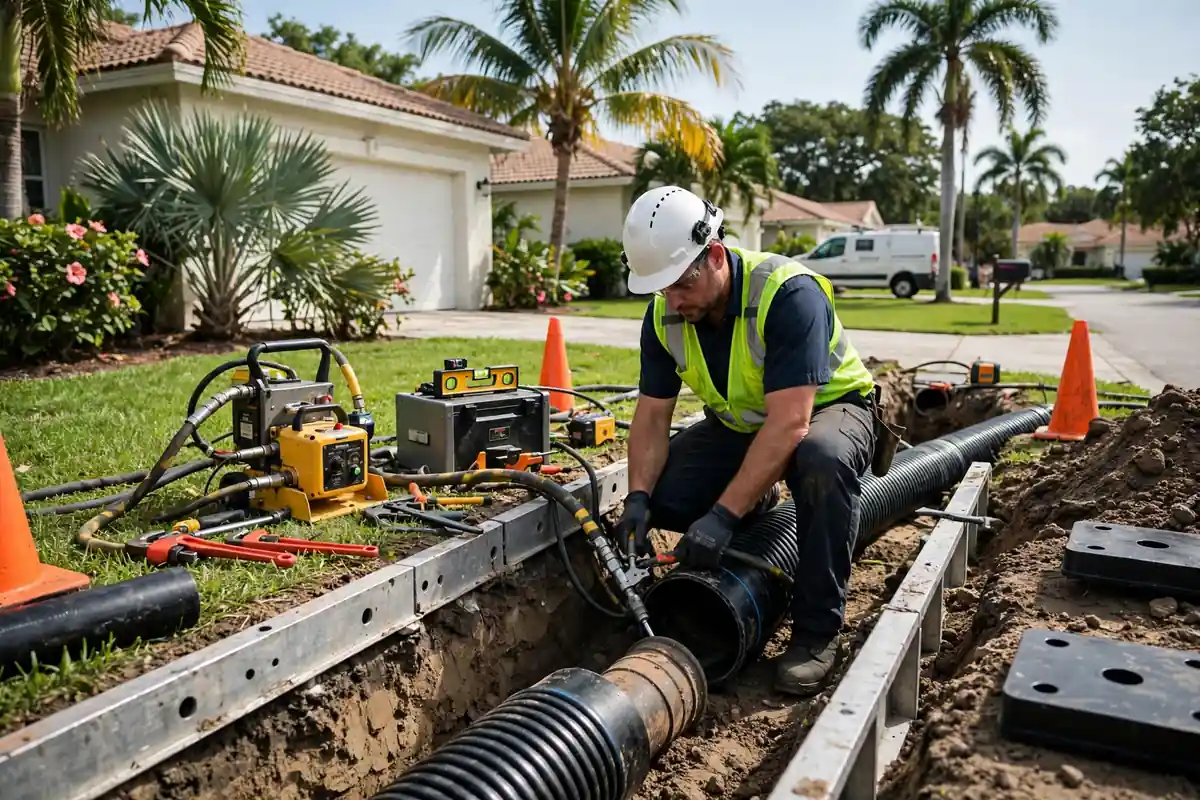
In short: This page covers full sewer line replacement in Coconut Creek, FL 33066 and 33073 — when replacement beats repair, trenchless vs. open-trench, and what the project looks like. Call (833) 713-2101 and we will camera-inspect your line and give you a straight recommendation.
Sewer line replacement is the point of no return in the truest sense: the old line comes out of service permanently, and a brand-new line takes its place. It is the right call when the existing pipe is collapsed, chronically root-destroyed, made of a failed material like Orangeburg, or so undersized and misaligned that no rehabilitation method can give it a reliable future. Replacement is a bigger project than cleaning or lining — but it is also the only option that resets the clock to zero, giving you a new line with a multi-generational service life.
The key decision in any replacement is method, and in Coconut Creek the answer is trenchless more often than not. Pipe bursting replaces the line through the old pipe's path with only two small pits; open-trench replacement excavates the full run. Bursting wins wherever driveways, pool decks, and mature landscaping sit over the line — which describes most established Coconut Creek lots — while open trench still has its place for lines that need re-routing, grade correction, or upsizing beyond what bursting can achieve. Sewer Line Repair Crew recommends based on camera evidence and your property's reality, not on which method we prefer. The camera decides; we explain.
Signs You Need Sewer Line Replacement
The camera shows collapse or missing sections
A line with caved-in sections, crushed pipe, or stretches where the camera sees soil instead of pipe cannot be lined or cleaned back to health. Replacement — by bursting or trench — is the only fix that puts a whole, structural pipe back in the ground.
Orangeburg pipe anywhere in the run
Orangeburg was a tar-paper product with a finite life, and every year still in service is borrowed time. When camera inspection finds Orangeburg in a Coconut Creek lateral, replacement is not a question of if but when — and planning it beats discovering it during an emergency backup.
Chronic root destruction along the full length
A root problem at one joint is maintenance; root masses at every joint along a clay tile run is a failed line. When roots have won the whole run, replacing it with a joint-free HDPE or PVC line ends the war instead of scheduling the next battle.
Repeated backups despite professional cleaning
If hydro jetting and root cutting keep the line working for a few months and then the backups return, the pipe itself is the problem — deformed, bellied, or broken in ways cleaning cannot correct. Replacement addresses the pipe, not the symptom.
Severe bellies or grade problems
A line with deep sags that pond water, or a run laid so flat — or so inconsistently — that solids settle out, will never drain reliably no matter how clean it is. Replacement re-establishes correct grade end to end, which is something no cleaning or liner can do for a badly graded line.
You are already excavating for another reason
If a pool, addition, or major landscaping project is opening the ground over the lateral anyway, replacing an aging line at the same time is simple economics: one excavation, one restoration, and a new line that will outlast everything being built over it.
What Causes It
Lines reach replacement for the same reasons they fail, taken to the endpoint. Clay tile joints separate progressively in sandy soil until roots own every opening. Cast iron scales and corrodes until the pipe is structurally thin as well as hydraulically choked. Orangeburg, the weakest of the legacy materials, deforms and collapses under soil load and moisture — in Coconut Creek's wet ground, its lifespan was always going to be the shortest. Add decades of these processes compounding, and the line crosses from 'damaged but serviceable' to 'structurally finished.'
South Florida's environment writes the timeline. The high water table keeps old pipe saturated, accelerating corrosion and infiltration. The May-to-October rainy season loads weakened lines with groundwater they were never sized for. Sandy soil shifts under every heavy rain, working joints apart a little more each year. And ficus and live oak roots never stop probing. A line installed in 1975 has endured fifty years of all four — replacement is not a failure of maintenance, it is the honest recognition that the pipe's service life has ended.
Our Step-by-Step Process
Camera inspection and replacement assessment
Call (833) 713-2101 to start. We run a full camera inspection with sonar locating, document every defect, and determine whether the line is a replacement case or whether lining or bursting could still serve. You see the footage that drives the recommendation.
Method selection: bursting vs. open trench
We walk the property with you and compare the options honestly. Bursting where the path is followable and the surface must be preserved; open trench where the line needs re-routing, grade correction, or a new path entirely. The recommendation is explained with the camera evidence, not asserted.
Permits, locates, and scheduling
We handle permits and utility locates, coordinate any municipal main connection work, and schedule the project around your household — including water-use planning for the day or days the line is out of service.
The replacement itself
For bursting: entry and exit pits, the hydraulic pull fracturing the old pipe while new HDPE follows, then connections and testing. For open trench: excavation along the path, old pipe removed, new PVC or HDPE laid on compacted bedding at verified grade, then connections and testing. Either way, the new line is camera-verified before backfill.
Backfill, compaction, and restoration
Trenches and pits are backfilled in lifts and compacted to prevent settling, surfaces are restored — sod, pavers, concrete — and you receive the final camera footage of the new line plus an as-built record of its path, depth, and material.
Equipment & Materials
- Hydraulic pipe-bursting rigs for trenchless replacement
- Excavation equipment for open-trench replacement
- HDPE and PVC pipe with code-compliant fittings
- CCTV cameras for pre-replacement assessment and post-installation verification
- Sonar locators and utility detection for safe excavation
- Compaction equipment and bedding stone for proper backfill
Safety & Precautions
Replacement is the heaviest sewer work we do, and the safety plan matches it. Excavations are sloped or shored in sandy soil, barricaded and covered when unattended, with spoil kept back from trench edges. Utilities are located before any digging, and work stops if an unmarked line is encountered. During bursting pulls, the work zone is restricted to the operator and spotters. Wastewater handling follows the same hygiene discipline as all our sewer work: protective gear, containment, disinfection of tools and contact surfaces, and no discharge to lawns or storm drains. The household is briefed on water-use limits while the line is out of service so nobody is caught off guard.
Coconut Creek, FL Factors
Replacement decisions in Coconut Creek are shaped by the local pipe inventory. The 1960s and 70s neighborhoods still hold clay tile and Orangeburg laterals that are now fifty-plus years old — prime replacement candidates, and bursting was practically invented for their long runs under established landscaping. The 70s-to-90s cast iron is hitting the age where scale and corrosion make replacement the rational choice over another round of cleaning. Sandy soil and the high water table push us toward meticulous bedding and compaction on every open-trench job, because a replacement that settles into bellies within five years is a failure, not a fix. And in HOA communities, where trenching common areas triggers architectural review and restoration obligations, trenchless bursting through two small pits is often the only practical way to replace a line without a months-long approval saga.
Sewer Line Replacement by Area
Boca Raton, FL 33486
Sewer Line Replacement
Learn moreBoca Raton, FL 33487
Sewer Line Replacement
Learn moreCoconut Creek, FL 33063
Sewer Line Replacement
Learn moreCoconut Creek, FL 33066
Sewer Line Replacement
Learn moreCoconut Creek, FL 33073
Sewer Line Replacement
Learn moreCoral Springs, FL 33065
Sewer Line Replacement
Learn moreCoral Springs, FL 33067
Sewer Line Replacement
Learn moreDeerfield Beach, FL 33441
Sewer Line Replacement
Learn moreDeerfield Beach, FL 33442
Sewer Line Replacement
Learn moreDelray Beach, FL 33484
Sewer Line Replacement
Learn moreFort Lauderdale, FL 33308
Sewer Line Replacement
Learn moreHillsboro Beach, FL 33062
Sewer Line Replacement
Learn moreLauderhill, FL 33313
Sewer Line Replacement
Learn moreMargate, FL 33063
Sewer Line Replacement
Learn moreMargate, FL 33068
Sewer Line Replacement
Learn moreNorth Lauderdale, FL 33068
Sewer Line Replacement
Learn moreOakland Park, FL 33309
Sewer Line Replacement
Learn moreParkland, FL 33076
Sewer Line Replacement
Learn morePompano Beach, FL 33060
Sewer Line Replacement
Learn morePompano Beach, FL 33064
Sewer Line Replacement
Learn moreTamarac, FL 33319
Sewer Line Replacement
Learn moreTamarac, FL 33321
Sewer Line Replacement
Learn moreFrequently Asked Questions
How do I know replacement is necessary instead of lining?
The camera makes the call. Lining needs a host pipe with shape; replacement is for collapsed sections, missing pipe, Orangeburg, severe grade problems, or full-length root destruction. Call (833) 713-2101 for a camera inspection and we will show you exactly which category your line falls into.
Is trenchless replacement as good as digging a new trench?
For a line on a good path, yes — often better. Pipe bursting installs a continuous, joint-free HDPE line rated for generations, with a fraction of the surface disruption. Open trench is superior when the path itself is the problem: bad grade, wrong route, or the need to relocate the line.
How long will the new line last?
The HDPE and PVC lines we install are modern materials with multi-generational service lives — they do not corrode like cast iron, invite roots like clay joints, or deform like Orangeburg. Installed on proper grade with proper bedding, a new line should outlast the mortgage.
Will you have to dig up my driveway?
Usually not. Pipe bursting replaces the line underground between two pits, leaving driveways, pool decks, and patios intact. Open trench is only recommended when the situation genuinely requires it, and we explain why before you approve anything.
Can you replace just part of the line?
Yes — sectional replacement targets the failed run while leaving healthy sections in service. The camera inspection identifies exactly which sections are done and which have life left, so you replace what needs replacing and nothing more.
What happens to my water use during the replacement?
The sewer line will be out of service during the work itself — typically hours for a bursting pull, longer for open trench. We schedule the outage with you in advance, keep it as short as the method allows, and restore service the same project. You will know the plan before we start.
Don't Let a Sewer Problem Sit
Get connected with a trusted local specialist serving Coconut Creek and nearby areas — call anytime.
(833) 713-2101Free consultation call · Available 24/7
Serving Coconut Creek, FL