
Sewer Line Installation in Coconut Creek, FL
Building new, adding on, or connecting a structure that never had proper sewer service? Sewer Line Repair Crew installs sewer lines to code, on grade, and built for South Florida ground. Call (833) 713-2101 to plan your installation.
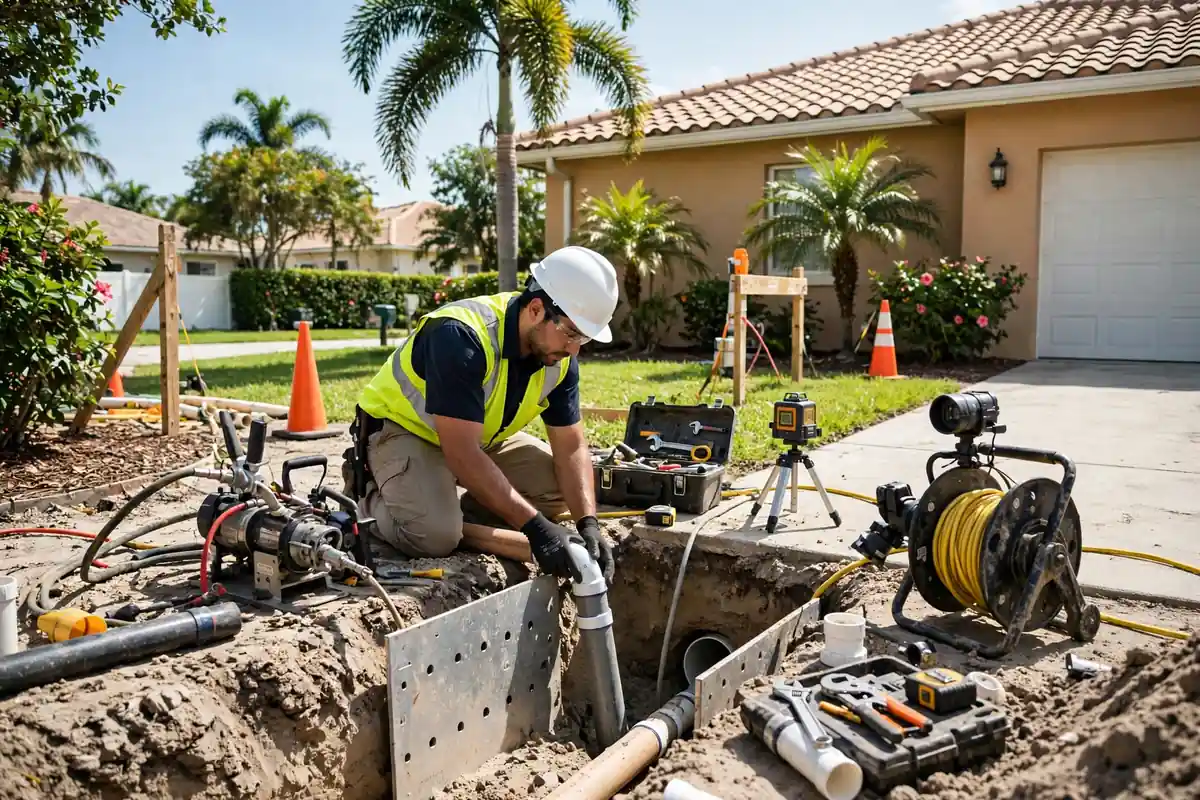
In short: This page covers new sewer line installation in Coconut Creek, FL 33073 — additions, guest houses, garage conversions, and commercial build-outs. Call (833) 713-2101 and we will survey your property, design the run on proper grade, and install a line built to last.
Most sewer work is repair — fixing what is already in the ground. Sewer line installation is the opposite: putting a brand-new line where none existed, or where the old one is being abandoned entirely. In Coconut Creek, that usually means one of a handful of projects: a home addition with a new bathroom, a detached guest house or in-law suite, a garage converted to living space, a pool house with a restroom, or a commercial tenant build-out that needs its own restrooms and kitchen drainage. Each one needs a sewer lateral designed from scratch — correct pipe, correct diameter, correct slope, correct connection to the municipal main.
Getting installation right matters more than getting it fast, because a new line is supposed to serve for generations. Slope is everything: too flat and solids settle out; too steep and water outruns the solids, leaving them stranded. In South Florida's sandy soil and high water table, bedding and compaction matter as much as slope — a line laid on poorly compacted sand will settle into bellies within a few rainy seasons. Sewer Line Repair Crew designs every installation for this ground: proper bedding, proper grade, proper materials, and cleanouts placed where future maintenance can actually reach them.
Signs You Need Sewer Line Installation
You are adding a bathroom or kitchen to the home
Every new fixture group needs a drainage path to the sewer, and an addition's plumbing cannot just tie into the nearest pipe and hope it works out. A new bathroom or kitchen means calculating fixture units, sizing the branch correctly, and connecting it to the lateral at the right point with proper slope.
A detached structure needs sewer service
Guest houses, in-law suites, pool houses, and converted garages all need their own sewer connection run underground to the main lateral or the municipal main. The run has to hold grade across the yard, clear other utilities, and connect without disrupting the existing line.
A commercial space is being built out
New restaurant, office, or retail tenants need sewer lines sized for commercial fixture counts and grease loads, often with a grease interceptor on the kitchen line. Build-outs have to coordinate with landlords, inspectors, and neighboring tenants — and the work has to happen on a construction schedule.
The old line is being abandoned, not repaired
Sometimes the right call is a fresh start: a new line on a better path replacing a chronically failing one, rather than rehabilitating pipe in a bad location. Installation gives you a clean design — straighter run, better grade, modern materials — instead of inheriting old compromises.
You are connecting to the municipal main for the first time
Properties converting from septic to municipal sewer need a complete new lateral from the house to the street main, including the tap connection. In parts of Coconut Creek where municipal service has expanded, this is a common and high-value project.
An inspector or permit requires a new compliant line
Unpermitted or non-compliant drainage discovered during a sale or renovation has to be replaced with a proper installation. We install to the applicable plumbing code, coordinate the required inspections, and leave you with documentation that satisfies buyers, insurers, and the city.
What Causes It
New installations are driven by growth, not failure — but the ground they go into is the same ground that destroys old lines, so the design has to respect it. Sandy soil is easy to trench and terrible for support: without proper bedding and compaction, a new line settles differentially and develops bellies that collect solids from day one. The high water table means trenches fill with water during installation in the rainy season, and a line laid in a flooded trench without dewatering will float off grade before it is even backfilled.
Material choice is the other cause-turned-decision. Modern PVC and HDPE are the right materials for new sewer work in South Florida — smooth, joint-fused or properly gasketed, immune to the corrosion that kills cast iron and the root invitation of clay bell joints. But the pipe is only as good as its installation: correct slope (the standard quarter-inch per foot for small lines), proper bedding stone, careful joint assembly, and solid compaction around the pipe. Most installation failures we are called to fix are not material failures — they are grade and bedding failures from rushed work.
Our Step-by-Step Process
Site survey and design
Call (833) 713-2101 to start. We walk the property, locate existing utilities, measure distances and elevations, and design the run: pipe material and diameter based on fixture count, slope calculated end to end, cleanout locations for future maintenance, and the connection point at the municipal main or existing lateral.
Permits and utility coordination
We handle the permit application and coordinate the required inspections, and we call in utility locates before any digging. For municipal main connections, we coordinate the tap with the city or utility so the connection is made correctly and legally.
Trenching with dewatering as needed
The trench is excavated to design depth and grade, with pumps handling groundwater — a routine necessity in Coconut Creek's high water table, especially May through October. Bedding stone is placed and compacted to give the pipe uniform support along its full length.
Pipe laying on grade
Pipe is laid section by section with grade checked continuously — not eyeballed at the end. Joints are assembled to manufacturer specification, connections to the house and the main are made with proper fittings, and cleanouts are installed at the designed locations.
Inspection, backfill, and restoration
The installation is inspected as required, then backfilled in lifts with proper compaction to prevent future settling. The surface — sod, pavers, concrete — is restored, and you receive an as-built description of the new line: path, depth, material, and cleanout locations for your records.
Equipment & Materials
- Trenching and excavation equipment sized for residential and commercial runs
- Dewatering pumps for high-water-table trench work
- Laser levels and grade rods for continuous slope verification
- PVC and HDPE pipe with code-compliant fittings and gaskets
- Bedding stone and compaction equipment for proper pipe support
- Utility locating gear used before every excavation
Safety & Precautions
New installation means open trenches, and open trenches are treated with full respect. Trenches are sloped or shored against collapse in sandy soil, spoil piles are kept back from the edge, and every open trench is barricaded and covered or guarded whenever the crew is not actively in it — especially on properties with children, pets, or foot traffic. Underground utilities are located and marked before excavation, and the trench is never dug blind near marked gas or electric lines. Heavy equipment operators keep spotters, and the work area is kept orderly so the construction zone never becomes a hazard for the household.
Coconut Creek, FL Factors
Installing sewer lines in Coconut Creek means designing for sand and water from the first shovel. Our trenches here routinely hit groundwater within a few feet, so dewatering pumps are standard equipment rather than a surprise — a line laid in standing water without proper bedding will be off grade before the trench is even closed. We bed every installation in compacted stone because sugar sand alone cannot be trusted to support a pipe through ten rainy seasons. Material choice follows the local lesson too: we install PVC or HDPE, never the clay or Orangeburg that fills our repair calls from the 1960s and 70s neighborhoods. And because so much of Coconut Creek is HOA-governed, we plan installations to respect common-area rules, architectural review requirements, and restoration standards — the new line should be invisible in every sense once we leave.
Sewer Line Installation by Area
Boca Raton, FL 33486
Sewer Line Installation
Learn moreBoca Raton, FL 33487
Sewer Line Installation
Learn moreCoconut Creek, FL 33063
Sewer Line Installation
Learn moreCoconut Creek, FL 33066
Sewer Line Installation
Learn moreCoconut Creek, FL 33073
Sewer Line Installation
Learn moreCoral Springs, FL 33065
Sewer Line Installation
Learn moreCoral Springs, FL 33067
Sewer Line Installation
Learn moreDeerfield Beach, FL 33441
Sewer Line Installation
Learn moreDeerfield Beach, FL 33442
Sewer Line Installation
Learn moreDelray Beach, FL 33484
Sewer Line Installation
Learn moreFort Lauderdale, FL 33308
Sewer Line Installation
Learn moreHillsboro Beach, FL 33062
Sewer Line Installation
Learn moreLauderhill, FL 33313
Sewer Line Installation
Learn moreMargate, FL 33063
Sewer Line Installation
Learn moreMargate, FL 33068
Sewer Line Installation
Learn moreNorth Lauderdale, FL 33068
Sewer Line Installation
Learn moreOakland Park, FL 33309
Sewer Line Installation
Learn moreParkland, FL 33076
Sewer Line Installation
Learn morePompano Beach, FL 33060
Sewer Line Installation
Learn morePompano Beach, FL 33064
Sewer Line Installation
Learn moreTamarac, FL 33319
Sewer Line Installation
Learn moreTamarac, FL 33321
Sewer Line Installation
Learn moreFrequently Asked Questions
How do you determine the right pipe size and slope?
By fixture count and code: we calculate the drainage fixture units the new line will serve, size the pipe accordingly, and lay it at the code-required slope — typically a quarter-inch per foot for small residential lines. Call (833) 713-2101 and we will survey your project and show you the design before any digging.
Do I need a permit for a new sewer line?
In almost all cases, yes — and connections to the municipal main always require coordination with the city or utility. We handle the permit application and schedule the required inspections as part of the project, so you are not navigating the process alone.
How long does an installation take?
A straightforward residential lateral — house to street — typically takes a few days including inspection and restoration. Longer commercial runs, difficult soil conditions, or municipal main connections add time. You get a realistic schedule up front, not a guess.
Will the installation tear up my whole yard?
The trench follows the designed path — usually a single straight run — and we restore sod, pavers, and concrete as part of the job. Where an installation can be done trenchlessly, such as pulling a new line with pipe bursting methods, we will discuss that option too.
Can you install a line for a detached guest house?
Yes, that is a common project here. We run a new lateral from the guest house to the main lateral or the municipal main, holding grade across the yard and clearing other utilities. The design accounts for the distance — longer runs need careful slope planning so the far end still drains correctly.
What material do you install?
PVC or HDPE — the modern standards for sewer laterals. Both are smooth, corrosion-proof, and, when properly jointed, highly resistant to root intrusion. We do not install clay, Orangeburg, or cast iron for new work: the repair calls we run on those materials are argument enough.
Get a Local Sewer Specialist on the Line Now
One call connects you with a Coconut Creek-area sewer line professional. Day or night, we're ready to help.
(833) 713-2101Speak with a local pro · No pressure
Serving Coconut Creek, FL