
Pipe Lining (CIPP) in Coconut Creek, FL
Pipe lining rebuilds your sewer line from the inside — a resin-saturated liner cures in place to form a brand-new pipe within the old one, with no digging. Call Sewer Line Repair Crew at (833) 713-2101 for a camera inspection to see if your line is a lining candidate.
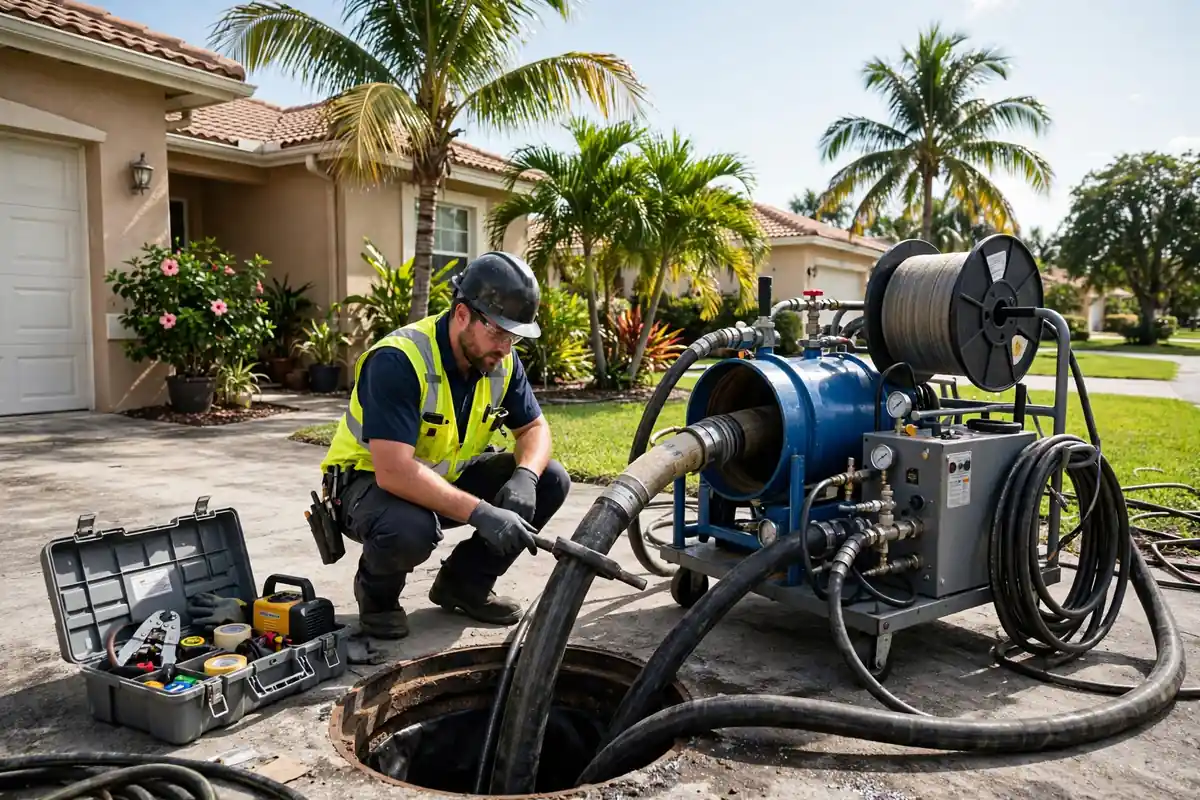
In short: A cracked or root-invaded sewer line in Coconut Creek, FL 33073 does not always need excavation. Pipe lining creates a new pipe inside the old one through existing access points. Call (833) 713-2101 and we will camera-inspect your line and tell you honestly whether lining is the right fix.
Pipe lining — technically called cured-in-place pipe, or CIPP — is the least invasive way to rehabilitate a damaged sewer line. A flexible liner saturated with epoxy resin is inserted into the existing pipe through a cleanout or small access point, inflated to press tightly against the old pipe's interior, and cured until it hardens into a rigid, seamless new pipe inside the old shell. The result is a joint-free, corrosion-proof, root-resistant line with a smooth interior that often flows better than the original — installed without opening a trench across your property.
Lining is the right answer for a specific kind of damage: pipes that are cracked, joint-separated, root-invaded, or scaled, but still hold enough of their shape to host a liner. In Coconut Creek that describes a huge share of the aging cast iron and clay tile in 1970s-to-1990s homes — lines with decades of life left in their location but not in their walls. Because the work happens entirely through existing access, your driveway, pool deck, and landscaping are never touched. The new liner bridges cracks, seals joints, locks out roots, and adds decades of structural life to a line that would otherwise need full excavation.
Signs You Need Pipe Lining (CIPP)
Cracks and joint separations on camera
When a camera inspection shows cracked clay, separated joints, or fine fractures running along a cast-iron line, the pipe is leaking at every break but still standing. A liner bridges all of those defects in one installation, sealing the line continuous from end to end.
Root intrusion that keeps coming back
Cutting roots out of clay tile joints buys time, but the open joints invite them back within a season or two — especially with ficus and live oak overhead. A cured-in-place liner has no joints at all, so roots lose every entry point they were using.
Scale and corrosion narrowing cast iron
Cast iron from the 70s and 80s builds up internal scale and tuberculation that chokes flow long before the pipe actually breaks. After descaling, a liner gives that cleaned pipe a brand-new smooth interior that resists future buildup instead of just resetting the clock.
A sagging belly that still drains
A slight sag or belly in a sandy-soil line collects solids but may still pass water. If the camera shows the pipe holding its round shape through the sag, lining can rehabilitate it — though severe bellies that pond water deeply are better handled by other methods, and we will tell you which yours is.
Leaks staining soil or attracting roots
Damp soil around a buried line, or a camera showing infiltration at every joint during the rainy season, means the pipe is leaking outward and letting groundwater in. The liner seals the full length at once, stopping both the leak and the infiltration in a single cure.
You want a decades-long fix without excavation
Some homeowners simply want the longest-lasting repair with the least disruption: no trench through the new pavers, no torn-up St. Augustine grass, no heavy equipment on the driveway. When the pipe qualifies, lining delivers a structural new pipe with essentially zero surface impact.
What Causes It
Lining candidates fail for familiar South Florida reasons. Clay tile joints separate as sandy soil shifts under slabs and driveways, opening hairline gaps at every bell. Cast iron corrodes from the inside out in the constant humidity, its interior roughening into scale that snags paper and slows flow until the line behaves like a much smaller pipe. Fine cracks develop from soil movement and from the sheer age of lines installed forty or fifty years ago — and every crack is both a leak path outward and a root doorway inward.
What makes these lines lining candidates rather than replacement cases is that the pipe, for all its defects, still holds its shape. The liner needs a host: a roughly round, continuous path to press against while it cures. Coconut Creek's high water table actually helps make the case for lining, because a sealed, joint-free liner also blocks the groundwater infiltration that swells flows during the May-to-October rains — fixing the leaks and the infiltration with one installation.
Our Step-by-Step Process
Camera inspection and liner qualification
Call (833) 713-2101 to start with a camera inspection. We measure the line's diameter, length, and depth, map every defect, and confirm the pipe holds enough shape to host a liner. If it does not — collapsed sections, severe offsets — we say so plainly and discuss bursting or replacement instead.
Thorough cleaning and descaling
A liner bonds most reliably to a clean host pipe, so the line is hydro-jetted and descaled first: roots cut, grease stripped, scale removed. A second camera pass verifies the pipe is clean and confirms the measurements the liner will be built to.
Liner preparation and insertion
The felt or fiberglass liner is cut to the exact length of the run and saturated with two-part epoxy resin. It is then inverted or pulled into the old pipe through the cleanout or access point — no trench — and positioned precisely over the damaged section or the full run.
Inflation and curing
The liner is inflated with air or water pressure, pressing it tightly against every contour of the old pipe. It then cures — with ambient, hot water, or steam cure depending on the installation — hardening into a rigid, structural new pipe. Cure times run hours, not days.
Final camera verification and reinstatements
A post-cure camera run verifies a smooth, continuous liner with no wrinkles or gaps. Any branch connections covered by the liner are robotically reinstated from inside, flow is tested, and you receive before-and-after footage of the transformation.
Equipment & Materials
- Epoxy resin systems formulated for potable-adjacent sewer rehabilitation
- Felt and fiberglass CIPP liners in residential and commercial diameters
- Inversion drums and pull-in rigs for trenchless liner placement
- Hot-water, steam, and ambient cure equipment
- Robotic reinstatement cutters for restoring branch connections
- CCTV cameras for pre-liner cleaning verification and post-cure inspection
Safety & Precautions
Pipe lining is a chemical process done inside your home's drainage system, so containment and ventilation are handled deliberately. The work area around the access point is isolated and ventilated during resin saturation and curing, and technicians wear chemical-rated gloves, eye protection, and respirators when handling uncured resin. You will notice an odor during the cure — similar to a strong adhesive — which is why we ventilate the space and keep the area clear until curing completes and the line is flushed. All resin waste and cleaning materials are contained and removed from the property, never poured into drains or onto soil.
Coconut Creek, FL Factors
Pipe lining fits Coconut Creek's built environment unusually well. Slab-on-grade construction means sewer lines run under the slab itself in many homes, where open-trench replacement would mean cutting concrete inside the house — lining rehabilitates those under-slab runs through the cleanout with the floors untouched. The city's mature tree canopy is the other reason lining thrives here: ficus, live oak, and royal palm roots exploit every clay joint in the older neighborhoods, and a joint-free liner permanently closes every door they were using. During the May-to-October rainy season, we also see lining pay off against infiltration — sealing the joints that let groundwater flood the system when the water table peaks.
Pipe Lining (CIPP) by Area
Boca Raton, FL 33486
Pipe Lining (CIPP)
Learn moreBoca Raton, FL 33487
Pipe Lining (CIPP)
Learn moreCoconut Creek, FL 33063
Pipe Lining (CIPP)
Learn moreCoconut Creek, FL 33066
Pipe Lining (CIPP)
Learn moreCoconut Creek, FL 33073
Pipe Lining (CIPP)
Learn moreCoral Springs, FL 33065
Pipe Lining (CIPP)
Learn moreCoral Springs, FL 33067
Pipe Lining (CIPP)
Learn moreDeerfield Beach, FL 33441
Pipe Lining (CIPP)
Learn moreDeerfield Beach, FL 33442
Pipe Lining (CIPP)
Learn moreDelray Beach, FL 33484
Pipe Lining (CIPP)
Learn moreFort Lauderdale, FL 33308
Pipe Lining (CIPP)
Learn moreHillsboro Beach, FL 33062
Pipe Lining (CIPP)
Learn moreLauderhill, FL 33313
Pipe Lining (CIPP)
Learn moreMargate, FL 33063
Pipe Lining (CIPP)
Learn moreMargate, FL 33068
Pipe Lining (CIPP)
Learn moreNorth Lauderdale, FL 33068
Pipe Lining (CIPP)
Learn moreOakland Park, FL 33309
Pipe Lining (CIPP)
Learn moreParkland, FL 33076
Pipe Lining (CIPP)
Learn morePompano Beach, FL 33060
Pipe Lining (CIPP)
Learn morePompano Beach, FL 33064
Pipe Lining (CIPP)
Learn moreTamarac, FL 33319
Pipe Lining (CIPP)
Learn moreTamarac, FL 33321
Pipe Lining (CIPP)
Learn moreFrequently Asked Questions
How is pipe lining different from pipe bursting?
Lining builds a new pipe inside the old one and needs the old pipe to hold its shape; bursting destroys the old pipe and pulls a new one through, and can even upsize the diameter. The camera inspection tells us which your line qualifies for — call (833) 713-2101 and we will show you the footage and explain the difference for your specific pipe.
How long does a cured-in-place liner last?
A properly installed CIPP liner is a structural new pipe with a design life measured in decades — it resists roots, corrosion, and scale because it has no joints and a smooth epoxy surface. We will show you exactly what was installed with post-cure camera footage.
Will lining reduce the diameter of my pipe?
Slightly — the liner sits inside the old pipe, so the interior diameter shrinks by a small fraction. In practice, the liner's perfectly smooth interior flows as well as or better than the rough, scaled pipe it replaced, so drainage performance typically improves.
Can you line a pipe with bends in it?
Yes, within reason. The flexible liner navigates standard bends and sweeps during insertion. What rules lining out is not bends but structural loss — collapsed sections, missing pipe, or severe offsets where there is nothing for the liner to press against.
Do I have to leave my home during the installation?
Usually not. You will need to avoid using drains during the insertion and cure — typically a matter of hours — and you will notice a resin odor that we ventilate away. Most homeowners stay home and simply plan water use around the cure window.
What if only part of my line is damaged?
Then we line only that part. Sectional lining targets a single defective run — a cracked stretch, one bad joint area — while full-length lining rehabilitates the entire lateral. The camera inspection determines which makes sense, and we quote the work to match.
Fast Help for Sewer Line Trouble
Call now for a local sewer line specialist in the Coconut Creek area. No obligation, just answers.
(833) 713-2101No obligation · Emergency help 24/7
Serving Coconut Creek, FL