
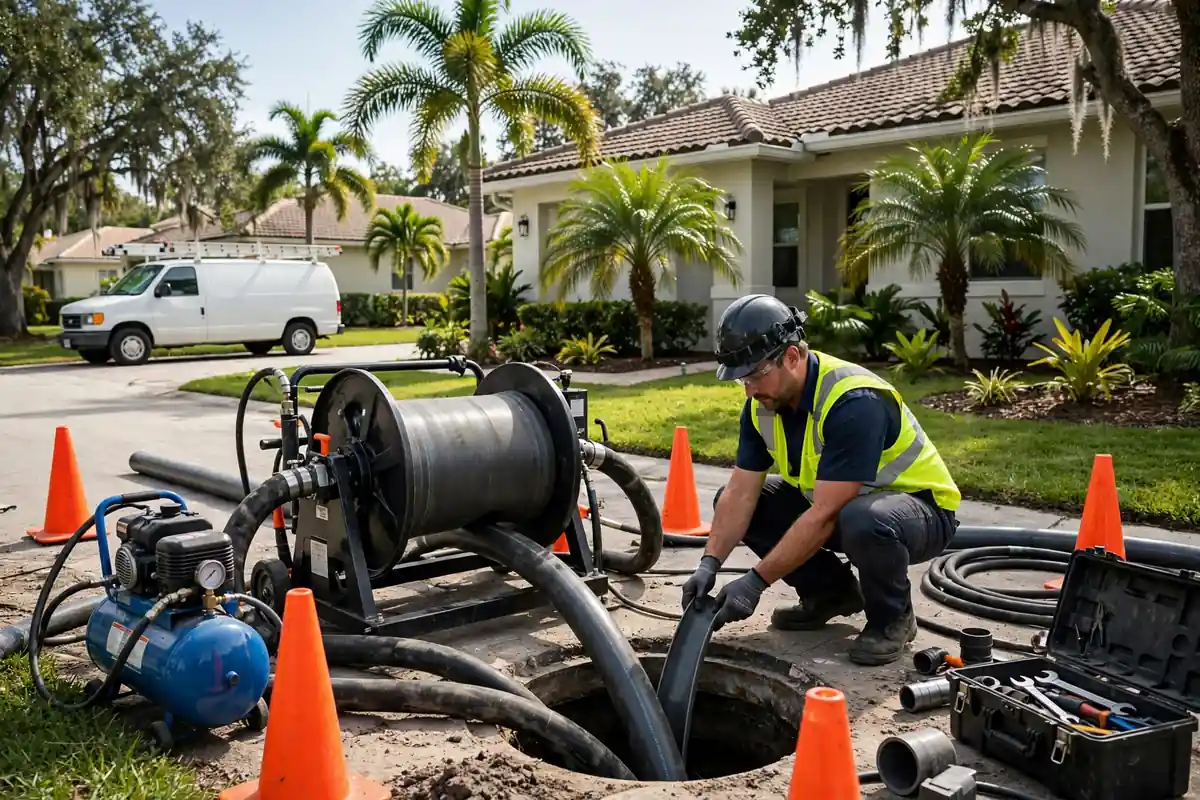
In short: Pipe Lining (CIPP) in Fort Lauderdale, FL 33308. Saltwater is the signature problem: sewers below a tidal water table in beach sand take on saltwater infiltration through cracked cast iron, which both overloads the system and accelerates corrosion f Call (833) 713-2101 to describe the problem and get a local specialist.
Quick answer: For line lining (cipp) in Fort Lauderdale 33308, call (833) 713-2101 today. A nearby specialist assesses the line, explains all available options clearly, and schedules the work promptly — emergency service available 24/7.
In Fort Lauderdale, pipe lining (cipp) starts with reading the property: 1960s–80s beachfront elevated-rise condos along A1A/Ocean Blvd (1960s–80s vintages), Harbor..
Piping materials here generally follow the construction era — 1960s–80s condo cast-iron stacks at end-of-life; Harbor Beach 1950s–60s estates. — so the pro verifies actual material on site prior to choosing an approach.
Saltwater Doesn't Just Flood A1A — It Eats Pipes From the Inside
Saltwater is the signature problem: sewers below a tidal water table in beach sand take on saltwater infiltration through cracked cast iron, which both overloads the system and accelerates decay from the inside out — camera + salinity-aware inspection framing; logistics are brutal (A1A single corridor, no staging room, elevated-rise associations, valet garages), so trenchless methods that need only cleanout.
Foundations here: Slab-on-grade; elevated-rise podiums with garage-level utility runs. Drainage and earth play their part — Barrier-island beach sand; Intracoastal Waterway on the west side of the strip; tidal water table at 1–3 ft; chronic king-tide flooding on A1A and Harbor.
High-Rise Stacks and Harbor Beach Estates: Two Lining Jobs in One ZIP
The first hints of line lining (cipp) in Fort Lauderdale are typically cracks and joint separations on camera, root intrusion that keeps coming back, and scale and corrosion narrowing cast iron.
Camera inspection and liner qualification comes first, followed by thorough cleaning and descaling and liner preparation and insertion. Rainy-season earth saturation can add dewatering steps. Pipe Lining — Fort Lauderdale 33308.
How Pipe Lining (CIPP) Works in Fort Lauderdale
Camera inspection and liner qualification
Phone (833) 713-2101 to start with a camera inspection. We measure the line's diameter, length, and depth, map every defe Adapted here for slab-on-grade access and the elevated supply table.
Thorough cleaning and descaling
A liner bonds most reliably to a clean host piping, so the line is hydro-jetted and descaled first: roots cut, grease stri Adjusted for rainy-season ground saturation common in Fort Lauderdale.
Liner preparation and insertion
The felt or fiberglass liner is cut to the exact length of the run and saturated with two-part epoxy resin. It is then i Planned around Fort Lauderdale soil and runoff conditions.
Inflation and curing
The liner is inflated with air or water pressure, pressing it tightly against every contour of the old line. It then cur Adjusted for rainy-season ground saturation common in Fort Lauderdale.
Final camera verification and reinstatements
A post-cure camera run verifies a smooth, continuous liner with no wrinkles or gaps. Any branch connections covered by t Sequenced to keep your Fort Lauderdale property usable throughout.
Keeping Pipe Lining (CIPP) Lines Healthy in Fort Lauderdale
- A pre-season inspection in April or May catches issues before saturation.
- Track drainage speed after storms — sudden changes mean call sooner.
- Landscaping over the lateral should stay shallow-rooted.
- Make sure every adult in the home knows where the cleanout is.
- Older clay or cast-iron lines deserve a camera look every couple of years.
The cheapest line lining (cipp) is the one you never need: a spring camera inspection in Fort Lauderdale costs far less in hassle than an emergency dig in August mud.
Signs You Need Pipe Lining (CIPP) in Fort Lauderdale
Cracks and joint separations on camera
When a camera inspection shows cracked clay, separated joints, or fine fractures running along a cast-iron line, the line is leaking at ever In Fort Lauderdale, this symptom frequently traces back to 1960s–80s condo cast-iron stacks at end-of-life; Harbor Beac.
Root intrusion that keeps coming back
Cutting roots out of clay tile joints buys time, but the open joints invite them back within a season or two — especially with ficus and liv In Fort Lauderdale, this symptom often traces back to 1960s–80s condo cast-iron stacks at end-of-life; Harbor Beac.
Scale and corrosion narrowing cast iron
Cast iron from the 70s and 80s builds up internal scale and tuberculation that chokes flow long before the pipe actually breaks. After desca Here in Fort Lauderdale, 1960s–80s beachfront elevated-rise condos along A1A/Ocean Bl makes this sign worth quick attention.
A sagging belly that still drains
A slight sag or belly in a sandy-ground line collects solids but may still pass water. If the camera shows the pipe holding its round shape th Here in Fort Lauderdale, 1960s–80s beachfront elevated-rise condos along A1A/Ocean Bl makes this sign worth quick attention.
Leaks staining soil or attracting roots
Damp soil around a buried line, or a camera showing infiltration at every joint throughout the rainy season, means the pipe is leaking outward a Here in Fort Lauderdale, 1960s–80s beachfront elevated-rise condos along A1A/Ocean Bl makes this sign worth quick attention.
Why 33308's Beach Strip Lines Pipes Through Cleanouts Only
The combination of 1960s–80s beachfront elevated-rise condos along A1A/Ocean Blvd (1960s–80s vintag, Barrier-island beach sand; Intracoastal Waterway on the west side of., and the elevated supply table creates a specific risk profile for line lining (cipp) that differs from inland Florida.
Add 1960s–80s condo cast-iron stacks at end-of-life; Harbor Beach 1950s–60s estates. and the May–October rainy season, and pipe lining (cipp) becomes a maintenance priority rather than a wait-and-see item for Fort Lauderdale property owners.
The Signature Problem Is Saltwater
Northeast beachside Fort Lauderdale's 33308 — the A1A beach corridor north of Sunrise Boulevard, Harbor Beach, and the Lauderdale-by-the-Sea and Sea Ranch Lakes edges — has a sewer signature no inland ZIP can claim. The 1960s–80s beachfront high-rise condos along Ocean Boulevard carry cast-iron stacks at end of life; Harbor Beach's luxury estates from the 1950s–70s mix clay tile with cast iron; the cottages of Sea Ranch Lakes and the 1960s garden condos fill out the edges. The whole strip sits on barrier-island beach sand with the Intracoastal Waterway on its west side and a tidal water table just 1–3 feet down, under chronic king-tide flooding. Sewers below that water table take on saltwater infiltration through cracked cast iron — which both overloads the system and accelerates corrosion from the inside out. The inspection framing here is camera plus salinity awareness: the footage has to show where saltwater has been working, not just where roots are.
Then there is the logistics problem, which is brutal. A1A is a single corridor with no staging room, high-rise associations run every building, and valet garages sit on top of the garage-level utility runs — so trenchless methods that need only cleanout access win every bid. Harbor Beach estates add the long-lateral version: private laterals crossing to the mains under seawall-protected lots, where a liner through one access point beats a trench across a seawall every time. Hugh Taylor Birch State Park, Anglin's Pier, and Port Everglades to the south all sit in the same roughly 63-inches-a-year rain regime, but rain is the secondary enemy here. Saltwater is the signature, and the liner is the barrier that cracked cast iron cannot be.
Stack Lining in an Occupied High-Rise
A 1960s–80s condo stack gets lined from the top down: roof or upper-floor cleanouts, resin-saturated liner, inversion or pull-in-place, cure, and a final camera pass — with no unit entry and no opened walls. The association coordinates one stack at a time, residents keep their bathrooms throughout, and the garage-level lateral mains get the same continuous-run treatment between cleanouts. For buildings where the alternative is opening walls in twenty occupied units, the board vote is usually short. The camera survey comes first and decides everything: stacks with their shape intact take the liner, and the footage becomes the board's documentation for the reserve study. In 33308, the buildings are vertical, the water is salty, and the only practical direction for a repair is from the inside out.
Serving Fort Lauderdale and Nearby
Our coverage for pipe lining (cipp) extends across Fort Lauderdale 33308 and the surrounding neighborhoods, with technicians who know the nearby soil, properties stock, and permit quirks.
Whether your property sits near the main corridors or in a quieter subdivision of Fort Lauderdale, the same 24/7 line — (833) 713-2101 — reaches a area specialist.
Frequently Asked Questions
How fast can pipe lining (cipp) be handled in Fort Lauderdale?
Call (833) 713-2101 and describe the problem — a local specialist serving Fort Lauderdale, FL 33308 will plan the visit. Emergency calls are prioritized day and night.
What kind of sewer pipes do Fort Lauderdale homes have?
1960s–80s condo cast-iron stacks at end-of-life; Harbor Beach 1950s–60s estates. Pipe material here generally follows the residence's construction era; the technician verifies on site before recommending a fix approach.
Does the soil in Fort Lauderdale affect buried sewer lines?
Barrier-island beach sand; Intracoastal Waterway on the west side of. Sandy earth, the elevated supply table, and rainy-season saturation all influence buried lines and access planning here.
Do you serve Fort Lauderdale 33308?
Yes — we serve Fort Lauderdale, FL 33308 and surrounding neighborhoods. Exact coverage is confirmed when you phone (833) 713-2101.
What should I mention when calling from Fort Lauderdale?
The home's age, the pipe stock if you know it, and where the problem shows. 1960s–80s beachfront elevated-rise condos along A1A/Ocean Blvd (1960s–80s vintages), Harbor.
Are foundations in Fort Lauderdale a factor?
Slab-on-grade; high-rise podiums with garage-level utility runs. Most homes here sit on slab-on-grade, which shapes how lines are accessed during pipe lining (cipp).
Does rainy season change pipe lining (cipp) in Fort Lauderdale?
May–October downpours saturate the soil and stress vintage lines, so timing and dewatering can matter. ~63"/yr .
Which neighborhoods near Fort Lauderdale do you cover?
We cover Fort Lauderdale plus nearby areas across the Coconut Creek region — phone (833) 713-2101 to confirm your street. Pipe Lining — Fort Lauderdale 33308.
Your Local Sewer Line Connection
Reach a Coconut Creek, FL sewer professional in one call — emergency service around the clock.
(833) 713-2101Free to call · No obligation · 24/7 emergency line
Serving Fort Lauderdale, FL 33308