
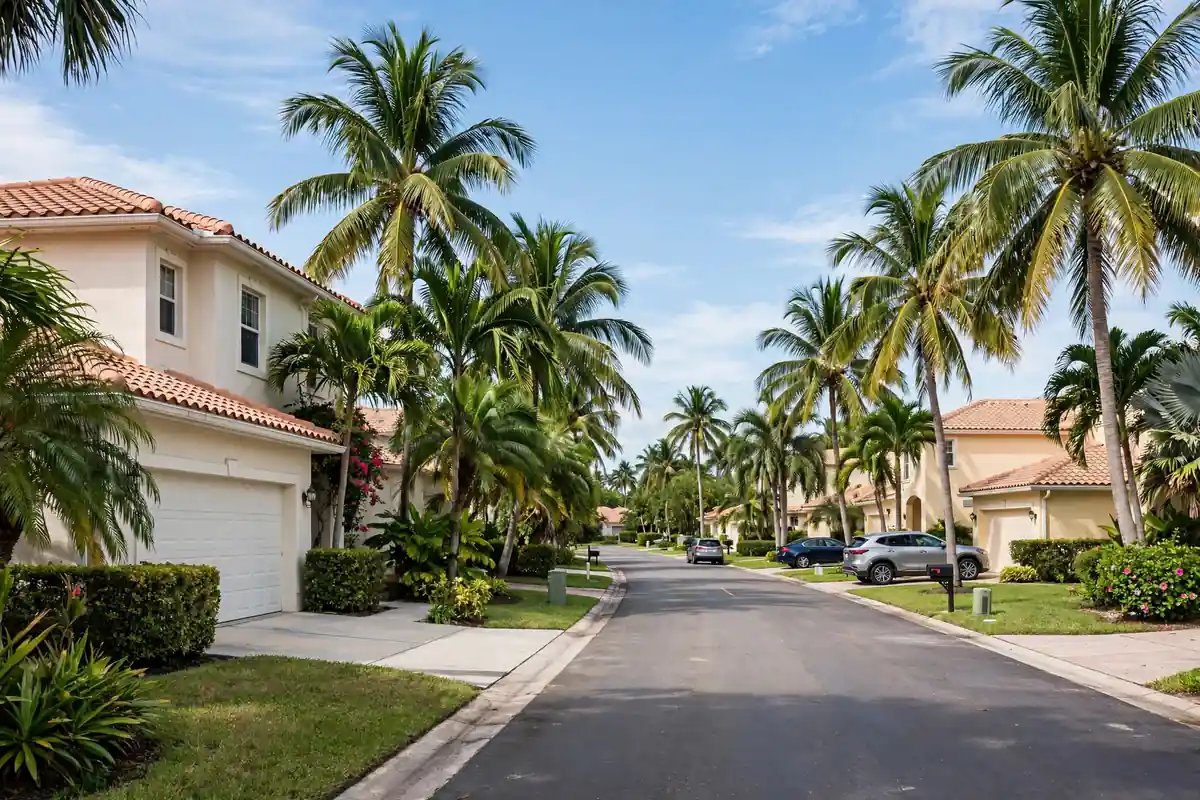
In short: Central Coconut Creek (33063) sits inside the planned 'Butterfly Capital of the World,' where 1980s–2000s townhome, villa, and condo communities — Regency Lakes, Banyan Trails — make up the housing stock. Calls here skew to inspection and maintenance: 1990s–2000s PVC laterals rarely need replacement, but 30-year canopies send roots into joints. Call (833) 713-2101.
Area Facts
- Area
- Coconut Creek, FL
- ZIP
- 33063
- Housing
- 1980s–2000s townhome/villa/condo communities (Regency Lakes, Banyan Trails)
- Pipe stock
- PVC era (1990s–2000s); cast-iron mixes on late-1980s transition builds
- Water table
- 2–6 ft in sandy flat terrain
- Landmarks
- Tradewinds Park & Stables, 'Butterfly Capital of the World' identity, Broward College North Campus
Coconut Creek was incorporated in 1967 as a planned city, and ZIP 33063 shows the plan working: orderly townhome and villa communities — Regency Lakes, Banyan Trails — built from the 1980s through the 2000s on slab-on-grade pads, with the Tradewinds Park wetlands holding seasonal water nearby and the city's famous 'Butterfly Capital of the World' identity woven into its landscaping. Broward College North Campus anchors the educational side. The sewer profile here is the youngest in the batch. Laterals from the 1990s and 2000s are PVC-era pipe — the material transition that Broward builders completed by the late 1980s — so full pipe replacement is the exception, not the rule: PVC does not corrode, does not scale shut, and does not deform with age. The exceptions cluster on the late-1980s transition builds, where original cast-iron segments can still be in service, now approaching 40 years and entering the window where joints open and scale builds. The villa and townhome communities here were built around shared lakes and preserve edges — the Tradewinds Park wetlands to the north and the city's butterfly-garden landscaping standards — which means irrigation is constant and soils rarely dry out, keeping lateral joints in the moisture zone that roots prefer.
What keeps Sewer Line Repair Crew busy in 33063 is not pipe age but the canopy and the water table. Thirty years of ficus, live oaks, and tropical plantings have grown into mature root systems that straddle laterals in these communities, and in sandy flat soil with a 2–6 ft water table, joints stay wet enough year-round for roots to keep hunting them — the Tradewinds Park wetlands nearby keep the seasonal water table on the high side of that range. The typical call is a homeowner with slow drains that came back a few months after a cleaning, and the typical answer is camera-verified root cutting on a maintenance rhythm, plus relining for any joint that refuses to stay clear. Because these are individual homeowners rather than association boards, the sale is one conversation with documented footage, not a committee vote — the technician shows the footage the same day, the homeowner approves the cutting schedule or the reline segment, and the work is scheduled while the camera is still warm. The crew's 33063 reports note pipe material by section, because the late-1980s transition builds hide cast-iron segments among PVC runs — and the maintenance plan treats those segments as reline candidates while the PVC gets the cutting schedule.
How Sewer Work Changes in Coconut Creek
The planned-community layout is itself a sewer factor, and it cuts both ways. Slab-on-grade pads are universal in 33063, which means every lateral runs shallow under the slab edge and the yard — good for camera access, since the cleanout-to-main run is short and readable, but bad for roots, because there is no deep burial to slow them down. During the mid-May to mid-October rainy season, soils around joints are saturated and infiltration finds any crack that roots have opened. The pairing matters because it is a loop: wet soil feeds roots, roots open joints, open joints admit groundwater, and the admitted groundwater keeps the soil wet. Only a sealed liner or a disciplined cutting schedule breaks it — and the camera is what tells the homeowner which joints are in the loop, so the maintenance money goes to the right footage of pipe instead of to blind repeat cleanings. Community irrigation schedules, set by the associations for the shared landscaping, run year-round — so unlike the seasonal root pressure in older neighborhoods, 33063's roots never get a dry season to slow them down.
The second factor is the decision chain, which is the mirror image of the 55+ association markets in neighboring ZIPs. In 33063 the caller is the homeowner, the footage is shown the same day, and a root-intrusion maintenance plan or a single reline segment can be approved in one visit — no board packet, no reserve-study cycle, no 44-HOA routing like Wynmoor Village in 33066. That simplicity is why inspection-led service works so well here: the written findings go straight to the person who signs, and the recommendation is sized to what the camera actually found — cutting, jetting, a reline segment, or nothing at all. Sewer Line Repair Crew's 33063 visits are built for that single-decision-maker reality: arrive, camera, show, decide, schedule. The whole engagement often fits inside one appointment, which is exactly what a homeowner market rewards. That single-decision-maker speed also means the crew can bundle the camera survey with the first cutting in one appointment when the footage shows active intrusion — the homeowner approves both from the same screen.
Services Available in Coconut Creek
In 33063 the services that matter most are camera inspections with written findings delivered same-day to the homeowner, root-intrusion cutting with before-and-after documentation on a maintenance rhythm matched to the 30-year canopy, and preventative hydro-jetting on the 1990s–2000s PVC laterals that will outlast their owners if maintained. Where late-1980s transition builds still carry cast-iron segments, trenchless CIPP relining seals those joints against both roots and groundwater infiltration without disturbing the community landscaping — the camera maps exactly where the cast iron remains so the liner covers the right footage. Open-cut replacement is reserved for the rare collapsed or severely bellied section, and it is quoted with the shallow water table and slab foundations accounted for in the dewatering plan. Nothing is sold that the footage does not support. Seasonal pre-rainy-season inspections are popular here: a May camera check before the mid-May to mid-October rains finds the joints the summer storms will exploit, so the cutting or relining happens before the backups do.
Sewer Services in Coconut Creek
Commercial Sewer Services
Coconut Creek, FL 33063
Learn moreEmergency Sewer Repair
Coconut Creek, FL 33063
Learn morePipe Bursting
Coconut Creek, FL 33063
Learn morePipe Lining
Coconut Creek, FL 33063
Learn moreSewer Camera Inspection
Coconut Creek, FL 33063
Learn moreSewer Leak Detection
Coconut Creek, FL 33063
Learn moreSewer Line Cleaning
Coconut Creek, FL 33063
Learn moreSewer Line Installation
Coconut Creek, FL 33063
Learn moreSewer Line Replacement
Coconut Creek, FL 33063
Learn moreSewer Maintenance
Coconut Creek, FL 33063
Learn moreTree Root Removal
Coconut Creek, FL 33063
Learn moreTrenchless Sewer Repair
Coconut Creek, FL 33063
Learn moreFrequently Asked Questions
My townhome in Regency Lakes was built in 1995. Could my sewer line really be failing?
Not failing from age — 1995 is solidly PVC era, and PVC does not corrode, scale, or deform. What it does suffer is root intrusion at joints and the occasional belly in sandy backfill: the 30-year ficus and live-oak canopy over these communities has had three decades to find every joint. If your drains keep slowing a few months after a cleaning, roots have found one. A camera inspection shows exactly which joint, the crew cuts it with before-and-after documentation, and a maintenance schedule — or a short trenchless liner for the joint that keeps re-intruding — ends the repeat visits.
Why do roots keep coming back after the plumber cleared them?
Because cutting without documentation is temporary: the root mass regrows into the same open joint, fed by the year-round moisture of the 2–6 ft water table. In 33063's mature communities, the fix is camera-verified cutting — the crew shows you the joint, cuts it, and re-cameras to confirm it is clear — on a rhythm matched to regrowth. And if the same joint re-intrudes twice, a short trenchless liner seals it permanently: roots cannot drink through a sealed pipe. The camera turns a recurring expense into a one-time fix.
Is the high water table in Coconut Creek damaging my sewer?
It enables the damage rather than causing it directly. A 2–6 ft water table — on the high side near the Tradewinds Park wetlands — keeps sandy soils wet around your lateral, which feeds root growth toward the joints; once a joint is open, groundwater infiltrates in. The water table is a given of the planned city's flat terrain. The controllable part is keeping joints sealed: relining for the joints that keep failing, and a cutting schedule for the ones that can be managed.
Do I need HOA approval for sewer work on my villa?
For work inside your property line — camera inspections, root cutting, a lateral reline — you are the decision-maker, not a board: the community's rules cover common areas and visible standards, not your underground lateral. If the work touches a common area or requires landscape restoration at the curb, the crew documents the plan and coordinates with the association. One call to (833) 713-2101 gets you the answer for your specific street, in writing if the community requires it.
How is 33063 different from the Wynmoor area of Coconut Creek?
Different buyer, different product, different pipe. Wynmoor's 55+ mid-rises in 33066 run through 44 HOAs and a master board with 40-year-old cast-iron stacks — an association reline market with committee approvals and phased programs. Your 33063 community is individual homeowners with younger PVC laterals: one decision-maker, camera inspections, root maintenance, decided in a visit or two. Same city, opposite service model.
What happens when I call Sewer Line Repair Crew?
A technician comes out, runs a camera from your cleanout to the street main, and shows you the footage with measurements — pipe material, joint locations, any intrusion or bellies, and exactly where the late-1980s cast iron remains if your build is transitional. You get written findings the same day, and the recommendation is sized to what the camera actually found: cutting, jetting, a reline segment, or nothing at all. Call (833) 713-2101 to start.
Don't Let a Sewer Problem Sit
Get connected with a trusted local specialist serving Coconut Creek and nearby areas — call anytime.
(833) 713-2101Call anytime · Real help, fast
Serving Coconut Creek, FL 33063