
In short: Sewer Leak Detection in Coconut Creek, FL 33063. The 55+ Wynmoor buildings are the money hook: 40+-year cast iron in occupied mid-rises where dig-access is impossible through occupied units — trenchless relining with master-association coordination Start with a call to (833) 713-2101 — a local specialist plans the visit.
Quick answer: For sewer leak detection in Coconut Creek 33063, call (833) 713-2101 today. A local specialist assesses the line, explains all available options clearly, and schedules the work promptly — emergency service available 24/7.
In Coconut Creek, sewer seep detection starts with reading the property: Planned city (inc. 1967) of 1980s–2000s townhome/villa/condo communities (Winston Park,..
Pipe materials here generally follow the construction era — PVC/cast-iron mixes; Wynmoor's 1978–88 buildings retain original cast-iron drain stacks. — so the technician verifies actual material on site prior to choosing a technique.
How Leak Detection Fits Coconut Creek's Planned Communities
The 55+ Wynmoor buildings are the money hook: 40+-year cast iron in occupied mid-rises where dig-access is impossible through occupied units — trenchless relining with master-association coordination is the only viable path, and each of the 44 HOAs has its own approval process, so the sales process must route through HOA boards. Sewer Leak Detection — Coconut Creek 33063.
Foundations here: Slab-on-grade essentially universal (planned-community pads). Drainage and soil play their part — Sandy flat terrain; C-14 (Cypress Creek) canal forms the northern border; water table 2–6 ft; Tradewinds Park wetlands nearby hold seasonal supply.
The 33063 Leak Profile: PVC-Era Pipes Under 30-Year Canopies
In Coconut Creek, sewer seep detection commonly starts with subtle clues: a water bill that climbs without explanation, an unusually green or fast-growing patch of lawn, or persistent musty or sewage odor near cleanouts or drains.
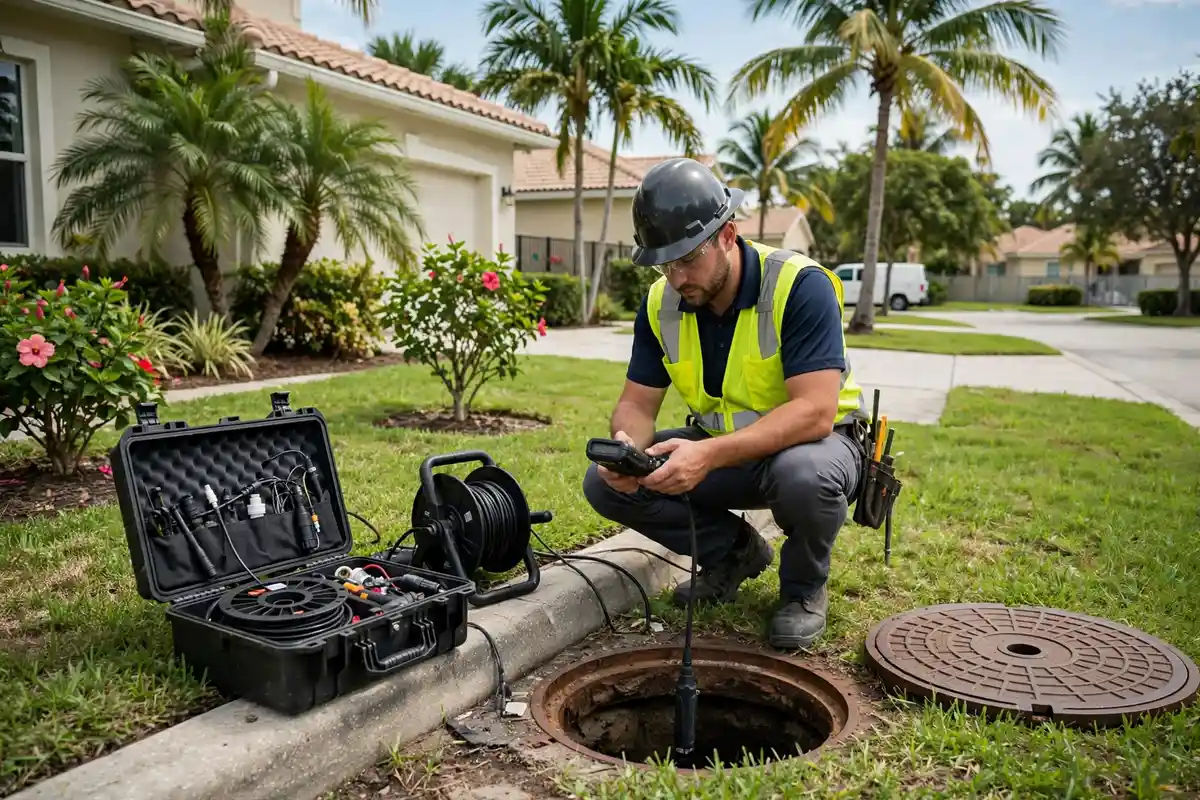
Expect symptom interview and site walk, camera inspection of the lateral, and acoustic listening for hidden leaks, sequenced to keep the property usable throughout.
How Sewer Leak Detection Works in Coconut Creek
Symptom interview and site walk
Call (833) 713-2101 and describe what you have noticed — bill changes, odors, wet spots, lush grass. Our technician walk Adapted here for slab-on-grade access and the high water table.
Camera inspection of the lateral
A camera run through the line is the backbone of seep detection. It shows cracks, separated joints, root entry points, a Planned around Coconut Creek soil and drainage conditions.
Acoustic listening for hidden leaks
Where the camera cannot reach or the line runs under the slab, acoustic listening equipment detects the distinct sound o Planned around Coconut Creek earth and drainage conditions.
Dye testing to confirm flow paths
Non-toxic tracing dye introduced at fixtures or cleanouts confirms which defects are actively leaking and where the flow Planned around Coconut Creek ground and runoff conditions.
Marked report and repair options
You receive a report with every leak point marked, photographed, and measured, plus the camera footage and an explanatio Planned around Coconut Creek soil and drainage conditions.
Keeping Sewer Leak Detection Lines Healthy in Coconut Creek
- Schedule a camera inspection before rainy season — May is ideal in Coconut Creek.
- Keep large trees' root zones away from the lateral path where possible.
- Watch for slow drains across multiple fixtures after heavy rain.
- Know where your cleanout is before an emergency hits.
- If your home predates 1980, ask about the pipe material at every visit.
The cheapest sewer drip detection is the one you never need: a spring camera inspection in Coconut Creek costs far less in hassle than an emergency dig in August mud.
Signs You Need Sewer Leak Detection in Coconut Creek
A water bill that climbs without explanation
When no fixture is running constantly and the bill still rises month after month, water is going somewhere unseen. A leaking sewer lateral i In Coconut Creek, this symptom often traces back to PVC/cast-iron mixes; Wynmoor's 1978–88 buildings retain orig.
An unusually green or fast-growing patch of lawn
Wastewater is fertilizer. A strip of grass along the sewer lateral's path that grows faster, greener, and lusher than the rest of the yard i Here in Coconut Creek, Planned city (inc. 1967) of 1980s–2000s townhome/villa/condo makes this sign worth quick attention.
Persistent musty or sewage odor near cleanouts or drains
A healthy sealed line does not smell. A cracked joint or broken section vents sewer gas at the surface — frequently noticeable near the cleanout Coconut Creek homeowners see this most throughout the May–October rainy stretch.
Soft, spongy, or sinking ground along the pipe's path
Sandy ground washed out by a steady drip loses its compaction, creating soft spots, sunken pavers, or small depressions that deepen over time. Here in Coconut Creek, Planned city (inc. 1967) of 1980s–2000s townhome/villa/condo makes this sign worth quick attention.
Foundation or slab moisture with no plumbing explanation
In slab-on-grade homes, a leaking under-slab line can push moisture up through the slab edge or into wall bases, showing as damp spots, effl Here in Coconut Creek, Planned city (inc. 1967) of 1980s–2000s townhome/villa/condo makes this sign worth quick attention.
Why 33063 Homeowners Benefit From Camera Inspections, Not Guesswork
The combination of Planned city (inc. 1967) of 1980s–2000s townhome/villa/condo communities (Winsto, Sandy flat terrain; C-14 (Cypress Creek) canal forms the northern., and the significant supply table creates a specific risk profile for sewer drip detection that differs from inland Florida.
Add PVC/cast-iron mixes; Wynmoor's 1978–88 buildings retain original cast-iron drain and the May–October rainy season, and sewer drip detection becomes a maintenance priority rather than a wait-and-see item for Coconut Creek property owners.
Leak Detection Across Coconut Creek's Planned Communities
Coconut Creek is a planned city — incorporated in 1967 — and the 33063 slice is its 1980s–2000s residential core: townhome, villa, and condo communities like Winston Park, Regency Lakes, and Banyan Trails on slab-on-grade pads in flat sandy terrain. The pipe story here is mostly the PVC era, which changes what leak detection means in practice: instead of hunting corroded cast iron, the camera looks for root intrusion at joints, bellied runs where sandy backfill has settled, and offset couplings from decades of minor ground movement. The mature landscaping planted when these communities were built — ficus and live oak canopies now 30-plus years old — is the dominant pressure on laterals across this ZIP.
The drainage geography sharpens the picture. The C-14 (Cypress Creek) canal forms the northern city border, the water table runs 2–6 feet, and the Tradewinds Park wetlands hold seasonal water just outside the neighborhoods — so after the mid-May to mid-October rainy season, groundwater sits high enough that a compromised joint shows active infiltration on camera. Detection work here is timed accordingly: a dry-season camera pass finds root balls and bellies, while a wet-season pass shows which joints are actually taking on water. That pairing is what separates a maintenance recommendation from an urgent repair, and it is the difference between a useful survey and an expensive shrug.
One Decision-Maker Per Lateral, Not a Board Vote
Unlike the Wynmoor association machine in neighboring 33066, most 33063 communities sell to individual homeowners — one decision-maker per lateral — which means detection findings go straight to the person who can approve the fix. The conversation is camera inspection and root-intrusion maintenance, not whole-building reline programs. For homeowners in the townhome and villa stock, the most valuable detection outcome is a mapped, located leak that lets a repair stay surgical: one spot, one joint, no exploratory digging. That is exactly what a good camera-plus-locator survey delivers in planned-community soil, and it is why 33063 rewards inspection-first service instead of emergency-first service.
Serving Coconut Creek and Nearby
Our coverage for sewer seep detection extends across Coconut Creek 33063 and the surrounding neighborhoods, with technicians who know the area ground, homes stock, and permit quirks.
Whether your property sits near the primary corridors or in a quieter subdivision of Coconut Creek, the same 24/7 line — (833) 713-2101 — reaches a area specialist. Sewer Leak Detection — Coconut Creek 33063.
Frequently Asked Questions
How fast can sewer leak detection be handled in Coconut Creek?
Call (833) 713-2101 and describe the problem — a local specialist serving Coconut Creek, FL 33063 will plan the visit. Emergency calls are prioritized day and night.
What kind of sewer pipes do Coconut Creek homes have?
PVC/cast-iron mixes; Wynmoor's 1978–88 buildings retain original cast-iron drain stacks. Pipe material here generally follows the home's construction era; the pro verifies on site ahead of recommending a repair technique.
Does the soil in Coconut Creek affect buried sewer lines?
Sandy flat terrain; C-14 (Cypress Creek) canal forms the northern. Sandy soil, the elevated supply table, and rainy-season saturation all influence buried lines and access planning here.
Do you serve Coconut Creek 33063?
Yes — we serve Coconut Creek, FL 33063 and surrounding neighborhoods. Exact coverage is confirmed when you call (833) 713-2101. Sewer Leak Detection — Coconut Creek 33063.
What should I mention when calling from Coconut Creek?
The house's age, the pipe piping if you know it, and where the problem shows. Planned city (inc. 1967) of 1980s–2000s townhome/villa/condo communities (Winston Park,.
Are foundations in Coconut Creek a factor?
Slab-on-grade essentially universal (planned-community pads). Most homes here sit on slab-on-grade, which shapes how lines are accessed throughout sewer seep detection.
Does rainy season change sewer leak detection in Coconut Creek?
May–October downpours saturate the soil and stress older lines, so timing and dewatering can matter. Elsewhere in Coconut Creek the 1980s–90s PVC stock shifts the pitch to root-intrusion camera inspections rather than line replacement
Which neighborhoods near Coconut Creek do you cover?
We cover Coconut Creek plus nearby areas across the Coconut Creek region — ring (833) 713-2101 to confirm your street. Sewer Leak Detection — Coconut Creek 33063.
Sewer Line Problems Don't Wait. Neither Should You.
Call now and get connected with a local sewer line specialist serving Coconut Creek, FL and nearby communities — 24/7.
(833) 713-2101Talk to a specialist now · Free call
Serving Coconut Creek, FL 33063