
Sewer Leak Detection in Coconut Creek, FL
A leaking sewer line can go unnoticed for months in sandy soil — until the water bill spikes, the yard sinks, or odors arrive. Sewer Line Repair Crew pinpoints the leak without tearing up your property. Call (833) 713-2101.
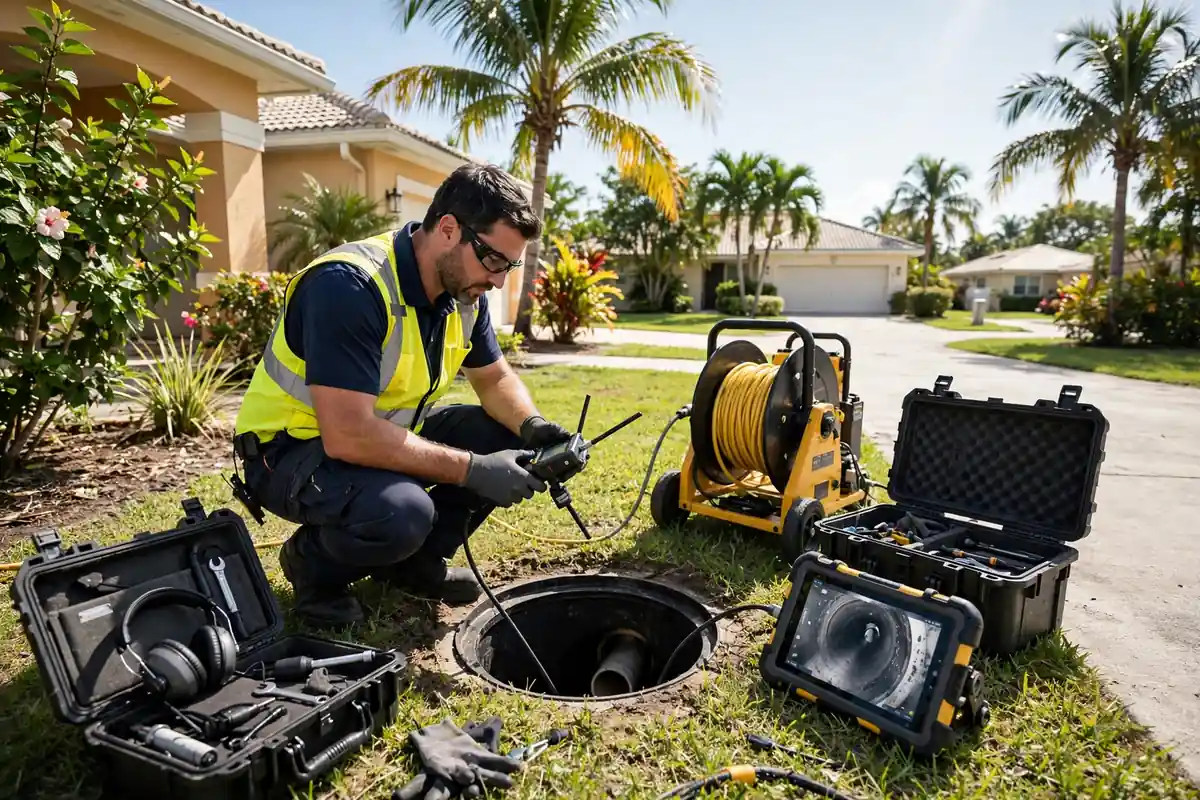
In short: Sewer leaks in Coconut Creek, FL 33066 hide easily in fast-draining sandy soil. This page explains how we find them — camera, acoustic listening, dye testing, and locators — without exploratory digging. Call (833) 713-2101 and we will track your leak to its exact source.
Sewer leaks are the quietest plumbing failure a home can have. Unlike a backup, which announces itself loudly, a leaking lateral quietly loses wastewater into the surrounding soil — sometimes for months — while the only clues are a climbing water bill, a suspiciously lush patch of grass, a faint odor near a cleanout, or a soft spot developing in the yard. In Coconut Creek's sandy soil, which drains almost as fast as the leak flows, the evidence washes away instead of pooling, so leaks here stay hidden longer than they would in clay country.
Finding the leak is a detective job, and it matters enormously where the detective looks. Digging exploratory trenches across a yard to hunt for a leak destroys landscaping and still might miss it; modern leak detection does the opposite, layering camera inspection, acoustic listening, dye testing, and electronic locating to converge on the leak's exact position before anyone picks up a shovel. Sewer Line Repair Crew approaches every suspected leak this way: prove where it is, prove what is causing it, and only then talk about repair — so the fix targets the real problem instead of the general area.
Signs You Need Sewer Leak Detection
A water bill that climbs without explanation
When no fixture is running constantly and the bill still rises month after month, water is going somewhere unseen. A leaking sewer lateral itself does not raise the water bill — but the supply-side leaks we rule out during detection do, and the dye and pressure tests in our process separate one from the other quickly.
An unusually green or fast-growing patch of lawn
Wastewater is fertilizer. A strip of grass along the sewer lateral's path that grows faster, greener, and lusher than the rest of the yard is feeding on a nutrient leak below. In South Florida's St. Augustine lawns, that contrast is often the first visible sign.
Persistent musty or sewage odor near cleanouts or drains
A healthy sealed line does not smell. A cracked joint or broken section vents sewer gas at the surface — often noticeable near the cleanout cap, along the lateral's path, or as a faint background odor in the yard after rain stirs the soil.
Soft, spongy, or sinking ground along the pipe's path
Sandy soil washed out by a steady leak loses its compaction, creating soft spots, sunken pavers, or small depressions that deepen over time. If the ground gives underfoot where the lateral runs, the soil below has been eroding for a while.
Foundation or slab moisture with no plumbing explanation
In slab-on-grade homes, a leaking under-slab line can push moisture up through the slab edge or into wall bases, showing as damp spots, efflorescence, or musty smells inside. When supply lines test tight, the sewer lateral becomes the prime suspect.
Rodent or insect activity concentrated in one area
Rats and insects follow the scent and moisture of a leaking sewer line, and a break in the pipe gives them an entry highway. A sudden pest concentration along one side of the house or yard often traces back to a compromised lateral — detection finds the breach they are using.
What Causes It
Sewer leaks in Coconut Creek start the way most local pipe failures start: joints opening in shifting sandy soil. Clay tile bell joints separate, cast-iron hub joints loosen with corrosion, and every gap becomes both an outward leak path for wastewater and an inward doorway for roots and groundwater. Fine cracks from soil settlement and age do the same on a smaller scale, weeping continuously rather than gushing — the kind of leak that persists for a year before anyone notices.
Two local factors make these leaks harder to catch. First, the sandy soil itself: it drains so freely that leaking wastewater percolates down and away instead of surfacing, hiding all but the most severe breaks. Second, the high water table during the May-to-October rainy season can mask a leak's symptoms — saturated ground everywhere makes one more wet spot invisible, and infiltration flowing into the pipe can even offset the outward leak. Effective detection here has to account for both, which is why we layer multiple methods instead of relying on any single test.
Our Step-by-Step Process
Symptom interview and site walk
Call (833) 713-2101 and describe what you have noticed — bill changes, odors, wet spots, lush grass. Our technician walks the property, notes the lateral's likely path from the house to the street, and looks for surface clues: depressions, green strips, cleanout condition, and pest activity.
Camera inspection of the lateral
A camera run through the line is the backbone of leak detection. It shows cracks, separated joints, root entry points, and breaks directly — and in many cases the camera alone identifies the leak. Every suspect defect is located with the sonar transmitter and marked on the surface with its depth.
Acoustic listening for hidden leaks
Where the camera cannot reach or the pipe runs under the slab, acoustic listening equipment detects the distinct sound of water escaping under pressure. This is especially valuable for under-slab sections in Coconut Creek's slab-on-grade homes, where the leak is completely invisible from the surface.
Dye testing to confirm flow paths
Non-toxic tracing dye introduced at fixtures or cleanouts confirms which defects are actively leaking and where the flow goes — whether wastewater is reaching the soil, surfacing elsewhere, or infiltrating where it should not. Dye turns suspicion into proof.
Marked report and repair options
You receive a report with every leak point marked, photographed, and measured, plus the camera footage and an explanation of what is causing each leak. Only then do we discuss repair: spot repair, lining, or bursting, matched to the leak's cause and location — never a trench dug on a hunch.
Equipment & Materials
- High-resolution CCTV cameras with sonar locating transmitters
- Acoustic leak-listening equipment with ground microphones
- Non-toxic tracing dyes for flow-path confirmation
- Electronic line locators for mapping the lateral's exact path
- Moisture meters for tracing dampness through slabs and walls
- Smoke-testing gear for finding vent and joint leaks that vent gas
Safety & Precautions
Leak detection is non-invasive by design, which makes it one of the safest services we perform — but wastewater exposure is still treated seriously. Technicians wear gloves and eye protection whenever cleanouts or access points are opened, and any standing water encountered during the investigation is treated as contaminated until proven otherwise. Dye testing uses only non-toxic, plumbing-safe tracing dyes that will not harm landscaping, pets, or the municipal system. If detection reveals an active sewage leak, we advise you on keeping people and pets away from the affected soil until the repair is complete, and we disinfect every tool that contacted wastewater.
Coconut Creek, FL Factors
Leak detection in Coconut Creek has to be built for sand. In heavier soils, a leaking lateral leaves a soggy, obvious trail; here, the water percolates straight down through sugar sand, so we lean harder on camera evidence, acoustic listening, and dye confirmation than on surface symptoms. The high water table complicates the picture further from May through October — saturated ground can hide a leak's wet signature entirely, and we time re-tests around dry spells when a leak's signal stands out. Slab-on-grade construction adds the under-slab dimension: many of the leaks we find run beneath the house itself, where only acoustic equipment and moisture tracing can reach. And in the 1960s–70s pockets with clay and Orangeburg laterals, we expect multiple small joint leaks along a run rather than one dramatic break — the report maps all of them so the repair addresses the whole pattern.
Sewer Leak Detection by Area
Boca Raton, FL 33486
Sewer Leak Detection
Learn moreBoca Raton, FL 33487
Sewer Leak Detection
Learn moreCoconut Creek, FL 33063
Sewer Leak Detection
Learn moreCoconut Creek, FL 33066
Sewer Leak Detection
Learn moreCoconut Creek, FL 33073
Sewer Leak Detection
Learn moreCoral Springs, FL 33065
Sewer Leak Detection
Learn moreCoral Springs, FL 33067
Sewer Leak Detection
Learn moreDeerfield Beach, FL 33441
Sewer Leak Detection
Learn moreDeerfield Beach, FL 33442
Sewer Leak Detection
Learn moreDelray Beach, FL 33484
Sewer Leak Detection
Learn moreFort Lauderdale, FL 33308
Sewer Leak Detection
Learn moreHillsboro Beach, FL 33062
Sewer Leak Detection
Learn moreLauderhill, FL 33313
Sewer Leak Detection
Learn moreMargate, FL 33063
Sewer Leak Detection
Learn moreMargate, FL 33068
Sewer Leak Detection
Learn moreNorth Lauderdale, FL 33068
Sewer Leak Detection
Learn moreOakland Park, FL 33309
Sewer Leak Detection
Learn moreParkland, FL 33076
Sewer Leak Detection
Learn morePompano Beach, FL 33060
Sewer Leak Detection
Learn morePompano Beach, FL 33064
Sewer Leak Detection
Learn moreTamarac, FL 33319
Sewer Leak Detection
Learn moreTamarac, FL 33321
Sewer Leak Detection
Learn moreFrequently Asked Questions
How can you find a leak without digging up my yard?
By layering methods: the camera sees cracks and breaks directly, the sonar locator marks their exact surface position, acoustic equipment hears leaks under slabs, and dye testing confirms active flow paths. Exploratory digging is the last resort we almost never need — call (833) 713-2101 and we will show you how the process works on your property.
My water bill went up. Does that mean my sewer line is leaking?
Not necessarily — a sewer leak lets water out after it has already been metered and used, so it does not raise the bill by itself. A rising bill usually points to a supply-side leak. Our detection process tests both sides, so one visit identifies whether the problem is supply or sewer.
Can a sewer leak make my family sick?
A leaking lateral releases wastewater into the soil around your home, where it can surface in the yard or attract pests that carry contamination indoors. It is not an immediate indoor emergency like a backup, but it is a health and environmental problem that should be repaired — and in sandy soil it spreads further than most homeowners expect.
How accurate is the location you mark?
Very. The camera's sonar transmitter is read from the surface to mark the defect's position, and we measure its depth at the same time. Repair crews work from those marks, which is why a detection-first approach means a small, targeted repair instead of a long exploratory trench.
Will the dye stain my fixtures or yard?
No. The tracing dyes we use are non-toxic, plumbing-safe, and designed to flush through the system without staining fixtures, and any surface traces dissipate quickly. They are the same class of dyes used by municipal utilities for system testing.
What happens after you find the leak?
You get a marked, photographed report with the camera footage and our explanation of the cause. Then we discuss the right repair for that specific leak — a spot repair for an isolated break, lining for joint and crack patterns, or bursting for a line that is failing along its length. The detection report is what makes the repair precise instead of approximate.
Sewer Line Problems Don't Wait. Neither Should You.
Call now and get connected with a local sewer line specialist serving Coconut Creek, FL and nearby communities — 24/7.
(833) 713-2101No obligation · Emergency help 24/7
Serving Coconut Creek, FL