
Trenchless Sewer Repair in Coconut Creek, FL
Trenchless sewer repair fixes or replaces your line without tearing up your yard — no trench through the driveway, no destroyed landscaping. Sewer Line Repair Crew are trenchless specialists. Call (833) 713-2101 to see what your line qualifies for.
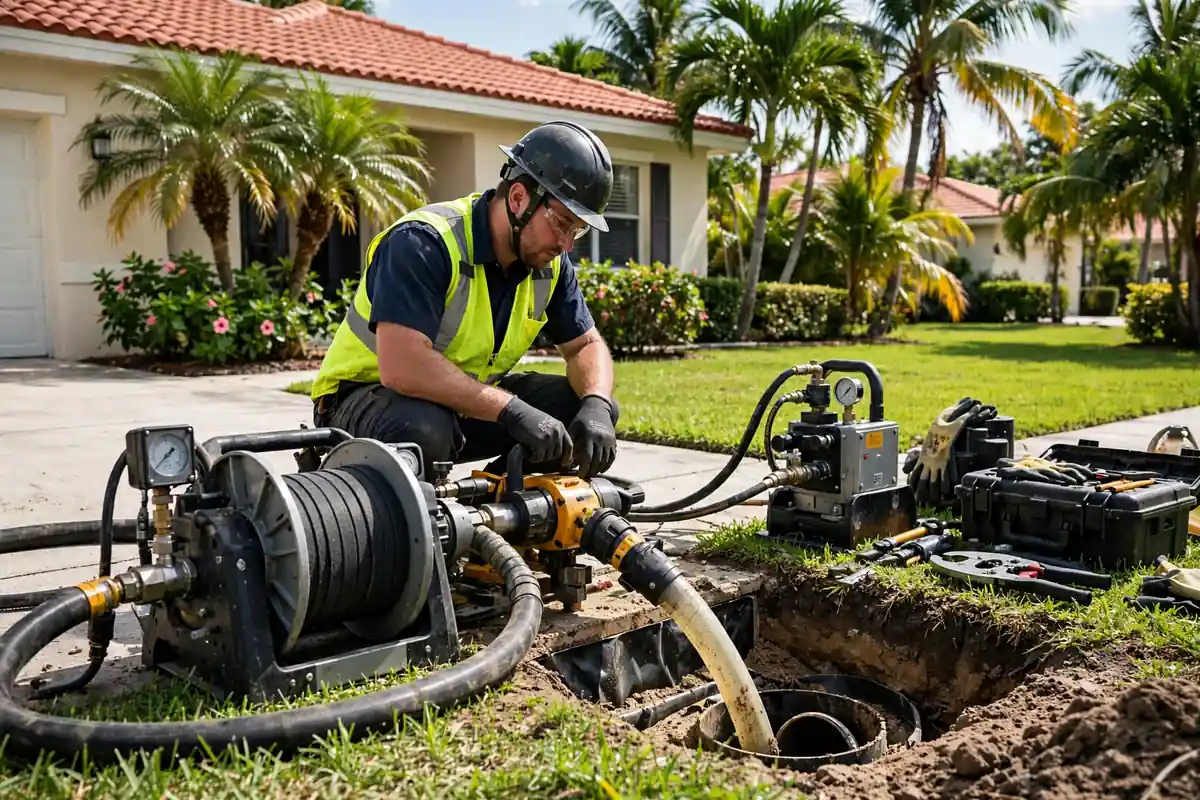
In short: This page explains trenchless sewer repair in Coconut Creek, FL 33063 — pipe lining, pipe bursting, and sectional repair without open trenches. Call (833) 713-2101 and we will camera-inspect your line and match it to the right trenchless method for your property.
Trenchless sewer repair is a family of methods that rehabilitate or replace an underground sewer line with little or no excavation. Instead of opening a trench along the pipe's entire path, trenchless techniques work through existing access points or small pits: pipe lining builds a new pipe inside the old one, pipe bursting fractures the old pipe outward while pulling a new one through, and sectional repairs fix isolated defects through a cleanout. The yard, driveway, pool deck, and landscaping above the line stay essentially untouched.
For Coconut Creek homeowners, trenchless is often the difference between a dreaded project and a manageable one. Sewer laterals here run under some of the most expensive square footage on the property — paver driveways, pool decks, mature tropical landscaping, HOA-maintained common areas — and open-trench replacement means destroying all of it and paying to rebuild it. Trenchless methods were developed precisely for this situation. But trenchless is not magic and not universal: the camera inspection determines which method your line qualifies for, and an honest contractor tells you when a line needs the trench. Sewer Line Repair Crew offers the full trenchless toolkit and the candor to match each line to the right method.
Signs You Need Trenchless Sewer Repair
Your line runs under expensive surfaces
Paver driveways, stamped concrete, pool decks, and mature landscaping make open-trench excavation brutally costly — the restoration often exceeds the pipe work. When the surface above the line is worth protecting, trenchless methods that work underground are the rational first look.
The camera shows damage a liner or burst can fix
Cracked pipe with shape intact qualifies for lining; collapsed or root-destroyed pipe with a followable path qualifies for bursting; a single bad joint qualifies for sectional repair. The camera footage is the qualification exam — and most damaged lines in Coconut Creek pass at least one of them.
You need the fix with minimal downtime
Trenchless projects typically complete in a day or two, versus a week or more for open-trench replacement with restoration. For households that cannot be without full plumbing for long — and for businesses that cannot close — that speed matters as much as the preserved landscaping.
An HOA restricts excavation in common areas
Many Coconut Creek HOA communities govern common-area landscaping strictly, and trenching through it can mean architectural review, restoration bonds, and months of process. Trenchless work through two small pits or existing access points sidesteps the entire ordeal.
You want a long-life fix, not a patch
Trenchless methods install genuinely new pipe — a structural CIPP liner or a continuous HDPE line — with service lives measured in generations. This is not a patch or a coating; it is a new pipeline built underground, which is why it suits homeowners planning to stay.
A previous contractor said trenching was the only option
Open-trench contractors recommend trenches. Before committing to destroying your yard, get a trenchless assessment: a camera inspection from a crew that actually performs lining and bursting. Call (833) 713-2101 for a second opinion grounded in footage, not habit.
What Causes It
The damage trenchless methods repair comes from the same local causes as every Coconut Creek sewer failure: clay tile joints separating in sandy soil, cast iron corroding and scaling from the inside, Orangeburg deforming and collapsing, and ficus, live oak, and royal palm roots exploiting every opening — all accelerated by the high water table and the May-to-October rainy season. Trenchless methods do not change what caused the damage; they change how the damage gets fixed.
What determines the trenchless method is the damage's character, which is why the camera inspection is non-negotiable. A pipe with cracks and separated joints but intact shape is a lining candidate — the liner needs a host to press against. A pipe that has lost its shape — collapsed, crushed, or root-destroyed along its length — is a bursting candidate, since bursting only needs a path to follow. An isolated defect in an otherwise sound line is a sectional repair. Matching method to damage is the entire discipline of trenchless work, and getting it wrong is how trenchless projects fail.
Our Step-by-Step Process
Trenchless qualification inspection
Call (833) 713-2101 to start. We run a full camera inspection with sonar locating — pipe material, diameter, depth, defect map — and determine which trenchless methods your line qualifies for. Lining, bursting, sectional repair, or, honestly, open trench: the footage decides.
Method selection with you
We lay out the qualifying methods, explain the trade-offs in plain language — what each installs, how long it takes, what access it needs, what it cannot do — and you choose with full information. No method is presented as the answer before the camera has spoken.
Access preparation
For lining and sectional repair: the line is cleaned and descaled through existing cleanouts, with no excavation at all. For bursting: two small pits are excavated at the ends of the run. Either way, the surface between access points is left alone.
The trenchless installation
Lining: the resin-saturated liner is inserted, inflated, and cured into a new structural pipe inside the old one. Bursting: the hydraulic head fractures the old pipe outward while new HDPE pipe follows into the path. Sectional repair: a short liner is placed precisely over the isolated defect and cured.
Verification and restoration
A post-installation camera run verifies the new pipe end to end — you see the finished work on the monitor. Access pits are backfilled and restored, branch connections are reinstated robotically where lining covered them, and you receive the before-and-after footage.
Equipment & Materials
- CIPP lining systems: liners, epoxy resins, inversion and curing equipment
- Hydraulic pipe-bursting rigs with heads for every residential diameter
- Sectional repair packers for isolated defect rehabilitation
- CCTV cameras for qualification, guidance, and verification
- Hydro jetting and descaling equipment for pre-liner preparation
- Robotic reinstatement cutters for branch connections
Safety & Precautions
Trenchless work's biggest safety advantage is what it does not do: no long open trenches across the property. Where pits are needed for bursting, they are shored or sloped in sandy soil, barricaded and covered when unattended. Lining work brings chemical safety discipline — ventilation during resin handling and curing, chemical-rated protective gear for technicians, and containment of all resin waste. Throughout every trenchless project, underground utilities are located before any ground is broken, work zones are kept clear during hydraulic pulls, and wastewater hygiene — protective gear, disinfection, no discharge to lawns or storm drains — is observed exactly as in open-trench work.
Coconut Creek, FL Factors
Trenchless repair might as well have been invented for Coconut Creek's lots. The city's homes sit on slabs with laterals running under driveways, paver walkways, pool decks, and mature tropical plantings — the exact surfaces that make open-trench replacement punishing. Our housing stock supplies ideal trenchless candidates in bulk: 1960s–70s clay tile with separated joints (classic lining jobs), Orangeburg and collapsed clay (classic bursting jobs), and 70s–90s cast iron with scale and cracks (lining after descaling). The sandy soil and high water table that destroy old pipe also argue for trenchless: every open trench here is a dewatering project from May through October, while lining and bursting happen entirely within the pipe's own environment. And in the HOA communities woven through the city, trenchless is frequently the only method that can proceed without a lengthy architectural review over torn-up common areas.
Trenchless Sewer Repair by Area
Boca Raton, FL 33486
Trenchless Sewer Repair
Learn moreBoca Raton, FL 33487
Trenchless Sewer Repair
Learn moreCoconut Creek, FL 33063
Trenchless Sewer Repair
Learn moreCoconut Creek, FL 33066
Trenchless Sewer Repair
Learn moreCoconut Creek, FL 33073
Trenchless Sewer Repair
Learn moreCoral Springs, FL 33065
Trenchless Sewer Repair
Learn moreCoral Springs, FL 33067
Trenchless Sewer Repair
Learn moreDeerfield Beach, FL 33441
Trenchless Sewer Repair
Learn moreDeerfield Beach, FL 33442
Trenchless Sewer Repair
Learn moreDelray Beach, FL 33484
Trenchless Sewer Repair
Learn moreFort Lauderdale, FL 33308
Trenchless Sewer Repair
Learn moreHillsboro Beach, FL 33062
Trenchless Sewer Repair
Learn moreLauderhill, FL 33313
Trenchless Sewer Repair
Learn moreMargate, FL 33063
Trenchless Sewer Repair
Learn moreMargate, FL 33068
Trenchless Sewer Repair
Learn moreNorth Lauderdale, FL 33068
Trenchless Sewer Repair
Learn moreOakland Park, FL 33309
Trenchless Sewer Repair
Learn moreParkland, FL 33076
Trenchless Sewer Repair
Learn morePompano Beach, FL 33060
Trenchless Sewer Repair
Learn morePompano Beach, FL 33064
Trenchless Sewer Repair
Learn moreTamarac, FL 33319
Trenchless Sewer Repair
Learn moreTamarac, FL 33321
Trenchless Sewer Repair
Learn moreFrequently Asked Questions
What is the difference between pipe lining and pipe bursting?
Lining builds a new pipe inside the old one and needs the old pipe to hold its shape; bursting destroys the old pipe and pulls a completely new one through its path, and can upsize the diameter. The camera inspection shows which your line qualifies for — call (833) 713-2101 and we will explain with your footage.
Is trenchless repair really permanent?
Yes. Trenchless installs genuinely new pipe — a structural cured-in-place liner or a continuous HDPE line — with multi-generational service life. It is not a patch, a coating, or a temporary sleeve; it is a new pipeline, built underground.
How much of my yard will be disturbed?
For lining and sectional repair: essentially none — all work happens through existing access points. For bursting: two small pits at the ends of the run. Compare that with open-trench replacement, which excavates the entire path, and the difference is the whole point.
Can every sewer line be fixed trenchlessly?
No, and honest contractors say so. Lines with severe bellies holding standing water, extreme offsets, or certain utility conflicts may need open trench. The camera inspection is what separates trenchless candidates from trench cases — never accept a trenchless quote, or a trenching verdict, without seeing the footage.
How long does a trenchless repair take?
Most residential trenchless projects finish in one to two days: lining cures in hours, bursting pulls complete in a day, with preparation and verification around them. Open-trench replacement of the same line typically takes a week or more including restoration.
Will trenchless work for a line under my pool deck?
Often yes — that is exactly the scenario trenchless methods were made for. Lining needs only cleanout access; bursting needs pits at the run's ends, which can usually be placed to avoid the deck. The camera and locator confirm the path before we commit, so the deck stays intact.
Fast Help for Sewer Line Trouble
Call now for a local sewer line specialist in the Coconut Creek area. No obligation, just answers.
(833) 713-2101Call anytime · Real help, fast
Serving Coconut Creek, FL