
Sewer Line Cleaning in Coconut Creek, FL
Slow drains, recurring clogs, and gurgling fixtures usually mean your sewer line needs a real cleaning — not another bottle of chemicals. Sewer Line Repair Crew clears lines right the first time. Call (833) 713-2101.
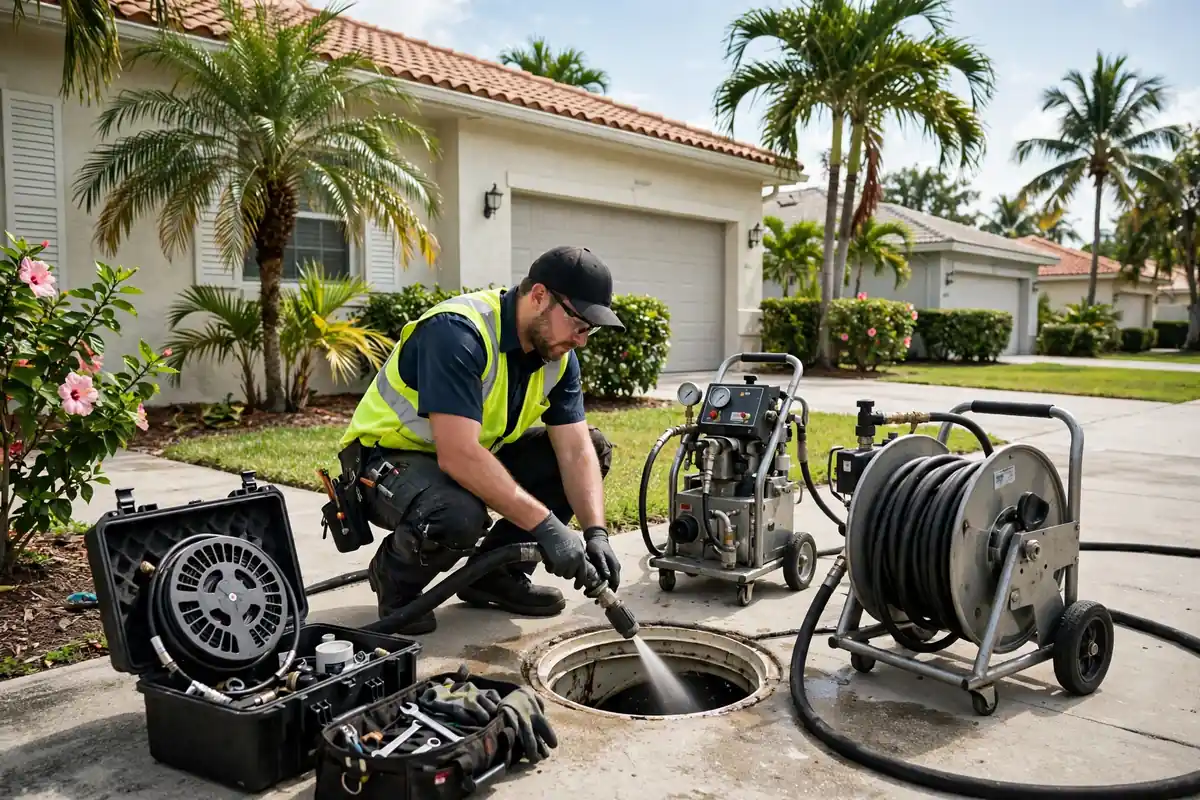
In short: This page covers professional sewer line cleaning in Coconut Creek, FL 33063 — hydro jetting, root cutting, and descaling that remove the actual cause of slow drains. Call (833) 713-2101 and we will diagnose your line, clean it thoroughly, and verify the result on camera.
Sewer line cleaning is the most misunderstood service in plumbing. Most homeowners picture a quick snake run — a cable punched through a clog, water flowing again, problem solved. Sometimes that is enough. But when the real problem is a wall of grease, a mat of ficus roots, or decades of scale inside cast iron, a cable only pokes a hole through the obstruction and the clog reforms within weeks. Professional sewer line cleaning removes the material causing the problem instead of just piercing it, and it ends with a camera verifying the pipe is actually clean.
In Coconut Creek, the case for real cleaning is strong. Commercial kitchens and busy households lay down grease that hardens into pipe-choking layers. Mature ficus, live oak, and royal palm roots invade clay tile joints every growing season. Cast iron lines from the 70s through the 90s accumulate internal scale that narrows them year by year. Hydro jetting — high-pressure water scours the full circumference of the pipe — addresses all three at once, stripping grease, slicing roots, and blasting scale off the walls. It is the difference between clearing a drain and restoring a pipe.
Signs You Need Sewer Line Cleaning
Drains slowing down throughout the house
When sinks, tubs, and toilets all drain slower than they used to, the restriction is in the shared line, not the fixtures. Grease films, scale, and early root intrusion narrow the pipe gradually — a thorough jetting restores the full diameter instead of just buying time.
Toilets that need double-flushing or plunge often
A toilet that struggles to clear its bowl is fighting backpressure from a downstream restriction. If plunging has become routine, the line downstream is telling you it is partially obstructed — cleaning removes the obstruction before it becomes a complete blockage.
Gurgling sounds from drains and toilets
Gurgling is air forcing its way past a partial blockage. It is the early-warning version of a backup: the line still passes water, but the passage is narrowing. Cleaning at the gurgling stage is routine; cleaning after the backup is urgent.
Foul odors rising from drains
Decomposing grease, trapped food solids, and biofilm coating the pipe walls produce the rotten, sour smells that air fresheners cannot fix. Jetting strips the organic layer off the walls, removing the odor at its source instead of masking it.
Water backing up into the lowest drain first
The tub, shower, or floor drain at the lowest point fills first when the main line restricts, because water seeks the lowest exit. If you have seen this even once, the line needs cleaning now — the next event may not stop at a warning.
It has been years since the line was cleaned
Sewer lines are out of sight and out of mind until they fail, and many Coconut Creek homes have laterals that have never been professionally cleaned in 30-plus years. Grease, scale, and roots do not pause for neglect — a preventive cleaning now is far cheaper than an emergency call later.
What Causes It
What clogs Coconut Creek sewer lines is a local recipe. Grease is the base: cooking fats washed down kitchen sinks cool and congeal on pipe walls, layer upon layer, until the line's diameter shrinks and food solids start catching. On top of that, roots: ficus, live oak, and royal palm roots enter through clay joints and cracks, forming fibrous mats that act like nets for paper and solids. And inside older cast iron, scale and tuberculation roughen the interior so that everything moving through snags and accumulates.
South Florida's conditions set the tempo. The year-round growing season means roots never go dormant — they invade in January as eagerly as in July. The May-to-October rainy season raises the water table and pushes groundwater into cracked joints, adding flow that stirs settled solids into moving clogs. Sandy soil lets joints shift and separate, creating the lips and offsets where debris catches. Cleaning removes the accumulation, but understanding these causes is what keeps it from coming straight back.
Our Step-by-Step Process
Diagnosis before cleaning
Call (833) 713-2101 and describe your symptoms. Where it helps, we run a camera first — because the cleaning method depends on the cause: grease needs jetting, heavy roots need cutting before jetting, and a collapsed section needs repair, not cleaning. We never sell a cleaning for a problem that cleaning cannot fix.
Access and line protection
Our technician works through your cleanout or an established access point, laying drop cloths and protecting the work area. Water supply is connected to the jetter, pressure is set for your pipe's material and condition — cast iron and Orangeburg get gentler treatment than PVC — and the line downstream is confirmed clear to receive the flushed debris.
Root cutting where needed
If the camera showed root masses, a motorized root cutter goes in first, chewing through the fibrous mats at the joints. This is a separate pass from jetting: the cutter removes the bulk root material so the jetter can then scour the walls clean behind it.
Hydro jetting the full line
The jetter nozzle travels the line under thousands of PSI, its rear-facing jets pulling it forward while forward and side jets blast grease, scale, and remaining root fibers off the full circumference of the pipe walls. Debris is flushed downstream to the municipal main. The pass is repeated until the discharge runs clear.
Camera verification and prevention advice
A final camera run proves the line is clean — you see the before and after on the monitor. We then explain what we found and how to slow its return: grease habits for kitchen-heavy homes, a root-maintenance schedule for root-prone lines, or a descaling interval for aging cast iron.
Equipment & Materials
- Truck-mounted hydro jetting units with adjustable pressure for every pipe material
- Specialized jetter nozzles: grease-cutting, root-slicing, and descaling heads
- Motorized root cutters for heavy root masses at clay joints
- CCTV cameras for pre-cleaning diagnosis and post-cleaning verification
- Heavy-duty cable machines for initial penetration of solid blockages
- Debris containment and wash-down gear to leave the work area clean
Safety & Precautions
High-pressure water demands respect, and so does wastewater. Our technicians wear waterproof protective gear, face shields, and gloves during jetting — a jetter stream can injure skin at close range, so the work zone is kept clear and nozzles are never handled while pressurized. Pressure is matched to the pipe: fragile Orangeburg and heavily scaled cast iron get settings that clean without damaging the host pipe. All flushed wastewater goes downstream to the municipal system, never onto lawns or into storm drains, and the work area is washed down and disinfected before we leave.
Coconut Creek, FL Factors
Sewer line cleaning in Coconut Creek is shaped by what grows here and what was built here. The ficus, live oak, and royal palm canopy sends roots into clay tile joints year-round — there is no dormant season for root intrusion in South Florida, so root cutting is a standing part of our cleaning work in the older neighborhoods. The 1970s-to-1990s cast iron still serving many homes scales from the inside in the constant humidity, and descaling is often the real fix behind a 'mystery' slow drain. During the May-to-October rainy season we schedule cleanings strategically: a freshly jetted line handles storm-driven groundwater infiltration far better than a line already half-choked with grease and roots, so pre-season cleaning is the smartest preventive move a homeowner here can make.
Sewer Line Cleaning by Area
Boca Raton, FL 33486
Sewer Line Cleaning
Learn moreBoca Raton, FL 33487
Sewer Line Cleaning
Learn moreCoconut Creek, FL 33063
Sewer Line Cleaning
Learn moreCoconut Creek, FL 33066
Sewer Line Cleaning
Learn moreCoconut Creek, FL 33073
Sewer Line Cleaning
Learn moreCoral Springs, FL 33065
Sewer Line Cleaning
Learn moreCoral Springs, FL 33067
Sewer Line Cleaning
Learn moreDeerfield Beach, FL 33441
Sewer Line Cleaning
Learn moreDeerfield Beach, FL 33442
Sewer Line Cleaning
Learn moreDelray Beach, FL 33484
Sewer Line Cleaning
Learn moreFort Lauderdale, FL 33308
Sewer Line Cleaning
Learn moreHillsboro Beach, FL 33062
Sewer Line Cleaning
Learn moreLauderhill, FL 33313
Sewer Line Cleaning
Learn moreMargate, FL 33063
Sewer Line Cleaning
Learn moreMargate, FL 33068
Sewer Line Cleaning
Learn moreNorth Lauderdale, FL 33068
Sewer Line Cleaning
Learn moreOakland Park, FL 33309
Sewer Line Cleaning
Learn moreParkland, FL 33076
Sewer Line Cleaning
Learn morePompano Beach, FL 33060
Sewer Line Cleaning
Learn morePompano Beach, FL 33064
Sewer Line Cleaning
Learn moreTamarac, FL 33319
Sewer Line Cleaning
Learn moreTamarac, FL 33321
Sewer Line Cleaning
Learn moreFrequently Asked Questions
What is the difference between snaking and hydro jetting?
Snaking punches a hole through a clog so water flows again; hydro jetting scours the entire inner circumference of the pipe, removing grease, scale, and root fibers from the walls. Snaking relieves the symptom, jetting removes the cause — which is why jetted lines stay clear far longer. Call (833) 713-2101 and we will recommend the right one for your situation.
Will hydro jetting damage my old pipes?
Not when it is done correctly. We camera-inspect first and set pressure for your pipe's material and condition — older cast iron, clay, and Orangeburg get appropriately gentler settings than modern PVC. If the camera shows a pipe too fragile for jetting, we tell you before any water flows.
How often should a sewer line be cleaned?
It depends on what your line collects. Grease-heavy households and restaurants benefit from annual or semi-annual jetting; root-prone lines near mature ficus or oaks do well on an annual root-cutting schedule; clean PVC lines with good habits may go years. Your post-cleaning camera footage tells us which category you are in.
Can you clean a line with heavy root intrusion?
Yes — that is one of jetting's strengths. We cut the root masses first with a motorized root cutter, then jet the line to scour the joint areas clean. For lines where roots return every year, we will also show you lining options that seal the joints permanently.
Do chemical drain cleaners work instead?
They rarely help main-line problems and they can damage pipes, harm septic systems, and create hazardous conditions for anyone who later works on the line. For a slow main sewer line, mechanical cleaning — cable or jetting — is the safe and effective answer.
Will I see proof the line is actually clean?
Yes. We finish every cleaning with a camera run that you can watch live, showing the cleaned pipe walls from end to end. Before-and-after footage is the difference between being told the line is clean and seeing it yourself.
Your Local Sewer Line Connection
Reach a Coconut Creek, FL sewer professional in one call — emergency service around the clock.
(833) 713-2101Speak with a local pro · No pressure
Serving Coconut Creek, FL