
Pipe Bursting in Coconut Creek, FL
Pipe bursting replaces your failed sewer line by fracturing the old pipe outward and pulling a brand-new HDPE line through the same path — a full replacement with only two small pits. Call Sewer Line Repair Crew at (833) 713-2101 to see if your line qualifies.
In short: If your Coconut Creek, FL 33066 sewer line is collapsed, root-destroyed, or undersized, pipe bursting installs a completely new pipe without trenching your whole yard. Call (833) 713-2101 and we will camera-inspect your line, confirm it is a bursting candidate, and walk you through the plan.
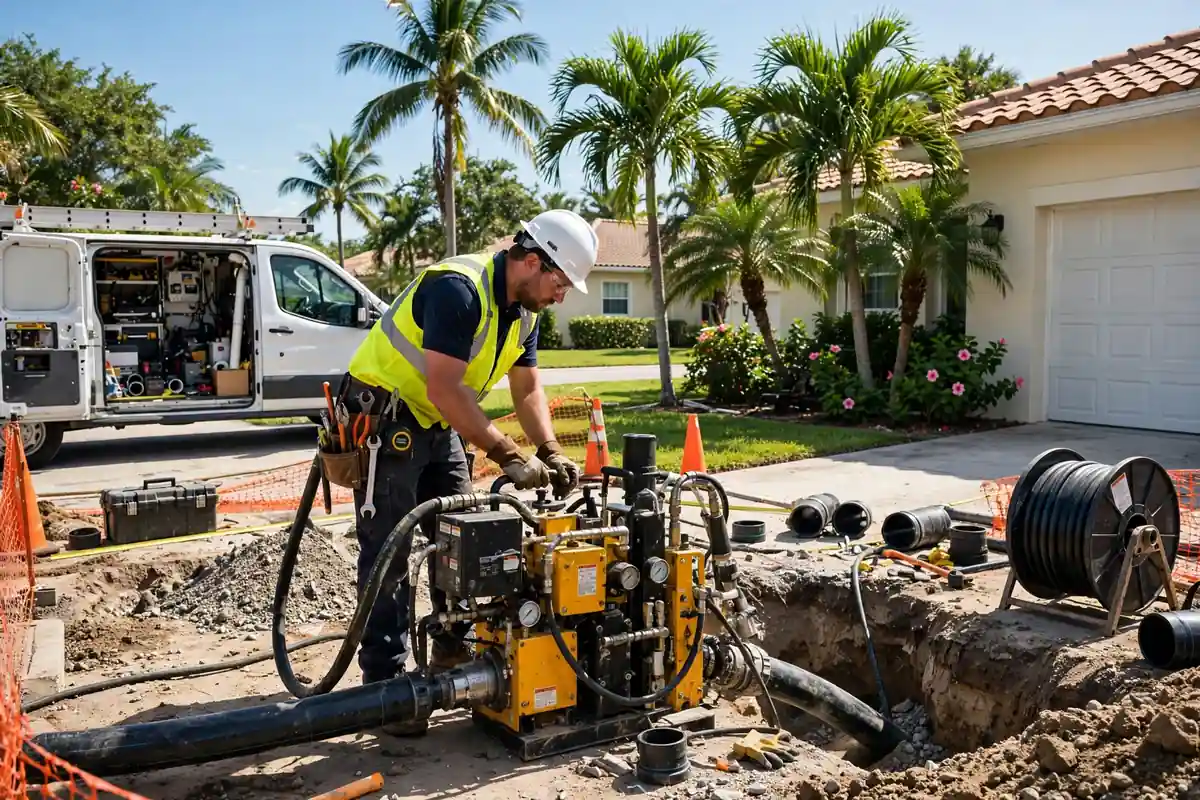
Pipe bursting is the trenchless answer to a sewer line that is too far gone to save. Instead of digging a trench along the entire length of the old pipe, a powerful bursting head is pulled through the existing line, fracturing the old pipe outward into the surrounding soil while a brand-new high-density polyethylene (HDPE) pipe follows directly behind it into the same path. When the pull is complete, you have a continuous, joint-free replacement line — and your driveway, landscaping, and patio are still standing.
This method shines exactly where Coconut Creek's older sewer lines fail. Clay tile lines from the 1960s and 70s with joints pried apart by ficus and live oak roots, Orangeburg pipe that has flattened or collapsed, and cast iron scaled shut from the inside are all ideal bursting candidates — the old pipe is destroyed in place, and the new HDPE line that replaces it is seamless, root-resistant, and rated to last for generations. Because the new pipe follows the old pipe's path, there is no re-routing, no re-grading, and no guessing about where the new line runs.
Signs You Need Pipe Bursting
Your line is collapsed or severely deformed
A camera inspection that shows flattened Orangeburg, crushed clay, or a section caved in by soil pressure means the pipe has no structural integrity left to rehabilitate. Bursting is made for this situation: the bursting head breaks the ruined pipe apart and the new HDPE line takes its place in a single operation.
Roots have destroyed the joints beyond repair
When camera footage shows root masses at every joint along a clay tile run, cutting them out is only temporary — the separated joints invite them right back. Bursting eliminates the joints entirely by replacing the whole run with one continuous pipe that roots cannot penetrate.
The pipe is undersized for the home
Some older Coconut Creek homes were built with 3-inch laterals that struggle with modern water use, especially when the rainy season adds groundwater infiltration. Bursting can upsize the line — pulling a larger-diameter HDPE pipe through the old pipe's path — restoring capacity the original line never had.
Repeat failures along the same run
If you have paid for spot repairs or root cutting on the same stretch of pipe more than once, the line is telling you it is done. Bursting replaces the entire problem run at once instead of chasing the next failure point down the line.
Lining was ruled out by the camera
Pipe lining needs a host pipe with enough shape left to hold a liner. When the camera shows missing sections, severe offsets, or collapse, lining is off the table — but bursting often still works, because it does not need the old pipe to hold anything. It just needs a path to follow.
You need a full replacement without a full trench
Driveways, pool decks, mature landscaping, and paver patios make open-trench replacement brutal in South Florida yards. Bursting needs only an entry pit and an exit pit — typically at the house and at the street or property line — leaving everything between them untouched.
What Causes It
Pipe bursting exists because certain pipes cannot be saved, and Coconut Creek has plenty of them. Orangeburg — the tar-paper pipe used in some mid-century homes — absorbs moisture over decades until it blisters, deforms, and collapses under soil load. Clay tile, common in 1960s and 70s installations, does not rot, but its bell-and-spigot joints shift in sandy soil, opening gaps that ficus and royal palm roots exploit until the joints separate completely. Cast iron from the 70s through the 90s corrodes from the inside out, building up scale until the pipe is a fraction of its original diameter.
South Florida's environment accelerates every one of these failures. Sandy soil provides little side support, so once a joint opens, the pipe keeps moving. The high water table and May-to-October rains add hydrostatic pressure and groundwater infiltration that stress weakened walls. And the region's aggressive root systems — ficus above all — treat every clay joint as an invitation. When these forces combine, the result is a line that cleaning cannot fix and lining cannot hold: the classic bursting candidate.
Our Step-by-Step Process
Camera inspection and bursting qualification
Everything starts with a camera run and a sonar locate. Call (833) 713-2101 to schedule it. We verify the pipe's material, diameter, depth, and path, confirm the damage type, and check for obstacles — sharp bends, unknown connections, or utilities crossing the line — that would rule bursting out. You see the footage and the locate marks before anything is decided.
Entry and exit pits are excavated
Two small pits are dug: one at the house end (usually near the foundation or cleanout) and one at the street, sidewalk, or property line where the lateral meets the main. Everything between the pits — lawn, driveway, landscaping — stays exactly as it is.
The bursting head and new pipe are set up
A steel cable or rod is threaded through the old line from pit to pit. The conical bursting head is attached at one end and the new HDPE pipe — fused into one continuous length with no joints — at the other. The HDPE is rated for decades of service and its smooth interior actually improves flow over the old pipe.
The pull fractures the old pipe and installs the new
Hydraulic power draws the bursting head through the old line, shattering clay, cast iron, or Orangeburg outward into the surrounding soil while the new HDPE pipe slides into the freshly opened path behind it. The operator monitors tension and progress continuously; a typical residential pull completes in hours, not days.
Connections restored and pits backfilled
The new line is connected to your home's plumbing at the house end and to the municipal main or septic tie-in at the street end, then pressure-tested and camera-verified. Both pits are backfilled, compacted, and restored as close to original condition as possible, and you get the final camera footage of your new line.
Equipment & Materials
- Hydraulic pipe-bursting rigs with calibrated pulling power
- Conical bursting heads sized to the old and new pipe diameters
- High-density polyethylene (HDPE) pipe, heat-fused into joint-free lengths
- CCTV cameras for pre-pull qualification and post-pull verification
- Sonar locators and utility detection gear for safe pit placement
- Compaction equipment for proper pit backfill and surface restoration
Safety & Precautions
Pipe bursting is powerful work done in tight spaces, so safety is engineered into every step. Pits are shored or sloped to prevent collapse in sandy soil, and both pits are barricaded and covered whenever the crew steps away — no open holes left accessible to kids, pets, or neighbors. Underground utilities are located and marked before any digging, because a gas or electric strike in South Florida's crowded utility corridors is the one accident that cannot happen. During the pull, the work zone is kept clear of everyone except the operator and spotters, and hydraulic equipment is inspected before every job.
Coconut Creek, FL Factors
Pipe bursting is a natural fit for Coconut Creek's lot layouts. Many homes here have long laterals running under driveways, paver walkways, and mature landscaping that would cost a fortune to trench and restore — bursting's two-pit approach was practically designed for these yards. The housing stock tells the rest of the story: 1960s–70s clay tile and Orangeburg pockets, 70s–90s cast iron, all sitting in shifting sandy soil with a high water table that punishes weakened pipe every rainy season from May through October. We also see strong bursting candidates in HOA communities, where tearing up common-area landscaping for a trench would need board approval and months of restoration — two discreet pits are a much easier conversation.
Pipe Bursting by Area
Boca Raton, FL 33486
Pipe Bursting
Learn moreBoca Raton, FL 33487
Pipe Bursting
Learn moreCoconut Creek, FL 33063
Pipe Bursting
Learn moreCoconut Creek, FL 33066
Pipe Bursting
Learn moreCoconut Creek, FL 33073
Pipe Bursting
Learn moreCoral Springs, FL 33065
Pipe Bursting
Learn moreCoral Springs, FL 33067
Pipe Bursting
Learn moreDeerfield Beach, FL 33441
Pipe Bursting
Learn moreDeerfield Beach, FL 33442
Pipe Bursting
Learn moreDelray Beach, FL 33484
Pipe Bursting
Learn moreFort Lauderdale, FL 33308
Pipe Bursting
Learn moreHillsboro Beach, FL 33062
Pipe Bursting
Learn moreLauderhill, FL 33313
Pipe Bursting
Learn moreMargate, FL 33063
Pipe Bursting
Learn moreMargate, FL 33068
Pipe Bursting
Learn moreNorth Lauderdale, FL 33068
Pipe Bursting
Learn moreOakland Park, FL 33309
Pipe Bursting
Learn moreParkland, FL 33076
Pipe Bursting
Learn morePompano Beach, FL 33060
Pipe Bursting
Learn morePompano Beach, FL 33064
Pipe Bursting
Learn moreTamarac, FL 33319
Pipe Bursting
Learn moreTamarac, FL 33321
Pipe Bursting
Learn moreFrequently Asked Questions
How do I know if my line qualifies for pipe bursting?
A camera inspection decides it. Bursting needs a followable path — collapsed, root-destroyed, undersized, or deformed pipe all qualify, while sharp unmarked bends or certain utility conflicts can rule it out. Call (833) 713-2101 and we will run the camera and give you a straight answer.
Is the new pipe really better than the old one?
Yes. The HDPE pipe we pull in is a single continuous length with no joints for roots to enter, a smooth interior that resists scale and grease buildup, and a service life measured in generations — a major upgrade over clay, Orangeburg, or scaled cast iron.
Can you make my sewer line bigger with bursting?
Often, yes. One of bursting's advantages is upsizing: the bursting head can open a path larger than the old pipe, so we can pull a larger-diameter HDPE line through. That is a real fix for older 3-inch laterals that cannot keep up with a modern household.
Will bursting damage my driveway or pool deck?
The bursting happens underground between the two pits, fracturing the old pipe outward into the soil. The surface between the pits is not excavated, so driveways, pool decks, and patios above the line stay intact. We verify the path with locators before the pull to keep it that way.
How long does a pipe bursting job take?
Most residential bursting projects complete the pull itself in a single day, with pits dug and restored around it. Larger or deeper commercial runs take longer, but the underground portion is still dramatically faster than trenching the same distance.
What happens to the old pipe?
It stays in the ground, fractured outward into the surrounding soil as the bursting head passes. The fragments are inert — clay, iron, or fiber shards dispersed in the earth — and the new HDPE line occupies the same path. Nothing needs to be hauled away.
Get a Local Sewer Specialist on the Line Now
One call connects you with a Coconut Creek-area sewer line professional. Day or night, we're ready to help.
(833) 713-2101Talk to a specialist now · Free call
Serving Coconut Creek, FL