
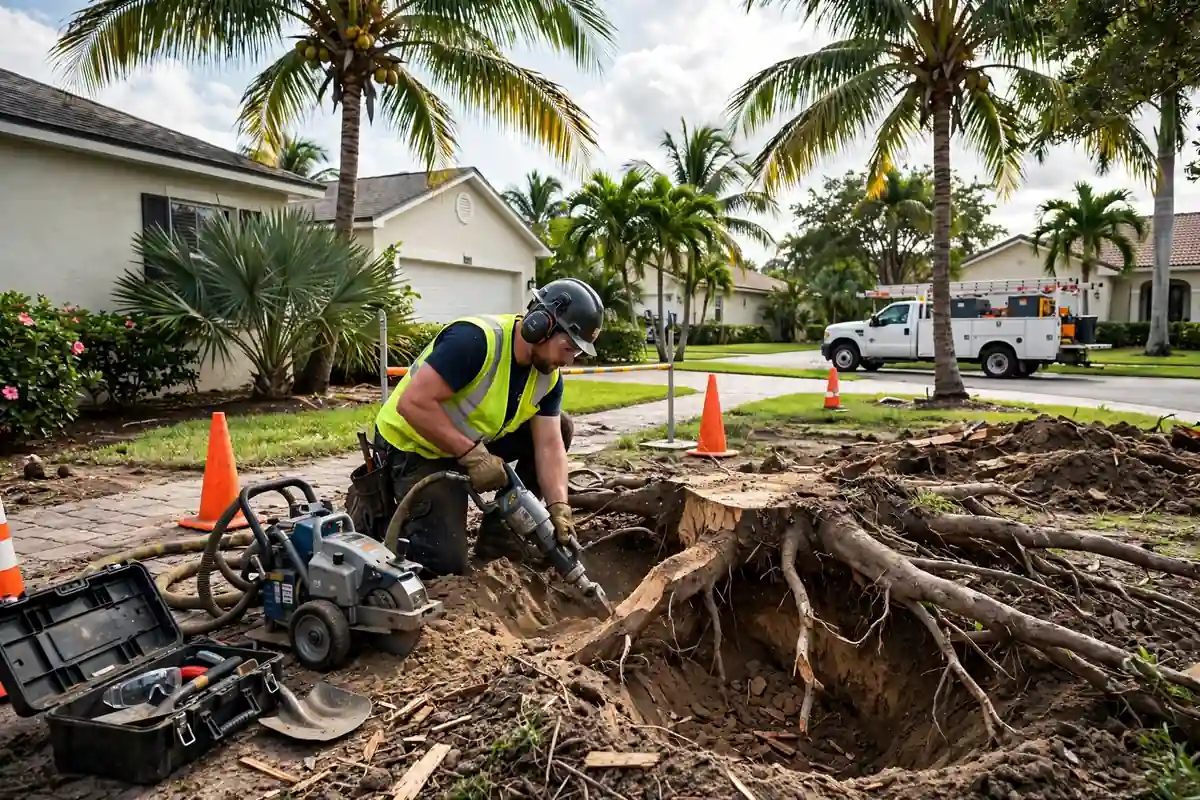
In short: Tree Root Removal in Coconut Creek, FL 33063. The 55+ Wynmoor buildings are the money hook: 40+-year cast iron in occupied mid-rises where dig-access is impossible through occupied units — trenchless relining with master-association coordination Start with a call to (833) 713-2101 — a local specialist plans the visit.
Quick answer: For tree root removal in Coconut Creek 33063, phone (833) 713-2101 today. A nearby specialist assesses the line, explains all available options clearly, and schedules the work promptly — emergency service available 24/7.
tree root removal in Coconut Creek is shaped by what's underground and what's overhead: Planned city (inc. 1967) of 1980s–2000s townhome/villa/condo communities (Winston Park,..
Since PVC/cast-iron mixes; Wynmoor's 1978–88 buildings retain original cast-iron drain stacks., the first job on site is confirming what stock is really installed, then matching the technique to it.
Planned Communities, Mature Canopy: Root Intrusion Across Coconut Creek 33063
The 55+ Wynmoor buildings are the money hook: 40+-year cast iron in occupied mid-rises where dig-access is impossible through occupied units — trenchless relining with master-association coordination is the only viable path, and each of the 44 HOAs has its own approval process, so the sales process must route through HOA boards. Tree Root Removal — Coconut Creek 33063.
Foundations here: Slab-on-grade essentially universal (planned-community pads). Runoff and soil play their part — Sandy flat terrain; C-14 (Cypress Creek) canal forms the northern border; water table 2–6 ft; Tradewinds Park wetlands nearby hold seasonal supply.
PVC Meets Cast Iron: Why Camera Diagnosis Comes First Here
In Coconut Creek, tree root removal often starts with subtle clues: backups that return every 6 to 18 months, the camera shows white fibrous masses at joints, or gurgling and slow runoff that worsens gradually.
The work typically runs through camera inspection mapping every intrusion, then mechanical root cutting, then hydro jetting to scour the joints — with access planned around slab-on-grade construction.
How Tree Root Removal Works in Coconut Creek
Camera inspection mapping every intrusion
Call (833) 713-2101 to start. We run a camera through the full lateral and map every root entry point — which joints, ho Sequenced to keep your Coconut Creek property usable throughout.
Mechanical root cutting
A motorized root cutter with the right head for your line — saw blades for heavy masses, chain flails for fibrous mats — Adjusted for rainy-season ground saturation common in Coconut Creek.
Hydro jetting to scour the joints
After cutting, hydro jetting flushes out every root fiber and scours the joint areas clean. This step matters: leftover Adapted here for slab-on-grade access and the elevated water table.
Permanent entry-point closure
With the line clear, we address the cause: pipe lining to seal every joint with a continuous, joint-free barrier; pipe b Adjusted for rainy-season soil saturation common in Coconut Creek.
Prevention schedule and monitoring
Even with sealed joints, we set a sensible monitoring rhythm — a camera re-inspect on an appropriate cycle, especially whe Sequenced to keep your Coconut Creek property usable throughout.
Keeping Tree Root Removal Lines Healthy in Coconut Creek
- Schedule a camera inspection before rainy season — May is ideal in Coconut Creek.
- Keep large trees' root zones away from the lateral path where possible.
- Watch for slow drains across multiple fixtures after heavy rain.
- Know where your cleanout is before an emergency hits.
- If your home predates 1980, ask about the pipe material at every visit.
The cheapest tree root removal is the one you never need: a spring camera inspection in Coconut Creek costs far less in hassle than an emergency dig in August mud.
Signs You Need Tree Root Removal in Coconut Creek
Backups that return every 6 to 18 months
The classic root signature: the line is cleared, everything works, and then — like clockwork — the backup returns. That cycle is regrowth, n Coconut Creek homeowners see this most during the May–October rainy stretch.
The camera shows white fibrous masses at joints
On camera, root intrusion is unmistakable: pale, hair-like fibers hanging from joints and cracks, sometimes grown into solid mats that fill Here in Coconut Creek, Planned city (inc. 1967) of 1980s–2000s townhome/villa/condo makes this sign worth quick attention.
Gurgling and slow drainage that worsens gradually
Roots do not block a line overnight; they narrow it week by week. Drains that were fine in spring and sluggish by fall, with gurgling that c In Coconut Creek, this symptom frequently traces back to PVC/cast-iron mixes; Wynmoor's 1978–88 buildings retain orig.
Problems concentrated near large trees
When the backup always involves the bathroom nearest the big ficus, or the camera finds the worst intrusion on the side of the yard under th In Coconut Creek, this symptom typically traces back to PVC/cast-iron mixes; Wynmoor's 1978–88 buildings retain orig.
Toilet paper and solids snagging without grease
A line that catches paper and solids even in a household careful about grease is generally a line with a fibrous obstruction. Root masses act In Coconut Creek, this symptom often traces back to PVC/cast-iron mixes; Wynmoor's 1978–88 buildings retain orig.
Why Coconut Creek’s 1980s–2000s Neighborhoods Need Root Maintenance
The combination of Planned city (inc. 1967) of 1980s–2000s townhome/villa/condo communities (Winsto, Sandy flat terrain; C-14 (Cypress Creek) canal forms the northern., and the high supply table creates a specific risk profile for tree root removal that differs from inland Florida.
Add PVC/cast-iron mixes; Wynmoor's 1978–88 buildings retain original cast-iron drain and the May–October rainy season, and tree root removal becomes a maintenance priority rather than a wait-and-see item for Coconut Creek property owners.
Why Coconut Creek’s Planned Landscaping Finds Every PVC Joint
Coconut Creek was a planned city from incorporation in 1967, and the landscaping went in with the plans. The ficus and live oaks shading Winston Park, Regency Lakes, and Banyan Trails are now thirty to forty years old — a full root network sitting over 1980s–2000s laterals in flat sandy soil. PVC does not fail the way cast iron does, but its joints are still joints, and in ground that stays wet from the C-14 canal along the northern border and the seasonal water held by Tradewinds Park wetlands nearby, roots find them. The water table here runs 2–6 feet, so laterals sit in moisture-rich sand for much of the year, exactly the conditions feeder roots are built to exploit.
The pipe stock in 33063 is mixed — PVC-era villas and townhomes alongside cast-iron runs from the late-1970s transition builds — which is why the camera inspection comes before any recommendation. Cutting roots out of a 1990s PVC lateral is a maintenance conversation; finding 1978-era cast iron under a mature canopy is a replacement conversation, and the footage tells you which one you are having. The mandatory subdivision HOAs here also shape the job: common-area cleanouts and landscape-protection rules mean the work is planned around the community’s calendar, not just the homeowner’s.
Wet-Season Growth Surges Near the Canal and Wetlands
From May through October, the combination of 60+ inches of annual rain and the Tradewinds Park wetlands holding seasonal water sends root growth into overdrive. Laterals near the C-14 corridor see the heaviest pressure, and backups that were a slow drain in April become a full stoppage by August. A pre-rainy-season camera check — May is the sweet spot — catches the intrusions while they are still fibrous mats, before they harden into the woody masses that need aggressive cutting heads and risk cracking older pipe.
Serving Coconut Creek and Nearby
Our coverage for tree root removal extends across Coconut Creek 33063 and the surrounding neighborhoods, with technicians who know the local earth, homes stock, and permit quirks.
Whether your property sits near the primary corridors or in a quieter subdivision of Coconut Creek, the same 24/7 line — (833) 713-2101 — reaches a nearby specialist. Tree Root Removal — Coconut Creek 33063.
Frequently Asked Questions
How fast can tree root removal be handled in Coconut Creek?
Call (833) 713-2101 and describe the problem — a nearby specialist serving Coconut Creek, FL 33063 will plan the visit. Emergency calls are prioritized day and night.
What kind of sewer pipes do Coconut Creek homes have?
PVC/cast-iron mixes; Wynmoor's 1978–88 buildings retain original cast-iron drain stacks. Pipe material here generally follows the residence's construction era; the specialist verifies on site prior to recommending a remedy approach.
Does the soil in Coconut Creek affect buried sewer lines?
Sandy flat terrain; C-14 (Cypress Creek) canal forms the northern. Sandy soil, the significant supply table, and rainy-season saturation all influence buried lines and access planning here.
Do you serve Coconut Creek 33063?
Yes — we serve Coconut Creek, FL 33063 and surrounding neighborhoods. Exact coverage is confirmed when you call (833) 713-2101. Tree Root Removal — Coconut Creek 33063.
What should I mention when calling from Coconut Creek?
The home's age, the piping material if you know it, and where the problem shows. Planned city (inc. 1967) of 1980s–2000s townhome/villa/condo communities (Winston Park,.
Are foundations in Coconut Creek a factor?
Slab-on-grade essentially universal (planned-community pads). Most homes here sit on slab-on-grade, which shapes how lines are accessed during tree root removal.
Does rainy season change tree root removal in Coconut Creek?
May–October downpours saturate the soil and stress older lines, so timing and dewatering can matter. Elsewhere in Coconut Creek the 1980s–90s PVC stock shifts the pitch to root-intrusion camera inspections rather than piping replacement
Which neighborhoods near Coconut Creek do you cover?
We cover Coconut Creek plus nearby areas across the Coconut Creek region — call (833) 713-2101 to confirm your street. Tree Root Removal — Coconut Creek 33063.
Fast Help for Sewer Line Trouble
Call now for a local sewer line specialist in the Coconut Creek area. No obligation, just answers.
(833) 713-2101Call anytime · Real help, fast
Serving Coconut Creek, FL 33063