
In short: Pipe Lining (CIPP) in Oakland Park, FL 33309. Oakland Park is the county's textbook infiltration case: the city itself documents 60-year-old clay with leaking joints below the supply table and is spending public money on CIPP lining of the C-1 ba Start with a call to (833) 713-2101 — a local specialist plans the visit.
Quick answer: For pipe lining (cipp) in Oakland Park 33309, call (833) 713-2101 today. A local specialist assesses the line, explains all available options clearly, and schedules the work promptly — emergency service available 24/7.
In Oakland Park, line lining (cipp) starts with reading the property: Working-class 1940s–60s single-family homes along the Dixie Hwy corridor and..
THE documented case — the City of Oakland Park's own.. That era profile is why technique selection waits for on-site verification here.
The City Already Chose CIPP — Your Lateral Can Follow
Oakland Park is the county's textbook infiltration case: the city itself documents 60-year-old clay with leaking joints below the supply table and is spending public money on CIPP lining of the C-1 basin — that public precedent is the sales lever (the city chose trenchless. Pipe Lining — Oakland Park 33309.
Foundations here: Slab-on-grade; some raised 1940s–50s stem-wall homes zone-wide. Drainage and soil play their part — Sandy; Middle River/Cypress Creek drainage; supply table 2–5 ft — and per the city report, most of the gravity system sits BELOW the water table,.
60-Year-Old Clay Below the Water Table: Oakland Park's Documented Crisis
In Oakland Park, piping lining (cipp) often starts with subtle clues: cracks and joint separations on camera, root intrusion that keeps coming back, or scale and corrosion narrowing cast iron.
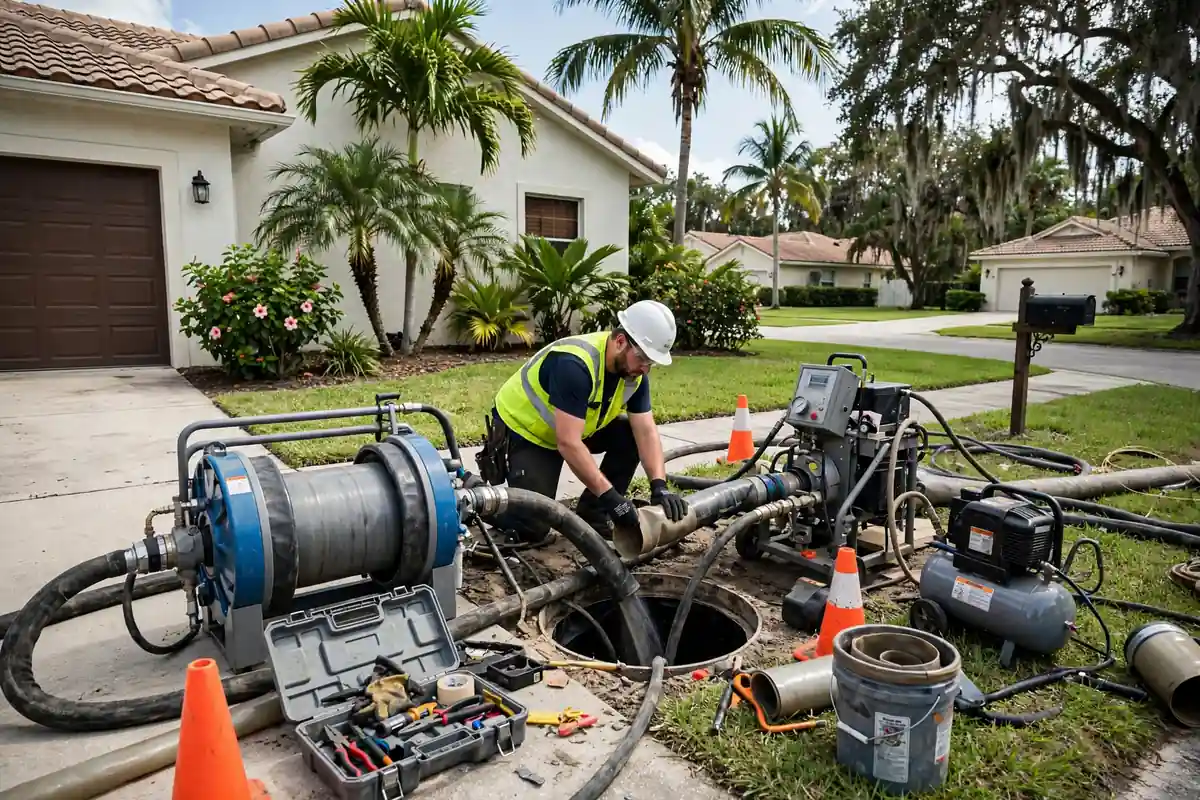
Camera inspection and liner qualification comes first, followed by thorough cleaning and descaling and liner preparation and insertion. Rainy-season ground saturation can add dewatering steps.
How Pipe Lining (CIPP) Works in Oakland Park
Camera inspection and liner qualification
Call (833) 713-2101 to start with a camera inspection. We measure the line's diameter, length, and depth, map every defe Adjusted for rainy-season soil saturation common in Oakland Park.
Thorough cleaning and descaling
A liner bonds most reliably to a clean host pipe, so the line is hydro-jetted and descaled first: roots cut, grease stri Adjusted for rainy-season soil saturation common in Oakland Park.
Liner preparation and insertion
The felt or fiberglass liner is cut to the exact length of the run and saturated with two-part epoxy resin. It is then i Sequenced to keep your Oakland Park property usable throughout.
Inflation and curing
The liner is inflated with air or water force, pressing it tightly against every contour of the old pipe. It then cur Adapted here for slab-on-grade access and the high water table.
Final camera verification and reinstatements
A post-cure camera run verifies a smooth, continuous liner with no wrinkles or gaps. Any branch connections covered by t Adjusted for rainy-season soil saturation common in Oakland Park.
Keeping Pipe Lining (CIPP) Lines Healthy in Oakland Park
- A pre-season inspection in April or May catches issues before saturation.
- Track drainage speed after storms — sudden changes mean call sooner.
- Landscaping over the lateral should stay shallow-rooted.
- Make sure every adult in the home knows where the cleanout is.
- Older clay or cast-iron lines deserve a camera look every couple of years.
The cheapest piping lining (cipp) is the one you never need: a spring camera inspection in Oakland Park costs far less in hassle than an emergency dig in August mud.
Signs You Need Pipe Lining (CIPP) in Oakland Park
Cracks and joint separations on camera
When a camera inspection shows cracked clay, separated joints, or fine fractures running along a cast-iron line, the piping is leaking at ever Oakland Park homeowners see this most during the May–October rainy stretch.
Root intrusion that keeps coming back
Cutting roots out of clay tile joints buys time, but the open joints invite them back within a season or two — especially with ficus and liv In Oakland Park, this symptom often traces back to THE documented case — the City of Oakland Park's own..
Scale and corrosion narrowing cast iron
Cast iron from the 70s and 80s builds up internal scale and tuberculation that chokes flow long before the line actually breaks. Following desca In Oakland Park, this symptom commonly traces back to THE documented case — the City of Oakland Park's own..
A sagging belly that still drains
A slight sag or belly in a sandy-soil line collects solids but may still pass water. If the camera shows the line holding its round shape th Here in Oakland Park, Working-class 1940s–60s single-family homes along the Dixie makes this sign worth quick attention.
Leaks staining soil or attracting roots
Damp soil around a buried line, or a camera showing infiltration at every joint throughout the rainy season, points to the line is leaking outward a In Oakland Park, this symptom commonly traces back to THE documented case — the City of Oakland Park's own..
Why Oakland Park Is the County's Textbook Infiltration Case
The combination of Working-class 1940s–60s single-family homes along the Dixie Hwy corridor and., Sandy; Middle River/Cypress Creek runoff; supply table 2–5 ft —., and the elevated supply table creates a specific risk profile for pipe lining (cipp) that differs from inland Florida.
Add THE documented case — the City of Oakland Park's own. and the May–October rainy season, and pipe lining (cipp) becomes a maintenance priority rather than a wait-and-see item for Oakland Park property owners.
The Public Precedent Is the Sales Lever
Oakland Park is the county's textbook infiltration case, and the documentation comes from the city itself. The city's own C-1 lift station basin report states that the majority of the gravity sewer system is vitrified clay pipe installed more than 60 years ago — with deteriorated, leaking joints, CCTV-confirmed cracks, severed segments, and shattered wyes. Most of that gravity system sits below the water table, so groundwater infiltrates into the pipes — the reverse of the usual leak story — overloading the lift stations. The city is spending public money on CIPP lining of the C-1 basin right now. That public precedent is the lever for every private lateral in 33309: the city chose trenchless for its own 60-year-old clay, and the clay under your slab is the same vintage with the same joint failures.
The housing stock tells the same story at private scale. Working-class 1940s–60s single-family homes along the Dixie Highway corridor and Andrews Avenue carry 1940s–50s clay tile plus cast iron; the 1960s added more cast iron; PVC arrived with the post-1970s builds, including the 1982 Lake Emerald Condominium. The Fat Village arts-district warehouses and the lake communities at Lake Emerald and North Andrews fill out a mixed-use grid drained by the Middle River and Cypress Creek, with the water table 2–5 feet down. Any open-cut work below that water table demands dewatering pumps as a matter of routine, and camera footage here shows standing groundwater inside the pipes — not just roots. Jaco Pastorius Park, the Dixie Highway corridor, Oakland Park Boulevard, and even the Funky Buddha Brewery sit over the same saturated grid where infiltration, not exfiltration, is the problem.
What Standing Groundwater in Your Lateral Means
When the camera shows water standing in the pipe at every joint, the lateral is not draining groundwater away — it is collecting it, joint by joint, and delivering it to the city main and the lift stations. That is the infiltration the city's C-1 report documents, and a cured-in-place liner is the direct answer: one continuous tube with no joints for groundwater to enter through. The inspection quantifies it first — infiltration rate joint by joint — so the homeowner sees the same evidence the city saw before it chose CIPP for the basin. In 33309, lining a lateral does not just fix a private pipe; it takes one more straw out of the overloaded public system, which is exactly why the city's precedent matters at the kitchen table as much as it does at city hall.
Serving Oakland Park and Nearby
Our coverage for piping lining (cipp) extends across Oakland Park 33309 and the surrounding neighborhoods, with technicians who know the local earth, properties stock, and permit quirks.
Whether your property sits near the primary corridors or in a quieter subdivision of Oakland Park, the same 24/7 line — (833) 713-2101 — reaches a nearby specialist.
Frequently Asked Questions
How fast can pipe lining (cipp) be handled in Oakland Park?
Phone (833) 713-2101 and describe the problem — a local specialist serving Oakland Park, FL 33309 will plan the visit. Emergency calls are prioritized day and night.
What kind of sewer pipes do Oakland Park homes have?
THE documented case — the City of Oakland Park's own. Line piping here generally follows the home's construction era; the specialist verifies on site prior to recommending a restore method.
Does the soil in Oakland Park affect buried sewer lines?
Sandy; Middle River/Cypress Creek runoff; supply table 2–5 ft —. Sandy earth, the high water table, and rainy-season saturation all influence buried lines and access planning here.
Do you serve Oakland Park 33309?
Yes — we serve Oakland Park, FL 33309 and surrounding neighborhoods. Exact coverage is confirmed when you ring (833) 713-2101. Pipe Lining — Oakland Park 33309.
What should I mention when calling from Oakland Park?
The home's age, the pipe stock if you know it, and where the problem shows. Working-class 1940s–60s single-family homes along the Dixie Hwy corridor and.
Are foundations in Oakland Park a factor?
Slab-on-grade; some raised 1940s–50s stem-wall homes neighborhood-wide. Most homes here sit on slab-on-grade, which shapes how lines are accessed amid pipe lining (cipp).
Does rainy season change pipe lining (cipp) in Oakland Park?
May–October downpours saturate the soil and stress vintage lines, so timing and dewatering can matter. Homeowners should too); private laterals of the same vintage clay suffer the identical joint failure, and any open-cut work below the supply table demands dewatering.
Which neighborhoods near Oakland Park do you cover?
We cover Oakland Park plus nearby areas across the Coconut Creek region — phone (833) 713-2101 to confirm your street.
Don't Let a Sewer Problem Sit
Get connected with a trusted local specialist serving Coconut Creek and nearby areas — call anytime.
(833) 713-2101Talk to a specialist now · Free call
Serving Oakland Park, FL 33309