
In short: Pipe Lining (CIPP) in Coral Springs, FL 33065. The city's engineered lot-runoff design is a double edge: silted 1960s swales in 33065 send surface supply ponding against slab edges, where it migrates under slabs and into cracked cast-iron bell joi Call (833) 713-2101 to describe the problem and get a local specialist.
Quick answer: For pipe lining (cipp) in Coral Springs 33065, call (833) 713-2101 today. A local specialist assesses the line, explains all available options clearly, and schedules the work promptly — emergency service available 24/7.
Every Coral Springs call for piping lining (cipp) begins the same way — understanding the home first: America's first master-planned city (1963): first-generation 1960s–70s single-family ranches along..
Piping materials here generally follow the construction era — 1960s–70s core = cast iron drains, some Orangeburg on earliest. — so the technician verifies actual material on site before choosing a method.
The 1965 Ranch Problem: Cast Iron Under Silted Swales
The city's engineered lot-runoff design is a double edge: silted 1960s swales in 33065 send surface water ponding against slab edges, where it migrates under slabs and into cracked cast-iron bell joints — camera inspections here must pair with a runoff-grade survey. Pipe Lining — Coral Springs 33065.
Foundations here: Slab-on-grade (planned-city pads), near-universal. Drainage and soil play their part — Sandy soils with engineered runoff swales; C-14 canal north, Cypress Creek canal network; water table 2–6 ft; older swales in 33065 silt up, causing lot-to-lot.
Orangeburg, Cast Iron, and Ponding Lots: Reading 33065’s Original Core
In Coral Springs, pipe lining (cipp) typically starts with subtle clues: cracks and joint separations on camera, root intrusion that keeps coming back, or scale and corrosion narrowing cast iron.
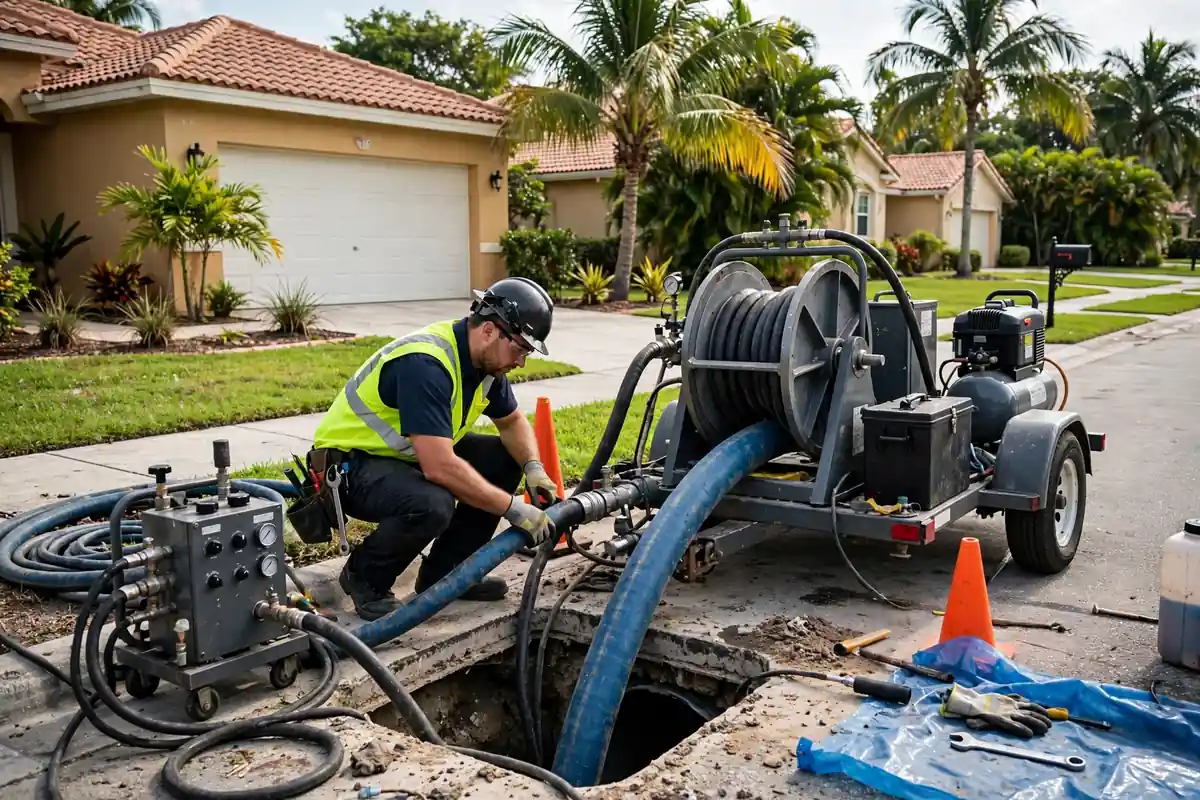
Expect camera inspection and liner qualification, thorough cleaning and descaling, and liner preparation and insertion, sequenced to keep the property usable throughout.
How Pipe Lining (CIPP) Works in Coral Springs
Camera inspection and liner qualification
Phone (833) 713-2101 to start with a camera inspection. We measure the line's diameter, length, and depth, map every defe Adjusted for rainy-season soil saturation common in Coral Springs.
Thorough cleaning and descaling
A liner bonds most reliably to a clean host pipe, so the line is hydro-jetted and descaled first: roots cut, grease stri Sequenced to keep your Coral Springs property usable throughout.
Liner preparation and insertion
The felt or fiberglass liner is cut to the exact length of the run and saturated with two-part epoxy resin. It is then i Adjusted for rainy-season ground saturation common in Coral Springs.
Inflation and curing
The liner is inflated with air or water force, pressing it tightly against every contour of the old pipe. It then cur Adjusted for rainy-season soil saturation common in Coral Springs.
Final camera verification and reinstatements
A post-cure camera run verifies a smooth, continuous liner with no wrinkles or gaps. Any branch connections covered by t Adapted here for slab-on-grade access and the significant supply table.
Keeping Pipe Lining (CIPP) Lines Healthy in Coral Springs
- A pre-season inspection in April or May catches issues before saturation.
- Track drainage speed after storms — sudden changes mean call sooner.
- Landscaping over the lateral should stay shallow-rooted.
- Make sure every adult in the home knows where the cleanout is.
- Older clay or cast-iron lines deserve a camera look every couple of years.
The cheapest pipe lining (cipp) is the one you never need: a spring camera inspection in Coral Springs costs far less in hassle than an emergency dig in August mud.
Signs You Need Pipe Lining (CIPP) in Coral Springs
Cracks and joint separations on camera
When a camera inspection shows cracked clay, separated joints, or fine fractures running along a cast-iron line, the pipe is leaking at ever Here in Coral Springs, America's first master-planned city (1963): first-generation makes this sign worth quick attention.
Root intrusion that keeps coming back
Cutting roots out of clay tile joints buys time, but the open joints invite them back within a season or two — especially with ficus and liv Coral Springs homeowners see this most amid the May–October rainy stretch.
Scale and corrosion narrowing cast iron
Cast iron from the 70s and 80s builds up internal scale and tuberculation that chokes flow long ahead of the pipe actually breaks. After desca Here in Coral Springs, America's first master-planned city (1963): first-generation makes this sign worth quick attention.
A sagging belly that still drains
A slight sag or belly in a sandy-earth line collects solids but may still pass water. If the camera shows the pipe holding its round shape th Coral Springs homeowners see this most throughout the May–October rainy stretch.
Leaks staining soil or attracting roots
Damp soil around a buried line, or a camera showing infiltration at every joint during the rainy season, means the pipe is leaking outward a Here in Coral Springs, America's first master-planned city (1963): first-generation makes this sign worth quick attention.
America's First Master-Planned City Has a First-Generation Pipe Problem
The combination of America's first master-planned city (1963): first-generation 1960s–70s single-fa, Sandy soils with engineered runoff swales; C-14 canal north, Cypress., and the high supply table creates a specific risk profile for line lining (cipp) that differs from inland Florida.
Add 1960s–70s core = cast iron drains, some Orangeburg on earliest. and the May–October rainy season, and line lining (cipp) becomes a maintenance priority rather than a wait-and-see item for Coral Springs property owners.
Silted Swales Send Water Where Pipes Cannot Take It
Coral Springs was America's first master-planned city, founded in 1963, and the 33065 core is its first generation: single-family ranches from the 1960s and 70s along Royal Palm Boulevard and University Drive. The pipe stock matches the era — cast-iron drains, with some Orangeburg on the very earliest builds. The city's engineered lot-drainage design is a double-edged sword here: the 1960s swales in 33065 have silted up over six decades, so rainy-season water ponds against slab edges instead of draining away, migrates under the slabs, and presses into cracked cast-iron bell joints. A camera inspection in this ZIP has to pair with a drainage-grade survey, because the pipe failure and the surface drainage failure are the same job wearing two hats.
Then there is the canopy. The live oaks and ficus planted in the 1970s have had fifty years to grow, and their roots now straddle laterals across the whole 33065 core — root intrusion is the dominant failure mode here, ahead of corrosion. The C-14 canal runs north, the Cypress Creek canal network drains the grid, the soils are sandy, and the water table sits 2–6 feet down. For pipe bursting versus lining, the triage is era-driven: Orangeburg that has gone oval or collapsed cannot take a liner and gets burst; cast iron that has held its round shape but lost its joints gets a cured-in-place tube. Either way the swale gets regraded in the same visit, because lining the pipe without fixing the ponding just schedules the next failure.
Lining vs. Bursting in the 33065 Core
The decision tree is short. Camera first: if the host pipe is round and continuous, CIPP seals every joint in one pull and the landscaping over Royal Palm Boulevard's older lots never gets touched. If the camera shows Orangeburg deforming or a cast-iron run with collapsed sections, pipe bursting pulls new pipe through the old path with only entry and exit pits. Both beat open-cut trenching across a 1960s lot, where the trench would cross the same silted swale that caused the problem. And both get specified alongside a drainage-grade correction — because in 33065, the pipe and the puddle fail together, and they get fixed together.
Serving Coral Springs and Nearby
Our coverage for pipe lining (cipp) extends across Coral Springs 33065 and the surrounding neighborhoods, with technicians who know the nearby ground, residences stock, and permit quirks.
Whether your property sits near the primary corridors or in a quieter subdivision of Coral Springs, the same 24/7 line — (833) 713-2101 — reaches a nearby specialist. Pipe Lining — Coral Springs 33065.
Frequently Asked Questions
How fast can pipe lining (cipp) be handled in Coral Springs?
Call (833) 713-2101 and describe the problem — a area specialist serving Coral Springs, FL 33065 will plan the visit. Emergency calls are prioritized day and night.
What kind of sewer pipes do Coral Springs homes have?
1960s–70s core = cast iron drains, some Orangeburg on earliest. Piping piping here generally follows the home's construction era; the technician verifies on site ahead of recommending a restore approach.
Does the soil in Coral Springs affect buried sewer lines?
Sandy soils with engineered runoff swales; C-14 canal north, Cypress. Sandy earth, the elevated water table, and rainy-season saturation all influence buried lines and access planning here.
Do you serve Coral Springs 33065?
Yes — we serve Coral Springs, FL 33065 and surrounding neighborhoods. Exact coverage is confirmed when you ring (833) 713-2101.
What should I mention when calling from Coral Springs?
The residence's age, the pipe material if you know it, and where the problem shows. America's first master-planned city (1963): first-generation 1960s–70s single-family ranches along.
Are foundations in Coral Springs a factor?
Slab-on-grade (planned-city pads), near-universal. Most homes here sit on slab-on-grade, which shapes how lines are accessed throughout piping lining (cipp).
Does rainy season change pipe lining (cipp) in Coral Springs?
May–October downpours saturate the soil and stress aging lines, so timing and dewatering can matter. Dense, mature canopy (live oaks, ficus) planted in the 1970s now straddles laterals → root-intrusion is the dominant failure mode in the 33065 core, while.
Which neighborhoods near Coral Springs do you cover?
We cover Coral Springs plus nearby areas across the Coconut Creek region — call (833) 713-2101 to confirm your street. Pipe Lining — Coral Springs 33065.
Don't Let a Sewer Problem Sit
Get connected with a trusted local specialist serving Coconut Creek and nearby areas — call anytime.
(833) 713-2101Call anytime · Real help, fast
Serving Coral Springs, FL 33065