
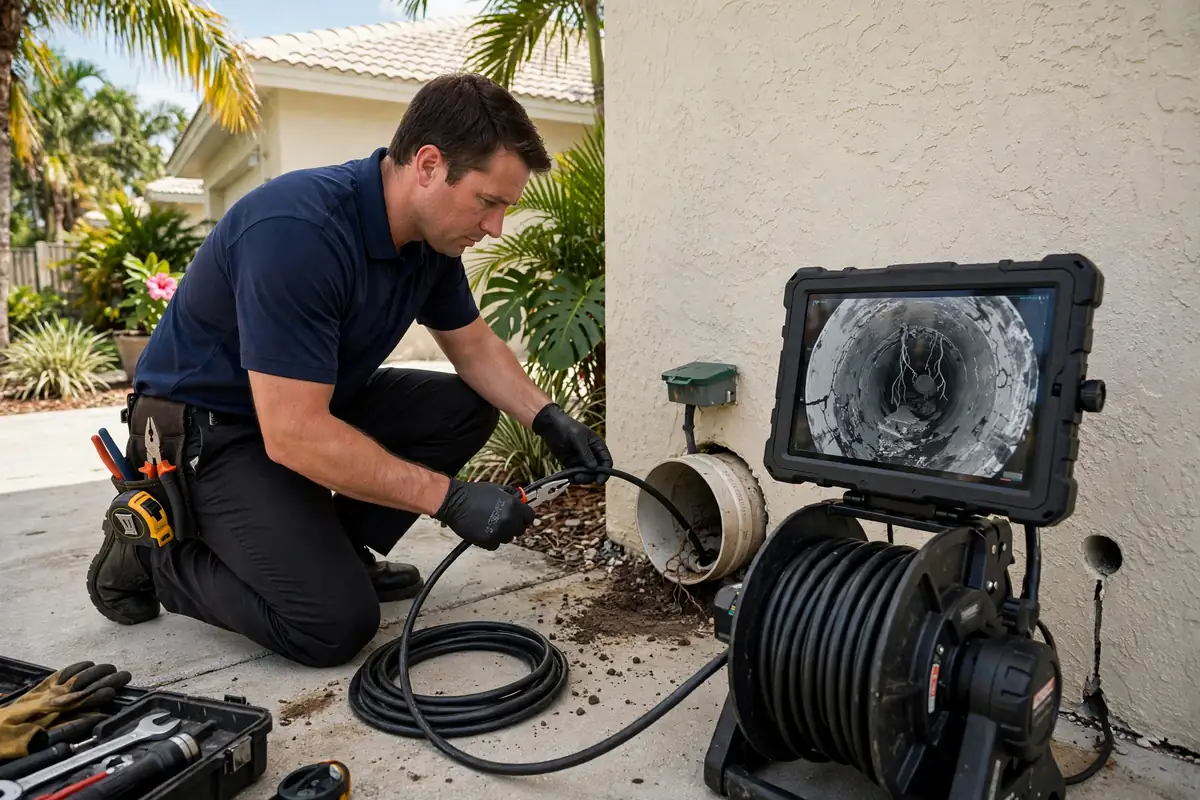
A sewer camera inspection is the closest thing the industry has to an X-ray for your underground pipes. A waterproof camera on a flexible push cable travels the length of your lateral, sending live video to a monitor where the technician — and you — can see cracks, roots, bellies, and blockages in real time.
This guide explains what the camera shows, what it cannot show, when an inspection is worth the money, and how to read the report afterward. In Coconut Creek, where many laterals are decades-old cast iron or clay, a camera inspection is often the single most informative hour you can buy for your home's plumbing.
What the Camera Actually Sees
The camera reveals the interior condition of the pipe wall: cracks, fractures, corrosion pitting, scale buildup, root intrusion at joints, separated or offset joints, bellies where water ponds, and any foreign objects or collapsed sections. Modern camera heads are self-leveling, so the image stays upright, and most carry a sonde — a transmitter that lets the technician locate the camera's exact position and depth from above ground.
Distance counters on the cable tell you how far each defect is from the access point, which is how crews mark dig spots precisely instead of excavating by guess. Color, high-resolution heads show fine cracks that older black-and-white units missed. If your inspection still uses a grainy old camera, ask for the newer equipment — the difference in diagnostic quality is real.
What the Camera Cannot Tell You
The camera shows the inside of the pipe, not the soil around it or the structural engineering of the system. It cannot measure remaining wall thickness precisely, cannot see voids forming in the soil outside the pipe, and cannot confirm the exact pipe material in every case — though experienced technicians read material from visual cues reliably.
It also cannot see the future. A pipe that looks acceptable today can still develop a root intrusion next season if a nearby tree keeps growing. Think of the inspection as a photograph, not a guarantee: it documents current condition so you can make decisions with evidence instead of anxiety.
When an Inspection Is Worth It
The highest-value moments for a camera inspection: before buying a home, when multiple drains slow down at once, when you smell persistent sewer gas, before any major landscaping or driveway project over the lateral's path, and as a pre-hurricane-season check on older lines. Each of these is a decision point where footage changes what you do next.
It is also worth it before signing any repair contract. A contractor who quotes a repair without camera footage is estimating blind — and you are buying blind. The inspection typically takes under an hour and costs far less than the repair it informs. Ask for a copy of the video file, not just a verbal summary; you own that evidence.
Reading the Report Like a Pro
A good inspection report includes the video file, a written summary of findings, defect locations measured in feet from the access point, and a recommendation. Learn the vocabulary: 'offset joint' means the pipe sections have shifted apart; 'belly' means a low spot holding water; 'intrusion' means roots or debris entering through a defect; 'scale' means mineral buildup narrowing the pipe.
Match each finding to an action. Roots at one joint suggest targeted root treatment or a spot repair; widespread cracking suggests lining or replacement; a single belly might just need monitoring. If the report's recommendation does not clearly follow from its findings, ask for the connection to be explained — or get a second opinion with the same footage.
Preparing for the Inspection Visit
Clear access to your cleanouts before the technician arrives — move planters, unlock gates, and note any cleanouts buried under mulch. Know roughly where your lateral runs; the property survey or the city's as-built records can help. If you have had previous sewer work, have those records handy so the technician knows what has already been addressed.
During the visit, watch the monitor with the technician and ask questions in real time. 'What is that dark band?' and 'Is that joint supposed to look like that?' are exactly the right questions. A good technician narrates the tour. To schedule yours, call Sewer Line Repair Crew at (833) 713-2101 — and keep the video file somewhere safe afterward.
Frequently Asked Questions
How much of my lateral can the camera reach?
A standard push camera covers typical residential laterals from the house to the street connection in one run. Very long runs or sharp bends can limit reach, in which case the technician may inspect from both ends.
Will the camera damage my pipes?
No. The camera head is smooth and rounded, designed to travel through pipes without catching. In severely collapsed or heavily scaled lines the technician may stop rather than force it — that caution protects your pipe.
Should I get an inspection before buying a Coconut Creek home?
Strongly yes, especially for homes built before the 1990s. Sewer laterals are not part of a standard home inspection, and a failing line can mean a five-figure repair within your first year of ownership.
How often should I repeat the inspection?
For healthy lines, every few years is plenty. For lines with known root intrusion or aging cast iron, annual or biennial inspections track the deterioration and time the repair before an emergency.
Fast Help for Sewer Line Trouble
Call now for a local sewer line specialist in the Coconut Creek area. No obligation, just answers.
(833) 713-2101Call anytime · Real help, fast