
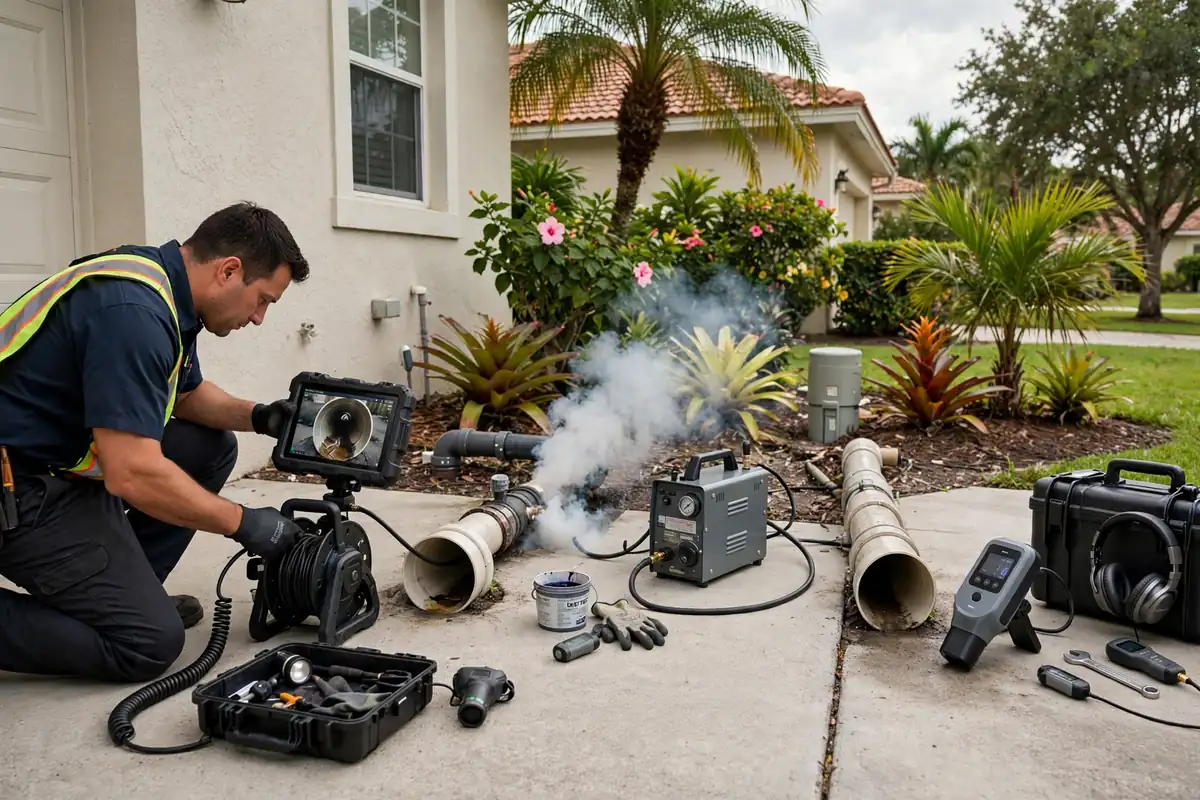
Finding a sewer leak is a detective problem: the evidence is underground, the symptoms are indirect, and digging blind is the most expensive way to be wrong. Fortunately, the industry has a toolkit of detection methods, each good at answering a different question. Used in the right order, they pinpoint leaks without exploratory excavation.
This guide compares the five main sewer leak detection methods — camera inspection, smoke testing, dye testing, acoustic detection, and pressure testing — on what each finds, what each misses, and when each earns its place. The goal is simple: the right test, the first time.
Camera Inspection: The Starting Point
The push camera is always first because it answers the most questions at once: the pipe's material and condition, the location and nature of defects, distances from access points, and whether the line is a candidate for trenchless repair. Cracks, separated joints, root masses, bellies, and collapsed sections all show directly on the monitor.
The camera's limits define when other methods join in. It cannot see through standing water clearly, cannot detect leaks that leave no visible interior defect — like a separated joint buried in mud — and cannot confirm active leakage versus an old, dry defect. When the camera shows 'something is wrong here' but not the full story, the next method is chosen to fill the specific gap.
Smoke Testing: Making Leaks Visible
Smoke testing pumps a harmless, theatrical-style vapor into the sewer line under light pressure. The smoke follows the path of least resistance — escaping through cracks, bad joints, broken vents, and illegal connections — and surfaces where the defect breathes: in yards, through foundation cracks, even out of roof vents that reveal cross-connections.
Its strength is mapping the leak's surface expression across a whole system quickly, which makes it excellent for finding the general area of elusive leaks and for verifying that a repaired line is sealed. Its weakness is precision: smoke shows you the neighborhood of the leak, and the camera then finds the exact address. It also needs calm weather — wind disperses the evidence.
Dye Testing: Tracing the Flow Path
Dye testing introduces a bright, non-toxic fluorescent dye into fixtures or the line and watches where the color emerges. It answers connectivity questions the camera cannot: is this wet spot actually connected to the sewer, which branch feeds that mysterious damp area, is stormwater infiltrating the sanitary line through a specific defect.
The method is simple, cheap, and decisive for yes-or-no questions about flow paths. Its limits are obvious — it traces where water goes, not the defect's size or exact location, and it needs an observable emergence point. Dye is the confirmatory test you run after the camera suggests a connection, not the exploratory test you start with.
Acoustic Detection and Pressure Testing
Acoustic detection listens for the sound of water escaping under pressure, using sensitive ground microphones. It works best on pressurized lines — supply pipes more than gravity sewers — but has niche uses in sewer force mains and in pressurized test setups where a leak's hiss betrays its position.
Pressure testing isolates a section of line, seals it, and monitors whether it holds air or water pressure over time. A pressure drop proves a leak exists in that section even when no defect is visible — useful for verifying new installations and for confirming that a lined or replaced section is truly sealed. Like smoke, it answers 'is there a leak' more than 'exactly where,' and pairs naturally with the camera's precision.
Putting the Methods in Order
The efficient sequence for a suspected leak: start with the camera to see the pipe's condition and locate visible defects. If the camera leaves questions — an ambiguous joint, a wet area with no clear source — add the targeted test: smoke for surface expression, dye for connectivity, pressure for verification of a repair.
Resist the urge to skip straight to excavation 'to see for ourselves.' Every detection method costs a fraction of an exploratory dig, and a dig in the wrong spot costs the dig plus the still-needed detection. For a camera-first leak investigation in Coconut Creek, reach Sewer Line Repair Crew at (833) 713-2101 — and save the video file no matter what it reveals.
Frequently Asked Questions
Which detection method is most accurate?
Accuracy is not a single-method property — it comes from the combination. The camera locates visible defects precisely; smoke, dye, and pressure answer the questions the camera cannot. A good investigation uses the camera first and adds methods only for the gaps.
Is smoke testing safe for my home and pets?
Yes. The smoke is a non-toxic theatrical vapor, not combustion smoke. Crews notify you before the test, and any smoke entering the home through a dry trap simply indicates a defect worth knowing about — pour water in the trap afterward.
Can these methods find leaks under a concrete slab?
They can narrow the location significantly — the camera with a sonde locator maps the line under the slab, and smoke or acoustic methods refine it. Slab leaks are exactly where detection earns its keep, since blind slab demolition is brutally expensive.
How long does a full leak investigation take?
A camera inspection takes under an hour. Adding smoke or dye testing typically extends the visit to a half day. Most residential leak investigations conclude the same day they start, with footage and findings in hand.
Sewer Line Problems Don't Wait. Neither Should You.
Call now and get connected with a local sewer line specialist serving Coconut Creek, FL and nearby communities — 24/7.
(833) 713-2101Speak with a local pro · No pressure