
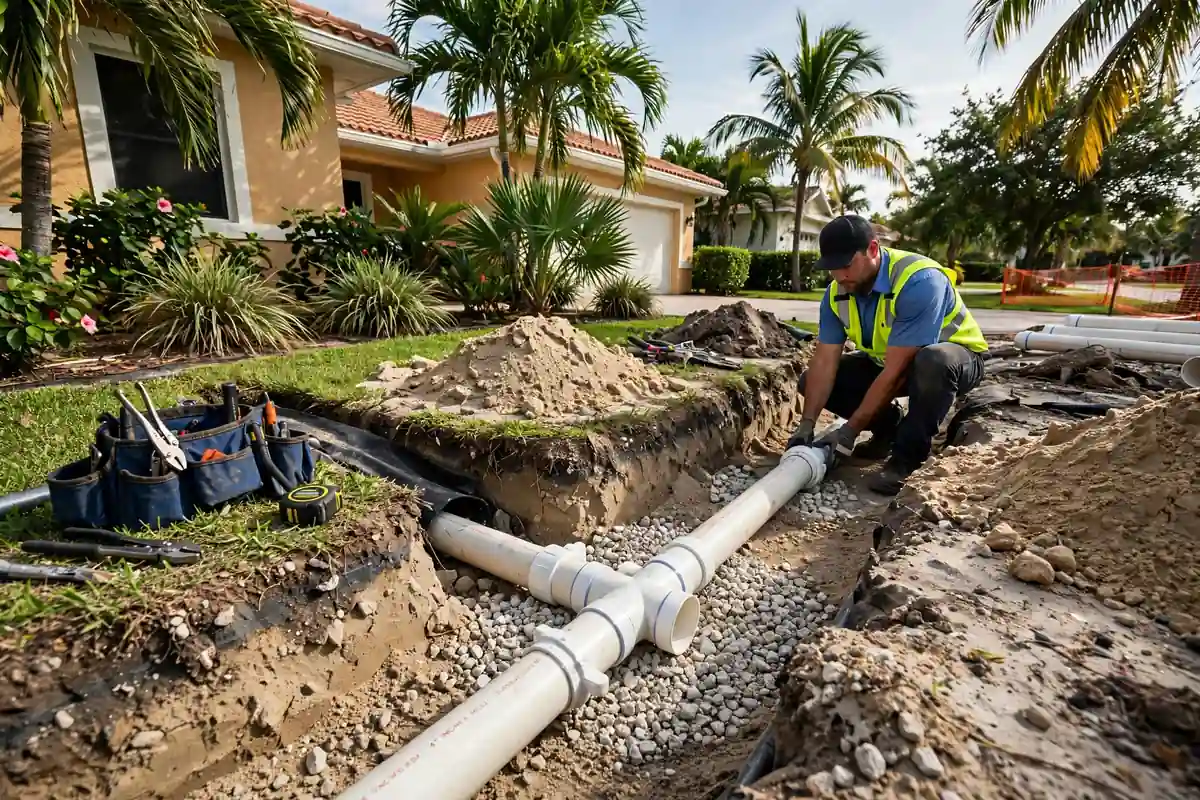
Whether it is a brand-new lateral for new construction or a full replacement of a failed line, installing a sewer line follows a strict sequence — and each step exists because skipping it causes failures. Permits, excavation, bedding, pipe laying with precise slope, testing, inspection, and backfill all happen in order, and the quality of each step decides the line's lifespan.
This guide walks through the complete installation process as it happens in Coconut Creek, including the permits Broward County expects, the materials crews use today, and the tests that prove the line is right before it gets buried. If you are planning an addition, a pool, or a replacement, this is the sequence your project should follow.
Permits and Planning Come First
Every sewer line installation in Broward County starts with permits — typically a plumbing permit and often right-of-way permits if the work reaches the street. The permit application includes the planned alignment, pipe material, and depth, and it triggers the inspections that follow. Working without permits risks stop-work orders, fines, and a line the city will not recognize.
Planning also means locates. The crew calls 811 for public utility marking and maps private lines — irrigation, landscape lighting, pool equipment — that the public locate does not cover. The lateral's path gets staked, depths get verified against the plan, and access for equipment gets arranged. A day of planning prevents a week of problems.
Excavation and Bedding
Excavation opens the trench along the staked alignment, with trench safety — shoring or sloping — matching the depth. In South Florida's sandy soils and high water table, dewatering pumps are common; a trench filling with groundwater cannot be bedded or piped properly. The trench bottom is graded to the design slope, because the pipe's fall is set by the dirt beneath it, not by the pipe itself.
Bedding is the unsung hero of the installation. A layer of compacted sand or fine gravel cradles the pipe, supporting it evenly along its full length. Poor bedding — pipe laid on lumps, rocks, or uneven soil — creates stress points that crack or belly years later. Inspectors check bedding before any pipe goes in, and good crews welcome that check.
Pipe Laying: Slope, Joints, and Materials
Modern residential laterals in Florida are typically SDR-35 or Schedule 40 PVC, joined with gasketed or solvent-welded connections that stay watertight for decades. The crew lays pipe from the low end uphill, maintaining a steady slope — usually around a quarter inch per foot — because too flat lets solids settle and too steep lets water outrun them.
Each joint gets seated fully and checked, and the alignment is verified with a level or laser as the run progresses. Cleanouts go in at required intervals and direction changes, giving future maintenance the access it needs. The details that seem fussy here — a sixteenth of an inch of slope, a fully seated gasket — are exactly what separate a fifty-year line from a ten-year problem.
Testing and Inspection
Before backfill, the new line gets tested. Common tests include a water or air pressure test of the pipe run and a mandrel or deflection check confirming the pipe held its round shape. Some jurisdictions require a camera pass of the new line as part of the final inspection — a practice worth requesting even where it is not required, because it documents your new line's day-one condition.
The municipal inspector then verifies slope, materials, bedding, connections at both ends, and cleanout placement against the approved plans. Only after the inspection passes does backfill begin. This hold point is your quality guarantee: a line that passes inspection is a line built to code, and the inspection record protects you at resale.
Backfill, Compaction, and Restoration
Backfill happens in lifts — thin layers of suitable material, each compacted before the next goes on. Dumping a trench full of loose soil in one shot guarantees settlement, dips in the yard, and stress on the new pipe. Proper compaction in lifts is slow, unglamorous, and absolutely essential.
Surface restoration follows: sod, pavers, or concrete replaced to match, irrigation lines reconnected, and the site cleaned. Ask your contractor what the restoration includes before work starts — the pipe underground is only half the job; the yard you live with afterward is the other half. For an installation done to this standard, call Sewer Line Repair Crew at (833) 713-2101 and ask about the full process, permits included.
Frequently Asked Questions
How deep is a typical residential sewer lateral?
Most residential laterals run two to six feet deep, deepening toward the street connection. Depth varies with the main's elevation and local code — the design slope, not a fixed depth, is what the installer follows.
Can a new line go in a different path than the old one?
Yes, and reroutes are common when the old alignment passes under a new pool, addition, or mature tree. The new path needs its own permits and must still meet slope and connection requirements at both ends.
What pipe material is used for new installations today?
PVC — typically SDR-35 for gravity sewer laterals — is the modern standard in Florida: jointless-feeling gasketed joints, smooth interior, and strong resistance to the soil conditions here. Cast iron and clay are legacy materials, not new-install choices.
Do I need to be home during the installation?
Not necessarily for the whole job, but be reachable. Crews need decisions if underground surprises appear, and the water-service interruptions for connections are easier to schedule when they can reach you.
Fast Help for Sewer Line Trouble
Call now for a local sewer line specialist in the Coconut Creek area. No obligation, just answers.
(833) 713-2101Free consultation call · Available 24/7