
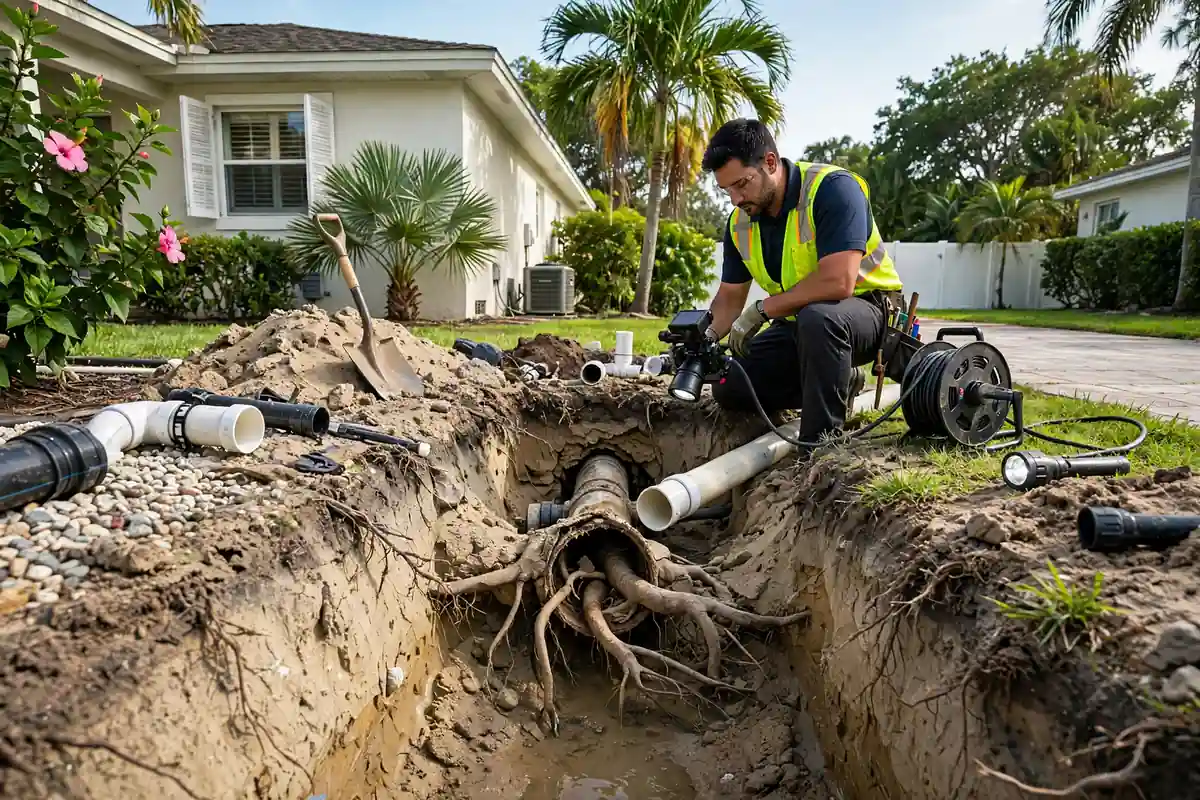
Nobody likes a vague estimate, and sewer line repairs have a reputation for them. The reason is not evasiveness — it is that five or six physical factors swing the scope of the job enormously, and none of them are visible from your kitchen window. Two neighbors with the same symptom can need very different repairs.
This guide explains the factors that determine a sewer line repair's scope and cost drivers — depth, length, method, access, pipe condition, and soil — so you can understand any estimate you receive and ask the questions that keep it honest. Knowledge here does not replace a camera inspection, but it makes the inspection's findings legible.
Factor 1: Depth and Length of the Line
Depth drives labor more than almost anything else. A lateral three feet down is a morning's careful digging; the same line at eight feet needs shoring, more soil moved, more safety measures, and more time at every step. Deeper lines also complicate trenchless setups, since entry and exit pits must reach the pipe.
Length multiplies everything: more pipe to line or burst, more liner material, longer curing or pulling time, more trench to open and restore. Long laterals on deep lots or far setbacks from the street cost more than short runs — which is why the camera's distance counter matters. The footage does not just diagnose; it measures the job.
Factor 2: The Repair Method
Spot repair, lining, bursting, and full open-trench replacement sit on a spectrum of scope. A spot repair addresses one bad section through one excavation — the smallest footprint. Trenchless lining and bursting rehabilitate long runs with minimal surface work but require specialized equipment and materials. Full excavation replaces everything and restores everything, with the most labor in digging and surface repair.
The method is not a menu you pick freely — the pipe's condition narrows the options, as the camera inspection reveals. But understanding the spectrum helps you evaluate the recommendation: if a crew proposes full replacement where the footage shows one bad joint, ask why the smaller fix was ruled out.
Factor 3: Access and Obstacles
Access is the hidden cost driver. A lateral with a clear, exposed cleanout in an open side yard is the easy case. A line with no cleanout, running under a concrete driveway, a pool deck, a mature oak, or an addition, turns access into its own project — concrete cutting, root pruning coordination, or rerouting around the obstacle.
HOA and condo properties add coordination costs: approvals, restricted work hours, and parking-lot logistics. Commercial sites add more. When you compare estimates, check that each one accounts for the same access reality — an estimate that ignores the driveway over your lateral is not cheaper, it is incomplete.
Factor 4: Pipe Condition and Soil
The worse the pipe's condition, the more the repair scope grows. Widespread cracking pushes a spot repair toward lining or replacement; multiple collapses push lining toward bursting or excavation; contaminated soil around a long-leaking line can require remediation handling. The camera inspection grades the condition, and the grade sets the method.
Soil matters too. South Florida's sandy soils dig easily but cave easily, requiring shoring. High water table means dewatering pumps and wet-weather scheduling constraints. Rock — less common here but present in pockets — slows every foot of excavation. A crew experienced in local soils prices these realities in; an out-of-area crew may discover them mid-job.
Getting an Estimate You Can Trust
A trustworthy estimate follows a camera inspection, references the footage, names the method and why, itemizes access work and restoration, and states what happens if underground conditions differ. It should also explain the warranty in plain terms — what is covered, for how long, and what voids it.
Get the scope in writing before work starts, and be wary of any quote given without camera footage — it is a guess, not an estimate. Ask each bidder the same questions so the answers are comparable. For a camera-first assessment and a written, footage-backed scope in Coconut Creek, call Sewer Line Repair Crew at (833) 713-2101.
Frequently Asked Questions
Why do estimates vary so much between companies?
Because they may be pricing different scopes — one quotes a spot repair, another a full replacement — or different access assumptions. Ask each company to walk you through the footage and the scope line by line; the differences usually become clear.
Does trenchless always cost more than digging?
Not necessarily. Trenchless methods use specialized equipment, but they skip the excavation and surface restoration that dominate open-trench labor. On lines under driveways or landscaping, trenchless often wins on total project scope.
Will my homeowner's insurance cover the repair itself?
Typically the repair of the pipe is not covered — insurance covers resulting damage to the home, and only with a backup endorsement. The pipe repair itself is generally the homeowner's responsibility, which is why understanding the scope matters.
Can I reduce the cost by handling restoration myself?
Sometimes. Some crews will quote the pipe work and rough backfill only, leaving final sod or pavers to you or your landscaper. Discuss it upfront — unbundling works when everyone agrees on where the crew's job ends.
Get a Local Sewer Specialist on the Line Now
One call connects you with a Coconut Creek-area sewer line professional. Day or night, we're ready to help.
(833) 713-2101Call anytime · Real help, fast