
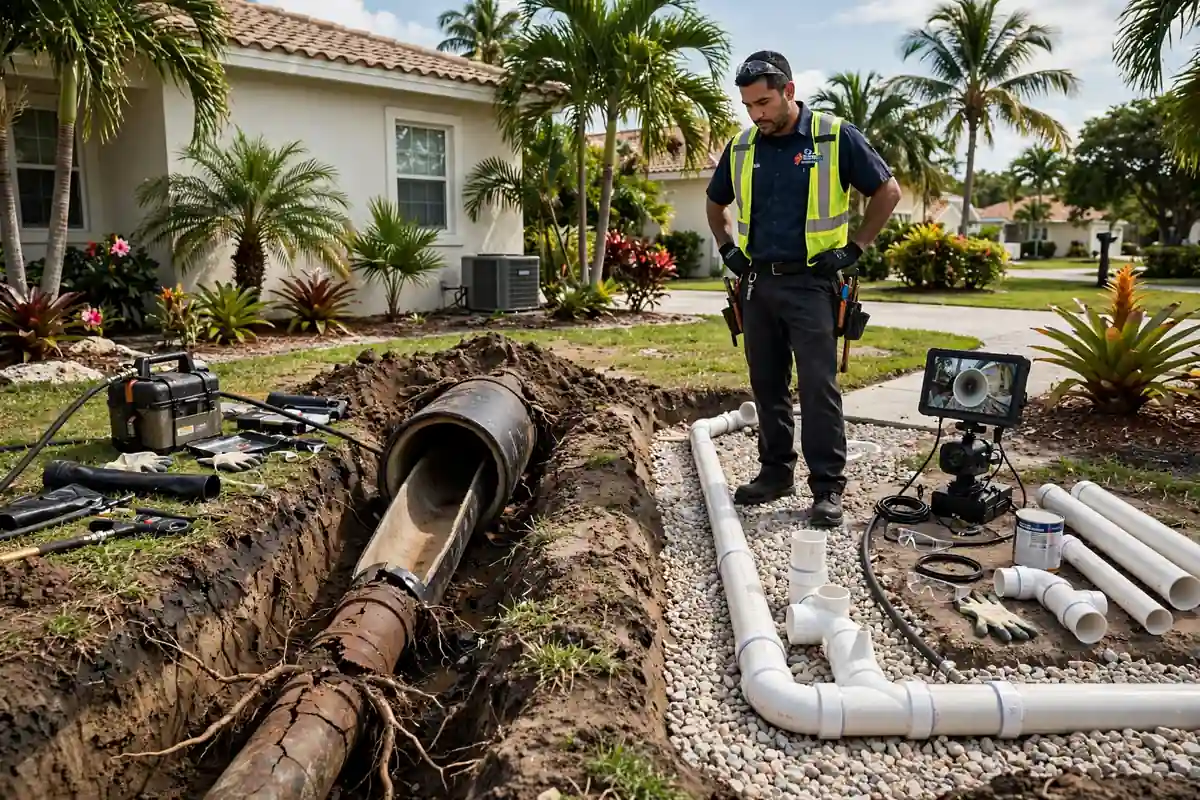
Patch the bad spot or replace the whole line? It is the most expensive question in residential sewer work, and the wrong answer costs you twice — once for the repair that fails, again for the replacement you should have done first. The right answer is rarely about the symptom; it is about the pipe's age, material, and overall condition.
This guide gives you a decision framework: the five questions that separate a repair candidate from a replacement candidate, how the camera footage answers each one, and the traps that push homeowners toward the wrong choice. Bring this framework to any estimate and the conversation changes immediately.
Question 1: How Old Is the Pipe, Really?
Pipe materials have lifespans, and South Florida's soil and water table spend them faster than drier climates. Cast iron laterals from the 1960s to 1980s are now 40 to 60 years old — at or past the age when internal corrosion thins walls to the failure point. Clay tile lasts longer structurally but its joints fail earlier. Orangeburg fiber pipe, used mid-century, is living on borrowed time everywhere it remains.
If your line is past its material's expected life and showing problems, replacement usually beats repair — you would be patching a system that is failing everywhere at once. If the line is mid-life with an isolated defect, repair is the rational call. The camera inspection plus knowledge of your home's build year answers this question definitively.
Question 2: Is the Damage Local or Systemic?
A single cracked joint, one root intrusion point, or one offset section is local damage — a spot repair or a sectional lining handles it cleanly. Widespread cracking along the whole run, roots at every joint, or corrosion pitting throughout is systemic — the pipe is failing as a system, and fixing one spot leaves the next failure months away.
The camera footage is the evidence. Ask the technician to show you the full run, not just the worst spot, and count the defects. One or two isolated problems argue for repair; a highlight reel of damage argues for replacement. This is also where a second opinion earns its keep — the footage does not change between viewers, only the recommendation does.
Question 3: What Does the Math Favor Over Ten Years?
Think in total cost of ownership, not single-job price. A spot repair now plus another spot repair in two years plus a third in four can exceed the cost of one replacement — while delivering years of anxiety and repeated yard disruption in between. Replacement resets the clock to zero with a new-material lifespan.
The break-even question to ask: 'How many more repairs will this line need before I've paid for a replacement anyway?' If the camera shows a line with years of life left after one repair, repair wins. If it shows a line that will need attention every year or two, replacement is the cheaper decade. Honest crews will do this math with you.
Question 4: Does the Line Meet Your Future Needs?
Replacement is also the moment to fix design problems, not just damage. If the line is undersized for the home's fixtures, has a chronic belly, or runs under a new addition or pool where future access would be impossible, replacement lets you correct the alignment, size, and slope in one project.
Pipe bursting even allows upsizing the diameter during replacement — a meaningful upgrade when you are adding bathrooms or converting a garage. Repair preserves the existing design, flaws included. If the design itself is part of the problem, only replacement solves it.
Making the Call — and Avoiding the Traps
Two traps catch homeowners here. The first is the cheap patch on a dying line — it feels thrifty and fails predictably, converting one project into two. The second is the oversold replacement on a repairable line — it feels decisive and wastes money a targeted repair would have saved. The camera footage, reviewed with the framework above, steers between them.
Get the recommendation in writing with the footage attached, and do not decide under emergency pressure if you can avoid it — a clearing buys time to decide well. For a camera inspection and a straight repair-vs-replace assessment in Coconut Creek, call Sewer Line Repair Crew at (833) 713-2101.
Frequently Asked Questions
Can part of the line be replaced and part repaired?
Yes — hybrid projects are common. A collapsed section gets replaced by excavation or bursting while the remaining sound run gets lined. The camera survey maps which sections get which treatment.
Does trenchless lining count as repair or replacement?
It is a rehabilitation — closer to replacement in outcome, since you get a new structural pipe wall, but it preserves the existing alignment and is usually classed as a repair method. For decision purposes, treat it as the middle path between spot repair and full replacement.
How do I know a contractor is not overselling replacement?
Ask to see the full camera run and have them point to each defect that justifies replacement over repair. Then get a second opinion on the same footage. If both independently land on replacement, the pipe has spoken.
Should I replace the line before selling my home?
A documented new or rehabilitated line is a selling asset, and pre-listing camera footage prevents closing-day surprises. Whether the investment pays back depends on your market — discuss it with your agent alongside the inspection results.
Talk to a Sewer Line Pro Today
Describe the problem once — a local specialist serving Coconut Creek, FL plans the visit. 24/7 emergency line.
(833) 713-2101Free consultation call · Available 24/7