
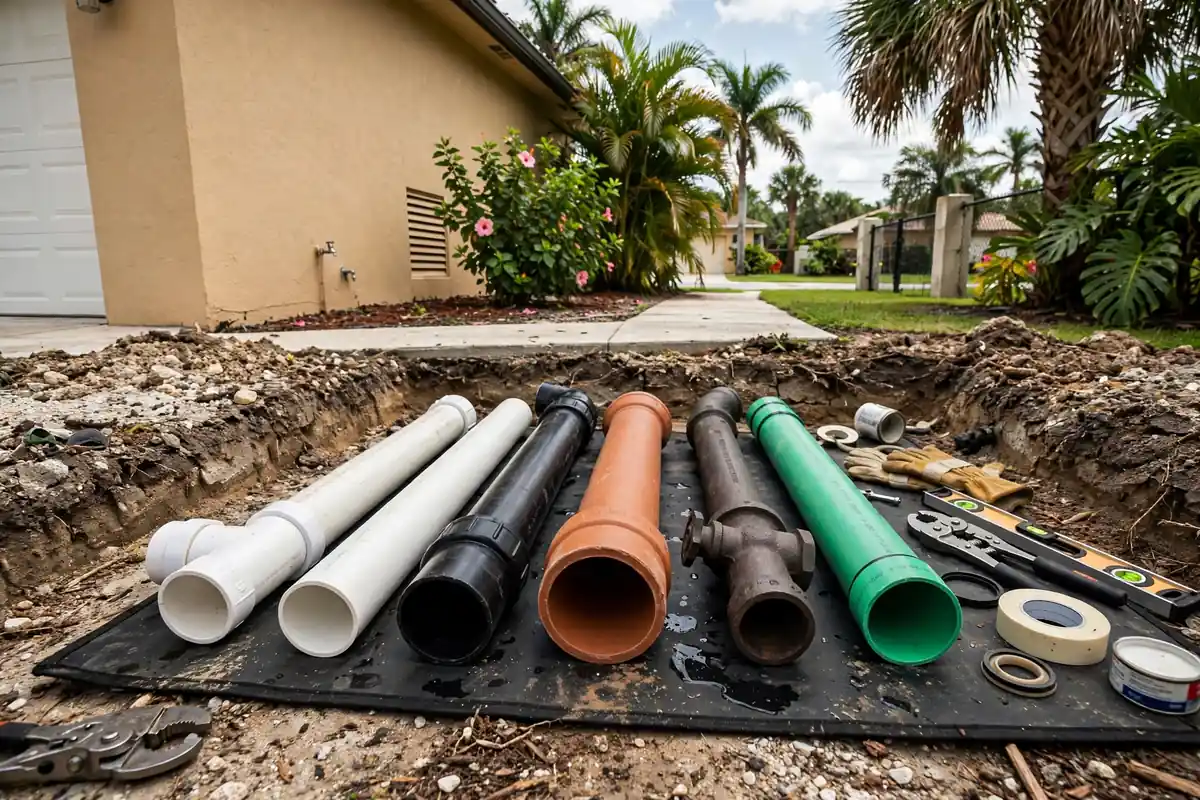
The pipe under your yard has a birth year and a material, and both predict how it will fail. Cast iron corrodes from the inside out. Clay tile holds up for decades but leaks at every joint. Orangeburg — a fiber pipe used mid-century — is essentially expiring everywhere it still exists. PVC, the modern standard, mostly fails at bad joints or from external damage.
This guide covers the four materials found under Coconut Creek homes: what each one is, how it ages in South Florida soil, what its failure looks like on camera, and what the right fix is when yours reaches the end. Knowing your material turns a mysterious plumbing problem into a predictable engineering one.
Cast Iron: The 1960s–80s Workhorse
Cast iron was the premium sewer pipe of its era — strong, quiet, and expected to last generations. Inside a sewer lateral, though, it faces constant moisture, corrosive gases, and abrasive flow. The result is internal corrosion: the pipe wall thins, pits, and develops rough scale that snags debris and narrows the diameter year by year.
On camera, aging cast iron shows a rough, flaky interior with tuberculation — mounded corrosion deposits — and eventually pinholes and cracks. In Coconut Creek's high water table, external corrosion attacks too. Cast iron laterals from the 60s through the 80s are now the most common replacement candidates in the area, usually by pipe bursting or lining before the walls give out completely.
Clay Tile: Strong Pipe, Weak Joints
Vitrified clay tile is remarkably durable as a material — century-old clay pipe still in service is not unusual. Its weakness was never the pipe but the joints: short bell-and-spigot segments joined with mortar or rubber gaskets that shift, crack, and admit roots over decades. Each joint is a potential entry point.
On camera, clay shows as segmented pipe with root intrusion fanning in at the joints, offset segments where soil has shifted, and occasional cracked bells. Because the pipe barrels themselves are often sound, clay is an excellent lining candidate — the liner seals every joint at once, neutralizing the material's one systematic weakness in a single project.
Orangeburg: The Pipe Living on Borrowed Time
Orangeburg pipe — bituminized fiber pipe — was installed in many mid-century homes as a cheap alternative to iron or clay. It was never meant to last: the fiber layers delaminate, the pipe ovalizes under soil pressure, and it eventually collapses inward. Any Orangeburg still in the ground is past its design life by decades.
On camera, Orangeburg shows a deformed, blistered interior, often with sections already partially collapsed. Lining is generally not an option — the host pipe cannot support it — which leaves pipe bursting or open replacement. If your home dates to the 1950s–60s and has never had sewer work, ask specifically whether the lateral is Orangeburg; the answer changes every plan.
PVC: The Modern Standard
PVC — usually SDR-35 for gravity sewers — became the standard for new installations from the 1980s onward: smooth interior, gasketed joints, immunity to corrosion, and a long rated life. A properly installed PVC lateral is the lowest-maintenance sewer pipe a home can have.
PVC fails differently: bad joints from poor installation, bellies from poor bedding, cracks from external damage like fence posts or heavy equipment, and root intrusion only where a joint was compromised. On camera, PVC problems look like installation defects rather than material decay — which also means they are usually localized and repairable with spot fixes or sectional lining.
Finding Out What You Have — and What to Do
Three ways to identify your pipe: your home's build year narrows it (pre-1960 could be clay or Orangeburg; 60s–80s likely cast iron; 90s+ likely PVC), any past plumbing invoices may name it, and a camera inspection shows it directly — experienced technicians read material from the interior appearance reliably.
The material sets the strategy. Cast iron near end of life: plan for lining or bursting before the emergency. Clay with root-prone joints: lining seals the system. Orangeburg: plan replacement, full stop. PVC with a defect: targeted repair. Whatever your home's vintage, a camera inspection is the step that converts material theory into your specific plan — schedule it with Sewer Line Repair Crew at (833) 713-2101.
Frequently Asked Questions
Can different materials be joined in one lateral?
Yes — repairs over the decades often splice PVC sections into older iron or clay runs, using proper transition couplings. Mixed-material laterals are common and work fine when the transitions are done correctly.
Does pipe material affect trenchless options?
Directly. Lining needs a host pipe with enough structure — fine for clay and mid-life iron, not for collapsed Orangeburg. Bursting needs brittle material that fractures — ideal for clay and iron, unsuitable for ductile materials that fold.
How does Florida soil affect each material?
Sandy soil with a high water table accelerates external corrosion of iron, encourages joint shifting in clay through soil movement, and speeds Orangeburg's deformation. PVC is largely indifferent to soil chemistry, which is one reason it became the standard.
Should I replace cast iron proactively?
If camera footage shows advanced internal corrosion — heavy scale, pitting, thin walls — proactive lining or bursting beats waiting for the collapse. If the iron still looks sound, scheduled monitoring is the rational middle path.
Talk to a Sewer Line Pro Today
Describe the problem once — a local specialist serving Coconut Creek, FL plans the visit. 24/7 emergency line.
(833) 713-2101Call anytime · Real help, fast