
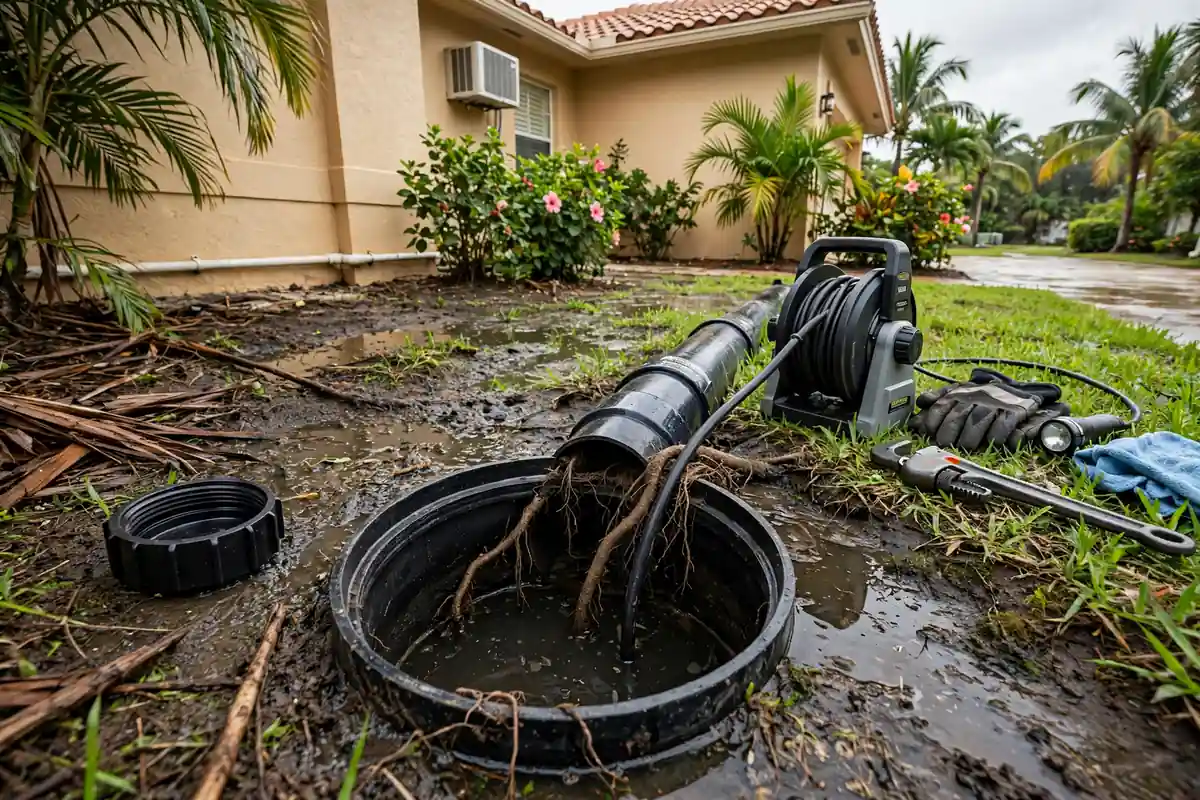
Sewer lines rarely fail without warning. They send signals for weeks or months — slow drains, odd gurgles, smells that come and go, a patch of lawn that is suddenly the greenest on the block. Homeowners who learn to read these signs get repairs on their schedule; those who miss them get emergencies on the sewer's schedule.
This guide catalogs the early, middle, and late warning signs of sewer line trouble in Coconut Creek homes, explains what each one means mechanically, and tells you which signs mean 'schedule an inspection' versus 'call today.' Print the urgency scale mentally — it is the cheapest diagnostic tool you own.
Early Signs: The Line Is Asking for Attention
The earliest signals are easy to dismiss. A bathroom sink that drains a little slower than it used to. A toilet that needs a second flush more often. A faint gurgling from a drain when the washing machine empties. Individually, each looks like a minor fixture issue; the pattern — multiple fixtures, gradually worsening — is the lateral talking.
Another early sign lives outside: a patch of grass over the lateral's path that grows faster and greener than the rest of the lawn. Leaking wastewater is fertilizer, and the lawn finds the leak before you do. If one strip of your yard is suspiciously lush, especially during the dry season, the line beneath it deserves a camera look.
Middle Signs: The Problem Is Advancing
When the signs graduate, they get harder to ignore. Sewage odors around drains, in the yard, or near the foundation. Toilets that gurgle when other fixtures drain — the classic sign of a developing main-line restriction. Water backing up into a tub or shower when the toilet flushes, meaning the line is struggling to pass normal flow.
This is also when you may notice the signs syncing with weather. Slowdowns that worsen after rain point to cracks admitting groundwater or roots swelling with moisture — both common in South Florida's wet season. A problem that is rain-linked is a problem with a deadline, because the next storm is already on the calendar.
Late Signs: Call Before It Calls You
The late signs need no interpretation. Sewage backing up through floor drains, tubs, or toilets. Multiple fixtures blocked simultaneously. Standing water or soggy ground over the lateral's path, sometimes with odor. A visible sinkhole or depression forming in the yard above the line — soil washing into a broken pipe leaves a void that the surface eventually follows.
Foundation cracks paired with any of the above deserve immediate attention, since chronic leaks undermine soil support. At this stage, the question is not whether to call but how fast — and the answer is today. Emergency service exists for exactly this moment.
What Each Sign Means Mechanically
Reading the signs means translating symptom to cause. Slow drains across multiple fixtures mean a restriction in the shared lateral, not in one branch. Gurgling means air trapped by a partial blockage, venting through fixture traps. Odors mean gas escaping through cracks, dry traps, or failed seals. Lush lawn patches mean nutrient-rich leakage fertilizing the soil.
Rain-linked symptoms mean the line's defects interact with groundwater — cracks, separated joints, or root masses that swell. Backups into low fixtures mean the blockage is downstream of those fixtures, at or beyond the point where the branches join. This mechanical reading is what the technician does on arrival; doing it yourself just gets you to the right call faster.
Your Next Step at Each Stage
Early signs: schedule a camera inspection within weeks, not months. You are buying information while the problem is small and the repair options are widest. Middle signs: schedule the inspection now and ask about interim measures — a preventive cleaning can hold the line while you plan the repair.
Late signs: call for emergency service immediately, stop water use in affected areas, and document everything for insurance. Whatever the stage, the camera footage is the step that converts worry into a plan. For an inspection scheduled around your signs — or an emergency crew when the signs have graduated — call Sewer Line Repair Crew at (833) 713-2101.
Frequently Asked Questions
My drains are slow but only in one bathroom — is that the sewer line?
Probably not. A single slow fixture usually means a local branch clog — hair, soap, or a fixture trap issue. The sewer line announces itself through multiple fixtures at once, or through low fixtures like tubs and floor drains.
Can a sewer problem fix itself?
No. Roots do not retreat, cracks do not heal, and scale does not dissolve on its own. Symptoms can seem to come and go with weather or usage, but the underlying defect only advances. 'Wait and see' is the most expensive strategy.
How quickly do early signs become emergencies?
Timelines vary wildly — months for slow root intrusion, days for a rapidly collapsing section. The honest answer is that no one can predict the failure date, which is exactly why early signs deserve prompt inspection rather than a wait.
Should I warn my HOA about a suspected lateral problem?
If the lateral runs through common areas or the problem could affect neighbors — shared walls, common landscaping — a heads-up to the association is wise. Check your documents for who owns which segment before the conversation.
Sewer Line Problems Don't Wait. Neither Should You.
Call now and get connected with a local sewer line specialist serving Coconut Creek, FL and nearby communities — 24/7.
(833) 713-2101Speak with a local pro · No pressure