
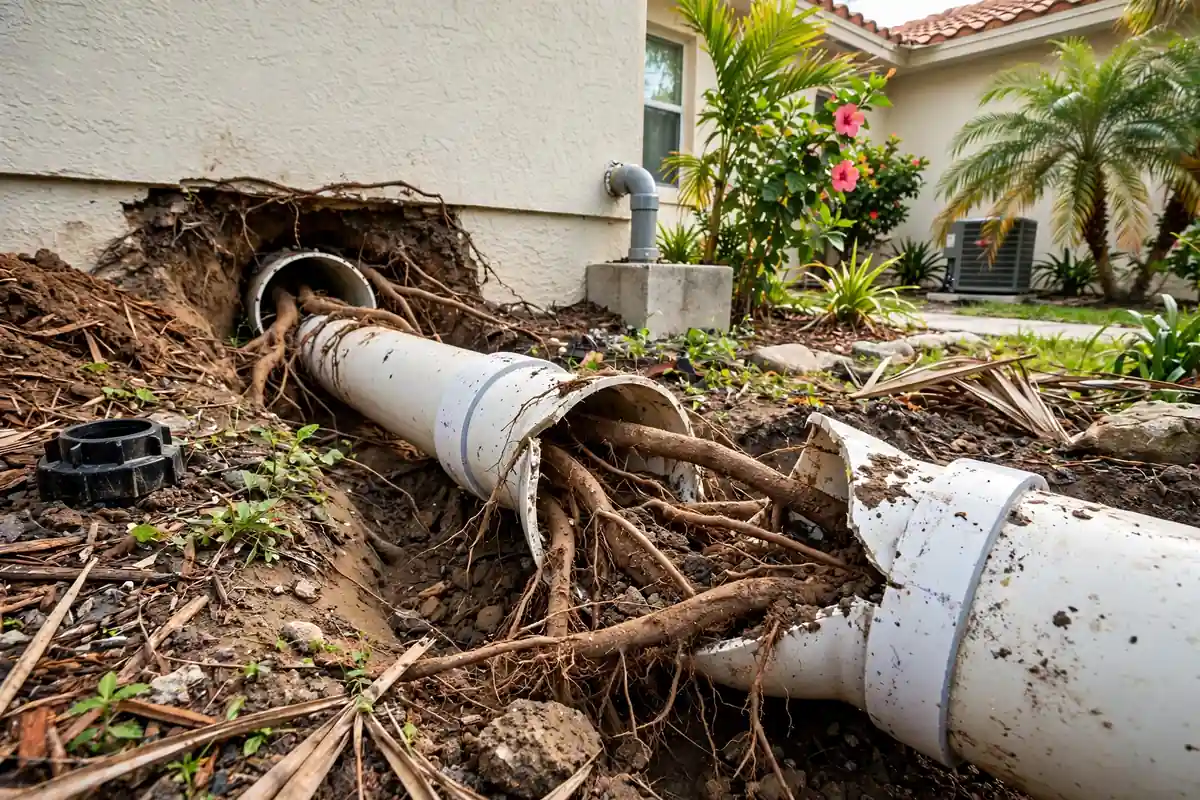
In South Florida, the battle between trees and sewer lines never really ends. Live oaks, ficus, and even palms send fine feeder roots hunting for moisture year-round, and a sewer lateral — warm, nutrient-rich, and slightly leaking at its joints — is the most attractive target in the yard. Roots do not break healthy pipe so much as exploit the tiny openings that age creates.
This guide explains how roots invade sewer lines, the warning signs that roots are your problem, what removal actually involves, and how to keep them from coming back. If you have mature trees anywhere near your lateral's path in Coconut Creek, this is required reading before the next rainy season.
How Roots Find and Enter the Pipe
Roots do not 'seek' pipes with intent, but they grow relentlessly toward moisture, and the vapor escaping from a hairline joint crack is a beacon. A fine root hair enters through an opening thinner than a credit card; once inside the nutrient-rich flow, it branches and thickens into a mass that catches paper and debris. The joint that admitted one hair eventually hosts a root ball.
Clay tile joints and the hub connections of old cast iron are the classic entry points, because those joints shift and open with soil movement over decades. PVC with properly seated gaskets resists entry far better — which is why root problems cluster in older neighborhoods. The invasion is slow, measured in seasons, but it never reverses on its own.
Warning Signs of Root Intrusion
Root blockages announce themselves in a pattern: drains that slow gradually over weeks, gurgling when fixtures drain, and backups that return months after a clearing — because the clearing cut the roots but left the entry cracks. If your line needs cabling on a regular cycle, roots are the prime suspect.
The calendar matters too. Root growth surges in the warm, wet months, so symptoms that worsen from late spring through fall fit the root profile. A camera inspection confirms it definitively — the footage shows the white, fibrous masses and the exact joints they enter through, which is the map for everything that follows.
Removal: Cutting, Jetting, and What Each Leaves Behind
Mechanical root cutting uses specialized saw-like heads on a drain cable to shred the root mass inside the pipe and restore flow. It is fast and effective at clearing, but it is pruning, not cure — the roots regrow from the entry points, typically within six to eighteen months, and each cutting leaves the cracks open.
Hydro jetting with a root-cutting nozzle does a more thorough job, flushing the shredded material out of the line instead of leaving it to resettle. Some crews follow with a foaming root treatment that inhibits regrowth in the pipe for a season. Both are maintenance, not repair: they manage the symptom while the entry points remain.
The Permanent Fix: Sealing the Entries
The only lasting answer to root intrusion is eliminating the entries. Cured-in-place lining seals every joint along the lined run at once — roots cannot penetrate the jointless liner wall, and the most common root problem in clay laterals disappears in a single project. For isolated entries, spot repairs replace the compromised joint or section.
Pipe bursting replaces the old pipe entirely with jointless HDPE or fused PVC, which is the full reset. The right choice depends on the pipe's overall condition: widespread entries in an aging line argue for lining or bursting, while one bad joint in an otherwise sound line argues for a spot fix. The camera footage makes the case either way.
Living With Trees and Sewers Long-Term
You do not have to choose between your trees and your plumbing. Keep large trees' critical root zones respected, plant new trees well clear of the lateral's corridor — your property survey shows the path — and favor species with less aggressive roots near underground utilities. Existing trees near the line get periodic root maintenance, not removal.
Build the habit: a camera inspection every year or two if you have root history, preventive cutting or treatment in spring before growth peaks, and prompt attention to the first slow drain rather than the third backup. Roots are a managed condition, like weeds in a garden — ignore them and they take over. To map your roots and plan the fix, call Sewer Line Repair Crew at (833) 713-2101.
Frequently Asked Questions
Which trees are worst for sewer lines in South Florida?
Ficus, live oaks, and ficus-family ornamentals top the list for aggressive, far-reaching roots. Palms are generally less destructive to pipes but can still exploit existing openings. Distance from the lateral matters more than species, though.
Will the city remove a street tree damaging my lateral?
Sometimes, if the tree is in the public right-of-way and documented as damaging infrastructure — but the process is slow and the burden of proof is yours, via camera footage and sometimes an arborist report. Do not count on it as your plan A.
Do chemical root killers actually work?
Copper sulfate and foaming dichlobenil products inhibit regrowth inside the pipe for a time, but they cannot remove an established mass or seal the cracks. Use them as between-visit maintenance after professional cutting, never as the sole strategy.
Can roots break a brand-new PVC line?
Properly installed PVC with seated gaskets is highly root-resistant — roots exploit defects, and a good PVC install has none. Roots become a new-PVC problem only where installation was poor or external damage created an opening.
Sewer Line Problems Don't Wait. Neither Should You.
Call now and get connected with a local sewer line specialist serving Coconut Creek, FL and nearby communities — 24/7.
(833) 713-2101Free consultation call · Available 24/7