
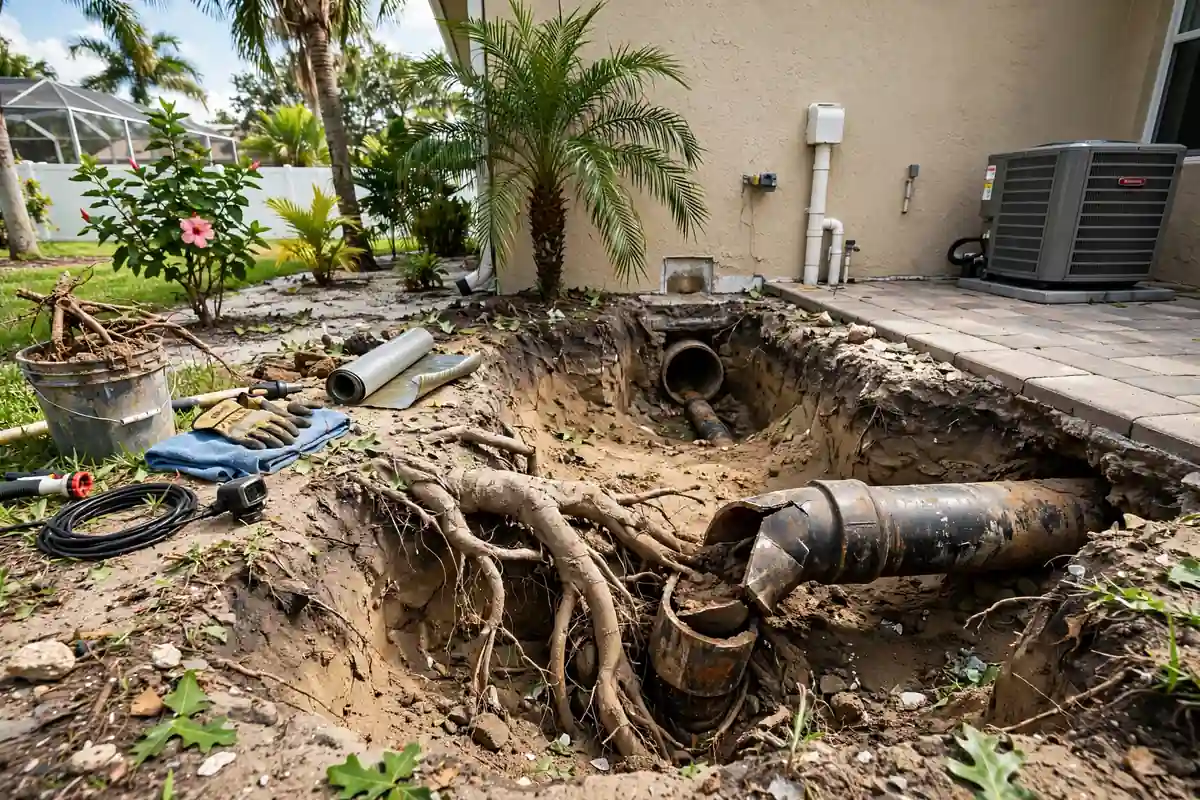
Trenchless sewer repair earns its glowing reputation honestly — most of the time. Lining and pipe bursting fix an enormous range of problems with minimal digging, and they have saved countless driveways, patios, and prize gardens across Coconut Creek. But trenchless methods are tools, not magic, and every tool has jobs it cannot do.
This guide covers the real limitations: the pipe conditions that rule out lining, the situations that stop bursting, and the site constraints that send even the best trenchless crew back to the excavator. Knowing the boundaries protects you from the most expensive mistake in this space — paying for a trenchless job that was never going to work.
When the Pipe Cannot Be Lined
Cured-in-place lining needs a host pipe with enough structural integrity to receive the liner. Fully collapsed sections are the hard stop — there is no round pipe for the liner to form against. Severe bellies are the functional stop: the liner will follow the sag, and the belly will still hold standing water after the cure, preserving the original problem.
Extreme joint offsets are the third stop. A liner can bridge modest steps between pipe segments, but a large offset creates a wrinkle or a tear risk that no reputable installer will accept. Heavily deformed Orangeburg, pipes packed with hardened debris that cleaning cannot remove, and lines with active groundwater infiltration too strong for the resin to cure against round out the list. The pre-lining camera inspection exists precisely to catch these.
When Pipe Bursting Cannot Proceed
Pipe bursting needs a brittle host pipe and a clear path. Pipes that have already fully collapsed and filled with compacted soil can stop the bursting head — there is nothing to fracture and no void to follow. Severe bellies can also defeat bursting, since the new pipe inherits the bad alignment.
Proximity risks stop bursting too. If the lateral runs extremely close to other utilities, foundations, or a pool shell, the outward fracturing force — modest but real — may be unacceptable, and the crew will recommend excavation with visual control instead. Ductile materials that fold rather than fracture, and repairs needed at sharp bends beyond the head's turning ability, complete the no-go list.
Site and Access Constraints
Trenchless equipment needs working room. Lining rigs need access for the inversion equipment and the resin handling; bursting needs space for the entry and exit pits plus the hydraulic puller. A lateral buried under a structure with no exposed access point, or one whose only access is through a finished interior with no cleanout, may force interior work or excavation regardless of the pipe's condition.
Depth extremes complicate both methods — very deep lines make pit work expensive and liner inversion harder to control. Very shallow lines under thin cover can heave during bursting. And in tight HOA or condo settings, equipment staging and work-hour restrictions can make the 'minimal disruption' promise harder to deliver, though still far better than trenching.
The Honest Conversation to Have
The limitation that matters most is not technical — it is commercial. A company that only sells lining will find every pipe 'lineable'; a company that only digs will find every pipe 'too far gone.' The honest conversation starts with a provider that offers lining, bursting, and excavation, shows you the camera footage, and explains which options the footage rules out and why.
Ask directly: 'What would make you recommend against trenchless here?' A good answer names specific conditions visible — or not visible — in your footage. A vague answer, or an answer that never mentions limitations at all, is itself a limitation worth noting. Get the method recommendation in writing, tied to the inspection findings.
When Digging Is Simply the Right Call
Excavation remains the right answer more often than trenchless marketing suggests. Reroutes around new construction, lines that need realignment or upsizing beyond bursting's range, repairs at complex junctions, and pipes in soil too unstable for trenchless forces all favor the excavator. There is no shame in digging — a well-executed open repair with proper bedding and compaction is a fifty-year solution.
The goal was never 'no digging at all costs'; it is the right fix for the pipe you have. Sometimes that is a liner slipped in through a cleanout, sometimes it is a careful excavation with full restoration. For an assessment that recommends whichever method your footage actually supports, call Sewer Line Repair Crew at (833) 713-2101.
Frequently Asked Questions
Can a failed lining job be fixed?
Usually, yes — a wrinkled or incompletely cured liner can sometimes be relined, and a liner that failed because the host pipe was unsuitable typically leads to bursting or excavation. The camera footage from the failure guides the recovery plan.
Do limitations differ between residential and commercial lines?
The principles are the same, but commercial lines add scale: larger diameters narrow the lining options, longer runs complicate curing, and higher flows raise the stakes of getting the method right the first time.
Can trenchless methods fix a belly in the line?
No — this is one of the firmest limitations. Trenchless methods follow the existing alignment, so a sag that ponds water stays a sag. Bellies need excavation and regrading to restore proper slope.
Is a second opinion worth it when trenchless is ruled out?
Absolutely. The boundary between 'lineable' and 'not lineable' involves judgment, and footage reviewed by two experienced eyes is more reliable than one. Bring the same video to both opinions.
Talk to a Sewer Line Pro Today
Describe the problem once — a local specialist serving Coconut Creek, FL plans the visit. 24/7 emergency line.
(833) 713-2101Talk to a specialist now · Free call