
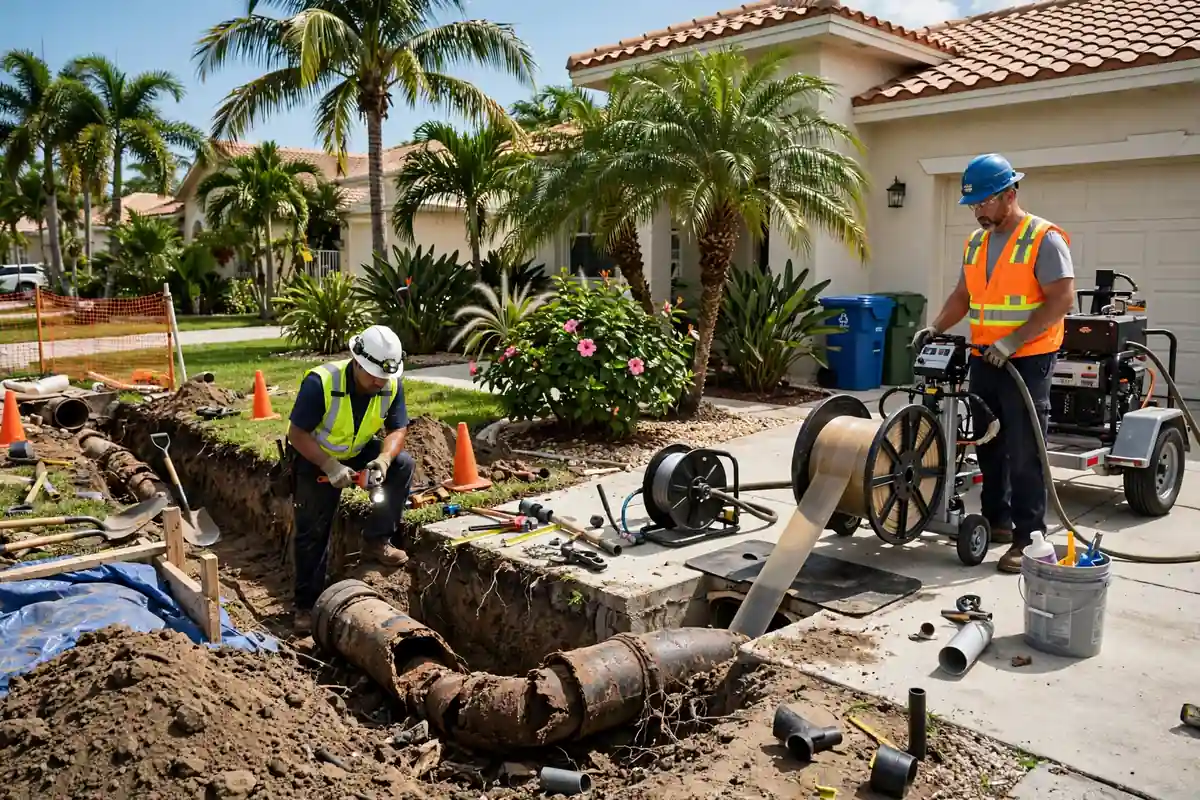
Every sewer line repair comes down to the same fork in the road: fix it from the inside with trenchless methods, or open the ground with traditional excavation. Both approaches produce working sewer lines. They differ in disruption, timeline, suitability, and what your property looks like when the crew leaves.
This comparison lays out trenchless and traditional repair side by side across the dimensions that matter to a Coconut Creek homeowner — so when a contractor recommends one, you understand the trade-offs behind the recommendation and can judge whether it fits your pipe, your property, and your plans.
Disruption: What Happens to Your Property
Traditional excavation opens a trench along the pipe's path — through lawn, landscaping, driveways, or patios. Everything above the line comes up, and restoration follows: backfill, compaction, sod, pavers, or concrete. For a full lateral replacement, the trench can run the length of the yard. The pipe work is straightforward; the property impact is the price.
Trenchless methods work through small access points. Lining typically needs a single cleanout; bursting needs two modest pits. The ground between stays intact — the driveway you just paved, the oak you have nurtured for twenty years, the patio where the family eats. When surface features are valuable or irreplaceable, disruption alone often decides the method.
Timeline and Daily Life
Open-trench replacement of a full lateral typically runs two to five days of active work, plus restoration trailing behind — sod needs time, concrete needs cure time. Water service interruptions are scheduled around the connection work, but the yard is a construction site for the duration.
Trenchless jobs usually complete in one to two days with minimal site impact. The water-use pause is similar — a few hours during lining cure or pipe connection — but the property never becomes a trench zone. For households that cannot easily relocate daily routines, or businesses that cannot close, the shorter, cleaner timeline is a genuine operational advantage.
Durability: Does the Fix Last as Long
A properly installed traditional replacement — correct bedding, correct slope, quality PVC, compacted backfill — is a full-lifespan solution, the benchmark everything else is measured against. There is nothing provisional about a well-dug line; it is new pipe in new bedding, built to code and inspected.
Trenchless results match that benchmark when the method fits the pipe. A cured liner becomes a new structural pipe wall with a decades-long service expectation; a burst replacement is literally new pipe. The durability question is never 'trenchless versus dug' in the abstract — it is whether the chosen method was appropriate for the specific pipe condition, which the camera inspection determines.
Suitability: Which Pipe Gets Which Method
Traditional excavation handles everything: collapsed lines, severe bellies needing regrade, reroutes, upsizing beyond trenchless range, complex junctions, and unstable soils. When the underground situation is complicated, the excavator's visual control — seeing the pipe, the soil, and the connections directly — is unmatched.
Trenchless handles the large middle of cases: cracked, corroded, or root-invaded pipes that still hold alignment, lines under valuable surfaces, and projects where speed and minimal disruption matter. Its boundaries are real — collapsed sections, bad bellies, extreme offsets — and honest contractors name them. The camera footage, not the sales pitch, draws the line between the two.
Cost Drivers and the Honest Comparison
Comparing costs means comparing total projects, not just pipe work. Traditional repair's big line items are excavation labor, shoring, dewatering, and surface restoration — the nicer your yard, the more restoration costs. Trenchless shifts cost toward specialized equipment and materials while nearly eliminating restoration.
On a line under open lawn, traditional can be the economical choice. Under a new driveway or mature landscaping, trenchless usually wins on total scope. Get both options priced against the same camera footage when both are viable, and make sure each estimate includes full restoration — that is where incomplete quotes hide. For a footage-based comparison of both paths, call Sewer Line Repair Crew at (833) 713-2101.
One cost that estimates sometimes hide is the risk premium of the unknown. An open excavation reveals everything — the crew sees the soil, the pipe, and any surprises directly, so the price you sign is close to the price you pay. Trenchless estimates carry a contingency for what the camera could not see, which is fair but worth understanding. Ask both bidders how they handle underground surprises, and get the answer in writing before anyone mobilizes.
Frequently Asked Questions
Is trenchless repair as reliable as traditional digging?
When matched to suitable pipe conditions, yes — the installed liner or new pipe meets the same performance expectations. Reliability problems come from misapplication, not from the method family, which is why the camera inspection matters so much.
Can I choose traditional even if trenchless would work?
Absolutely. Some homeowners prefer the certainty of seeing the new pipe in an open trench, or want to reroute the alignment at the same time. A good contractor respects the preference and prices it fairly.
Does traditional repair always destroy the landscaping?
It disrupts the trench path, but skilled crews protect what they can — tunneling under prized plantings where feasible, stockpiling sod for reuse, and restoring grades carefully. Discuss landscape protection explicitly before work starts.
Which method is better before hurricane season?
Whichever one your pipe needs, done before June. Both methods produce sealed lines that resist storm infiltration. The seasonal priority is timing — a failing line repaired by any sound method beats a perfect method scheduled after the storms.
Get a Local Sewer Specialist on the Line Now
One call connects you with a Coconut Creek-area sewer line professional. Day or night, we're ready to help.
(833) 713-2101Free to call · No obligation · 24/7 emergency line