
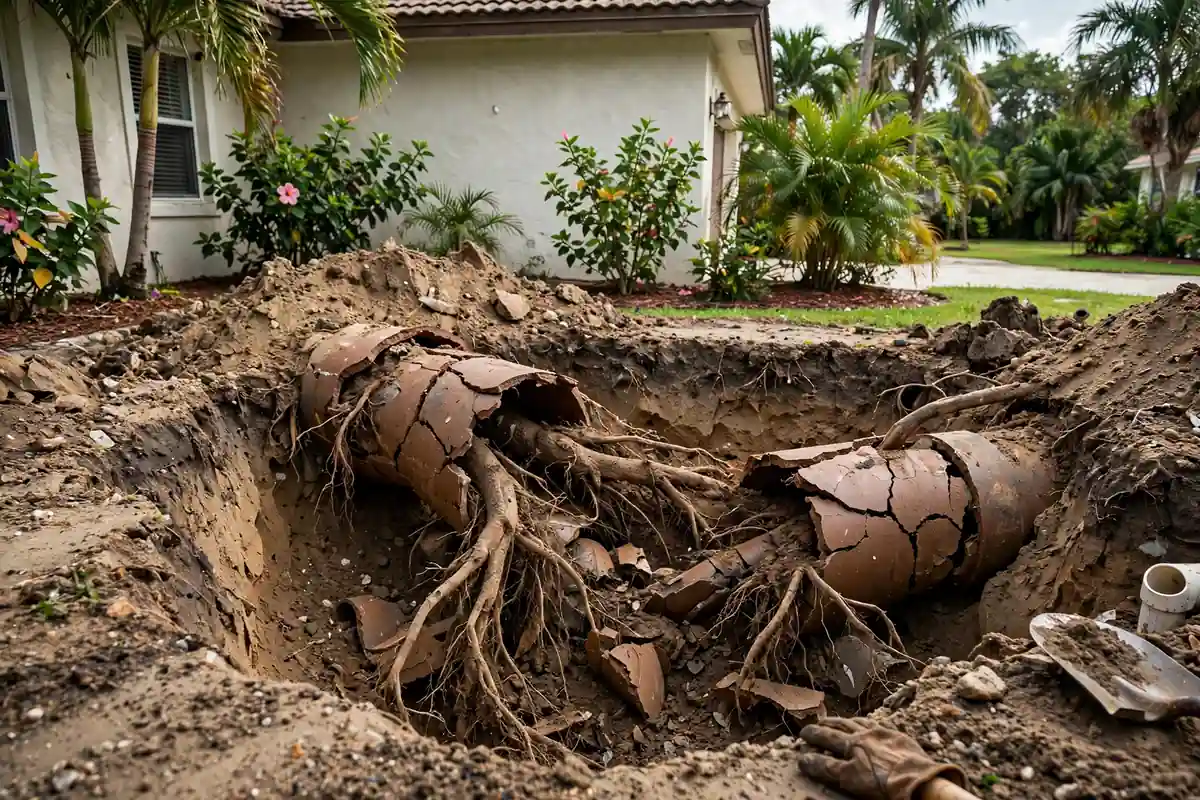
A collapsed sewer line is the nightmare scenario: the pipe that carried your wastewater caves in, flow stops completely, and sewage has nowhere to go but back. Collapses feel sudden — the drains worked last week — but the forces behind them build for years. Understanding those forces is how you catch a collapse before it happens.
This guide covers the five forces that collapse sewer lines in South Florida homes: age and corrosion, soil movement, root pressure, external loading, and hydraulic stress during storms. For each, you will learn the mechanism, the warning signs, and what an inspection can catch in time.
Force 1: Age, Corrosion, and Material Fatigue
Every pipe material has a structural lifespan, and collapse is how many of them end. Cast iron thins from internal corrosion until the wall can no longer carry the soil load above it — then a section buckles inward. Orangeburg fiber pipe delaminates and ovalizes until it folds. Even clay, strong as it is, can crack through at a weakened bell and drop a segment.
The warning signs are the classic deterioration signals: chronic slow drains, recurring blockages at the same spot, and camera footage showing heavy scale, pitting, or deformation. In Coconut Creek's 1960s–80s housing stock, age-driven collapse risk is the single most common story — the pipe simply reaches the end of what its walls can hold.
Force 2: Soil Movement and Washout
South Florida's sandy soils move. Seasonal water-table swings, heavy rain saturation, and minor settlement shift the ground around the pipe, stressing joints and creating voids. Worse, a small long-term leak washes fine soil particles into the pipe with every flush, hollowing out the bedding beneath — the pipe ends up spanning a void it was never designed to bridge, and eventually the span fails.
Surface clues include depressions or soft spots along the lateral's path and pavers or slabs settling near the line. On camera, the precursor is a belly or a joint with visible soil infiltration. This is the collapse mechanism most directly tied to rainy-season timing, because saturation accelerates both soil movement and washout.
Force 3: Root Pressure and Intrusion
Roots do more than block flow — mature root masses exert real mechanical pressure. A dense root ball growing through multiple joints can displace pipe segments, and the relentless expansion wedges joints apart over seasons. In clay tile laterals, where joints are the weak points by design, root pressure is a documented collapse contributor.
The progression is visible on camera across inspections: first fine hairs at a joint, then a fibrous mass, then visible joint displacement. Properties with large trees within the lateral's corridor and a history of root cuttings are on this timeline. Each cutting without sealing the entry resets the clock but never stops it.
Force 4: External Loading and Damage
Pipes fail from above as often as from within. Heavy vehicles parked or driven over a shallow lateral, construction equipment during a pool or addition project, and fence posts or landscape spikes driven through the pipe's crown all impose loads the pipe was not designed for. A single careless post-hole digger has collapsed more laterals than most homeowners would believe.
Know your lateral's path and depth — the property survey plus a camera locate gives you both — and treat the corridor as a no-drive, no-dig zone. Before any project near the line, hand the contractor the lateral map. Prevention here is almost free; repair after a crush is a full excavation.
Force 5: Hydraulic Stress During Storms
The fifth force is the one unique to our climate. During intense downpours and tropical systems, municipal mains surcharge — filling completely and pressurizing — and that pressure transmits back into private laterals. A weakened pipe section that survives normal gravity flow can fail under the transient pressure spikes of a storm event.
This is why collapses cluster in hurricane season and why pre-season inspection matters so much. A camera survey in spring finds the thin-walled sections, the displaced joints, and the bellies that storms will exploit. Reinforcing or replacing those weak points before June converts a potential collapse into a non-event. If your line has any of the warning signs above, call Sewer Line Repair Crew at (833) 713-2101 before the next storm names itself.
Frequently Asked Questions
What does a collapse feel like from inside the house?
Sudden and total: fixtures that drained yesterday now back up immediately, often with gurgling and odor. Unlike a gradual blockage, a collapse typically presents as an abrupt change — working to failed with little transition.
Can a collapsed line be repaired trenchless?
Sometimes. If the bursting head can pass through the collapsed section, pipe bursting replaces it without a full trench. Fully collapsed sections packed with compacted soil usually require excavation. The camera survey decides which.
How do I know if my soil is at risk of washout?
Sandy soil plus a high water table — South Florida's default — is inherently washout-prone wherever a leak exists. The risk factor is not the soil alone but soil plus an unrepaired leak, which is why small leaks deserve prompt attention.
Does a collapse always require full replacement?
Not always. An isolated collapse in an otherwise sound line can be spot-replaced by excavation while the rest of the line remains. Widespread deterioration with a collapse is the pattern that argues for full replacement.
Talk to a Sewer Line Pro Today
Describe the problem once — a local specialist serving Coconut Creek, FL plans the visit. 24/7 emergency line.
(833) 713-2101Talk to a specialist now · Free call